
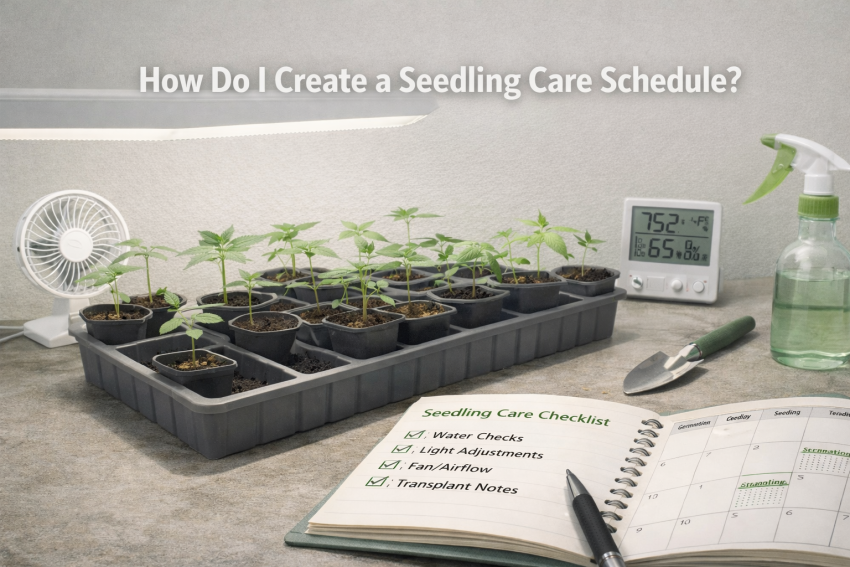
A good seedling care schedule gives young cannabis plants the right amount of light, moisture, airflow, and observation at the right time. The goal isn’t to follow a rigid checklist for its own sake. The goal is to create a repeatable routine that helps seedlings stay stable, avoid stress, and transition smoothly into stronger early growth.
Why Does a Seedling Care Schedule Matter?
Seedlings are one of the easiest stages to disrupt with inconsistent care. Overwatering, weak light, poor airflow, and missed environmental changes can all slow development early. A schedule helps you respond to the plant’s needs more consistently instead of guessing day by day.
For intermediate growers, a schedule is useful because it helps connect daily plant observation with actual cultivation decisions. That structure becomes even more valuable if you are managing more than one tray, strain, or starter environment.
What Should a Seedling Care Schedule Include?
- Daily moisture checks
- Light timing and intensity review
- Temperature and humidity monitoring
- Airflow and stem-strength support
- Periodic inspection for stretching, drooping, or discoloration
- Planning for transplant timing
A useful schedule tracks the seedling stage in simple intervals. You don’t need to overcomplicate it, but you do need to pay attention to patterns rather than isolated tasks.
How Should You Structure the First Two Weeks?
Days 1 to 3: Establishment
Focus on gentle moisture, stable warmth, and appropriate seedling light. Don’t overhandle the medium and don’t rush feeding. The seedling is still establishing its first root system and early leaves.
Days 4 to 7: Observation and Stability
Check whether the seedlings are stretching toward the light, staying evenly moist, and developing upright stems. Light intensity, distance, and airflow matter more during this window than nutrients do.
Days 8 to 14: Early Development
Once the seedlings are producing more established leaves, continue monitoring water use, environment, and spacing. This is also the period when weak routines start showing up as stretch, slow growth, or inconsistent vigor.
What Should You Check Every Day?
- Is the growing medium lightly moist rather than saturated?
- Are the seedlings standing upright rather than drooping?
- Are the stems stretching too much toward the light?
- Is the environment staying within a stable temperature and humidity range?
- Is airflow present without blasting the seedlings directly?
Daily checks should be short but consistent. The goal is to catch small problems before they turn into larger setbacks.
What Should You Review Every Few Days?
- Root development and container size
- Leaf color and overall vigor
- Whether watering frequency is changing as growth speeds up
- Whether the seedlings are ready for stronger light or more space
- Whether transplant planning should begin
This is where the schedule becomes more useful than a simple daily checklist. Seedlings change quickly, so your care rhythm should adjust as growth accelerates.
What Is a Practical Seedling Schedule Example?
Every day
- Check moisture before watering
- Confirm light position and environment
- Inspect seedlings for stretch, droop, or discoloration
Every 2 to 3 days
- Review overall growth rate
- Adjust light distance if needed
- Check whether containers are still appropriate
Once per week
- Assess readiness for transplant planning
- Review notes on growth patterns and environment
- Look for recurring issues in watering or airflow
That kind of schedule gives structure without encouraging over-intervention. Seedlings usually do better with consistent care than constant adjustment.
What Common Mistakes Should a Schedule Help You Avoid?
- Watering by habit instead of checking the medium first
- Keeping lights too far away and causing stretch
- Ignoring airflow until stems stay weak
- Feeding too early
- Waiting too long to plan for transplanting
Many seedling problems come from inconsistency, not from any one dramatic mistake. A schedule works best when it supports calm observation and repeatable habits.
Key Takeaways
The best seedling care schedule is one that helps you check moisture, light, airflow, and development on a reliable routine without overcomplicating the stage. For intermediate growers, the real value of a schedule is that it turns seedling care into a repeatable system instead of a guess-and-react process.