Blinding, also called masking, means withholding group identity from people whose handling, measurement or interpretation could be influenced by knowing it. In cannabis plant research, it can help prevent expectations about a named line or treatment from shaping the recorded result. The important question is who was unaware of what, at which stage.
A label saying “blind study” doesn’t answer that question. The person caring for plants, the person scoring photographs and the person analyzing results may each know different things, and each can introduce a different kind of bias.
Protect the judgment most open to expectation
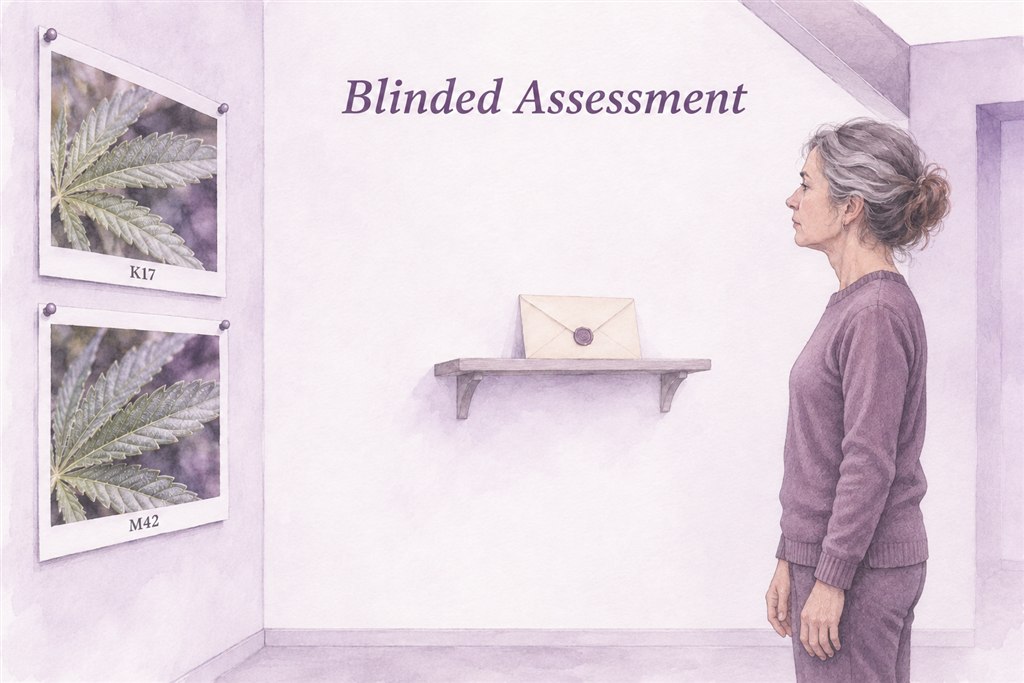
Suppose a research comparison uses a visual leaf-damage score. If an assessor knows which samples are expected to perform well, borderline judgments can unintentionally move in that direction. Neutral codes let the assessor apply the scoring rule without that particular cue.
That’s a general measurement safeguard, not a claim that every unblinded result is wrong. NC3Rs guidance on experimental bias describes role-specific masking and the need to report practical limits. Its examples concern laboratory models; applying the principle to a plant study still requires checking what information the assessor can actually see.
Keep the code useful without losing identity
For a hypothetical image-scoring task, retain the original plant and sample IDs in a protected identity table. Give the assessor a separate set of neutral image codes and a scoring protocol, with the link between codes and groups held by someone outside that assessment.
The working file should contain enough information to score correctly, but no names, filenames or ordering that plainly reveals the groups. Check a few coded files before assessment: a group name in the filename, a visible plant tag or batches presented in a predictable order can defeat the masking. Randomizing image order can reduce that last cue. Don’t strip information needed for safe handling or accurate measurement merely to make the masking sound more complete.
Set the scoring rules, permitted exclusions and planned analysis before assessment begins, then freeze the completed scores and analysis decisions before opening the key. If the rules change, keep the old version, the reason and the time of the change. Otherwise a masked reading can still become a selectively interpreted result when the key is opened.
That separation also depends on dependable sample identity. If a question involves confirming whether samples share a clone identity, what a DNA fingerprint can establish is a separate issue. A neutral code protects against expectation; it doesn’t prove that the underlying specimen was labeled correctly.
Masking can succeed at one stage and fail at another
Distinctive plant appearance may make group identity obvious to a person working with whole plants. Coding cannot erase that clue. You might still mask a second assessor scoring appropriately standardized images or an analyst working with neutral group labels, but check that those materials don’t reveal the same distinction.
When masking isn’t feasible, reduce measurement bias from discretionary judgment in other ways. Define the measurement in advance, calibrate the equipment, use a written scoring rubric and preserve the raw records. An automated reading can improve consistency, but the person choosing image boundaries, thresholds or exclusions may still influence the result. Where a validated objective readout and controls already constrain judgment, further masking may add little. The NC3Rs measurement guidance helps you assess where the remaining discretion lies and report when masking was unavailable.
Allocation concealment is related but different: it prevents advance knowledge of the upcoming assignment from influencing which units enter which group. Masking during assessment protects later judgments. Describe the actual safeguard instead of relying on a broad term such as “double-blind.”
Ask for a report you can evaluate
A useful methods statement names the masked roles, the information withheld, who held the key, when it was opened and any known failures. If the assessor recognized a group, that matters even when the codes stayed in place.
Blinding also doesn’t create independent replication. Ten masked readings from one experimental unit remain repeated readings from one unit. Review the experimental design, including the unit, assignment and measurement safeguards, together before judging the claim.
For a consequential study, ask a methods adviser to review those arrangements before scoring begins. Your practical test is whether someone can follow a coded sample from its original identity to its final result without allowing the expected answer to guide the measurement.