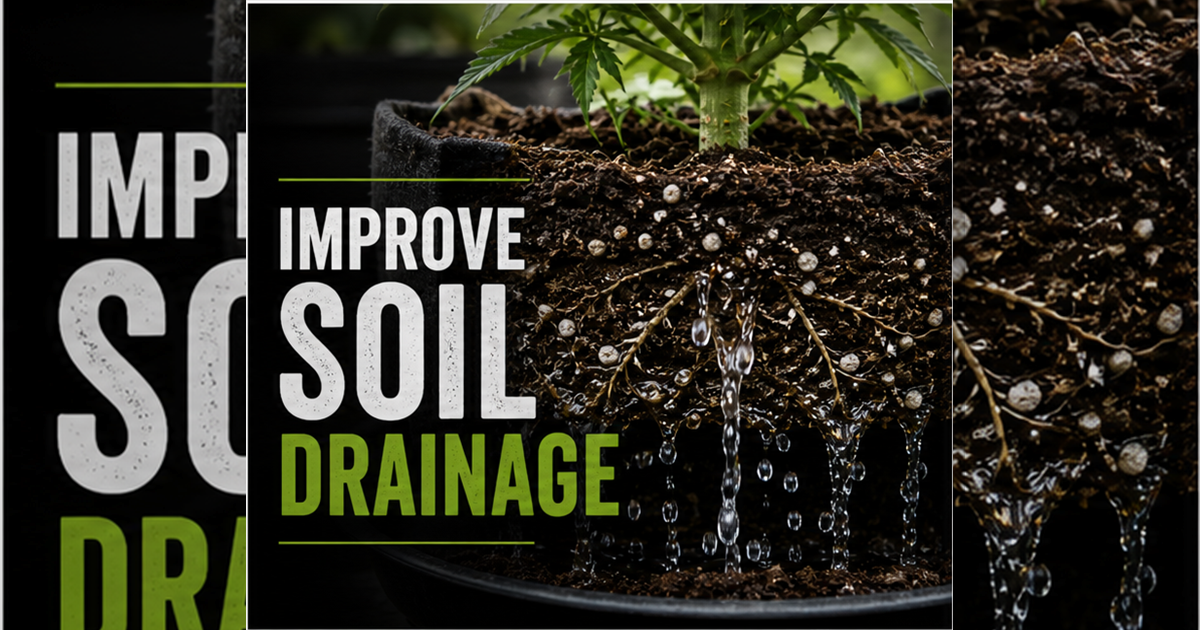
To improve soil drainage for cannabis plants, you need a root zone that holds enough moisture to stay biologically active but still allows excess water and stale air to move out of the container or planting site. In practice, that usually means reducing compaction, adding better aeration materials, choosing the right container setup, and watering in a way that supports drainage instead of overwhelming it.
Why Does Soil Drainage Matter So Much?
Cannabis roots do not just need water. They also need oxygen. When the medium stays heavy, dense, or waterlogged for too long, roots lose access to air and the whole plant begins to suffer. That stress can show up as slow growth, drooping, nutrient issues, weak vigor, and eventually more serious root problems.
Drainage is really about balance. A good soil does not dry out instantly, but it also does not stay saturated long after watering. If you are trying to build healthier root conditions overall, it helps to understand why growers value systems like living soil, where structure and biology work together rather than fighting each other.
What Are the Signs of Poor Drainage?
- Water sits on the surface too long after irrigation
- The container stays heavy and wet for too long
- Leaves droop even though the medium is still wet
- Growth slows and the plant looks dull or stalled
- The medium feels dense, muddy, or compacted
- Roots show stress from staying too wet for too long
These signs often get misread as simple nutrient issues, but poor drainage can be the deeper cause. If the root zone is not breathing properly, the plant will struggle to use water and nutrients efficiently no matter what feeding plan you follow.
What Usually Causes Drainage Problems?
- Heavy soil mixes with too many fine particles
- Too little aeration material in the medium
- Compaction from repeated watering or pressure on the soil
- Containers with poor drainage holes or weak airflow
- Watering too frequently before the medium has time to cycle air back in
- Outdoor sites with dense clay or poorly prepared planting zones
In other words, drainage problems are not always just a soil problem. They can be a structure problem, a container problem, or a watering-rhythm problem.
How Do You Improve Drainage in Container Soil?
1. Increase aeration in the mix
One of the simplest improvements is adding more coarse aeration material so water can move through the profile and air can re-enter after watering. Growers often use perlite, pumice, rice hulls, or other structural amendments depending on the system they prefer.
2. Avoid overly fine or compacted media
If the soil is made mostly of fine particles, it may hold too much water and collapse into a dense mass over time. A better medium keeps some structure instead of turning muddy after repeated irrigation.
3. Choose containers that actually breathe and drain
Drainage improves when the container allows excess water to exit and air to move back into the root zone. Fabric pots, well-designed plastic pots, and containers with sufficient drainage holes usually perform better than containers that trap water at the bottom.
4. Water based on condition, not habit
Even a good soil mix can act badly if it is watered again and again before it has cycled properly. Drainage improves when the watering schedule respects the medium instead of forcing saturation on a rigid timetable.
How Do You Improve Drainage in Outdoor Soil?
Outdoor drainage problems often require site preparation rather than quick correction. If the planting area holds too much water, the solution usually involves loosening the soil profile, adding structure-building amendments, and sometimes raising the planting zone.
- Loosen compacted planting areas before roots are established
- Blend in amendments that improve soil structure instead of sealing it tighter
- Use raised beds or mounded planting areas if the site stays wet
- Pay attention to runoff patterns, pooling zones, and low spots
If you are considering a direct outdoor method, it also helps to think ahead about whether you can plant cannabis seeds directly in soil at that site or whether the ground still needs more preparation first.
What Should You Avoid?
- Adding random amendments without understanding how they affect structure
- Putting a “drainage layer” of rocks at the bottom of pots and assuming the problem is fixed
- Watering on schedule even when the medium is still clearly wet
- Using containers with weak drainage or poor airflow
- Ignoring compaction after multiple irrigation cycles
One of the biggest mistakes is treating poor drainage like a small inconvenience. It is a foundational root-zone issue, and if it stays unresolved, the plant will keep signaling stress in different ways.
How Does Drainage Affect the Rest of the Grow?
Better drainage usually improves more than one thing at once. It can lead to steadier growth, better root function, more predictable watering, and a healthier biological environment. It also makes it easier to avoid the chain reaction where overwatering leads to compaction, compaction reduces oxygen, and reduced oxygen creates more stress after every irrigation.
If your goal is long-term root health rather than short-term rescue, drainage work also pairs naturally with more biologically active cultivation methods. That is one reason advanced growers often connect root-zone structure with tools like living soil and other regenerative approaches instead of thinking only in terms of feeding schedules.
Key Takeaways
The best way to improve soil drainage for cannabis plants is to build a medium and watering system that supports both water movement and root-zone oxygen. That usually means adding aeration, reducing compaction, using better containers, and watering with more discipline. Once drainage improves, the whole grow usually becomes easier to manage because the roots are finally operating in a healthier environment.
1 response