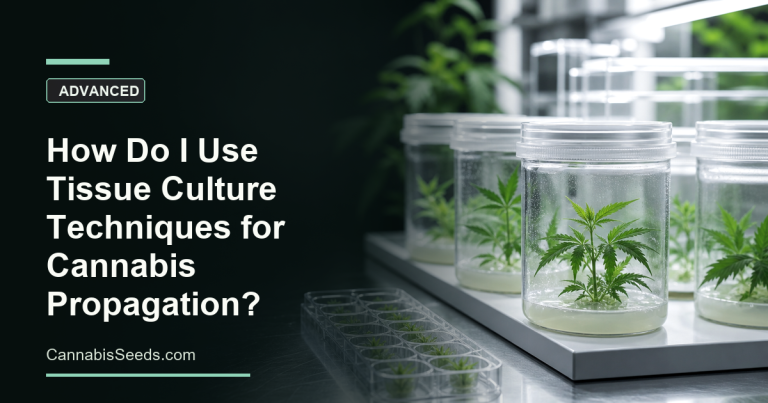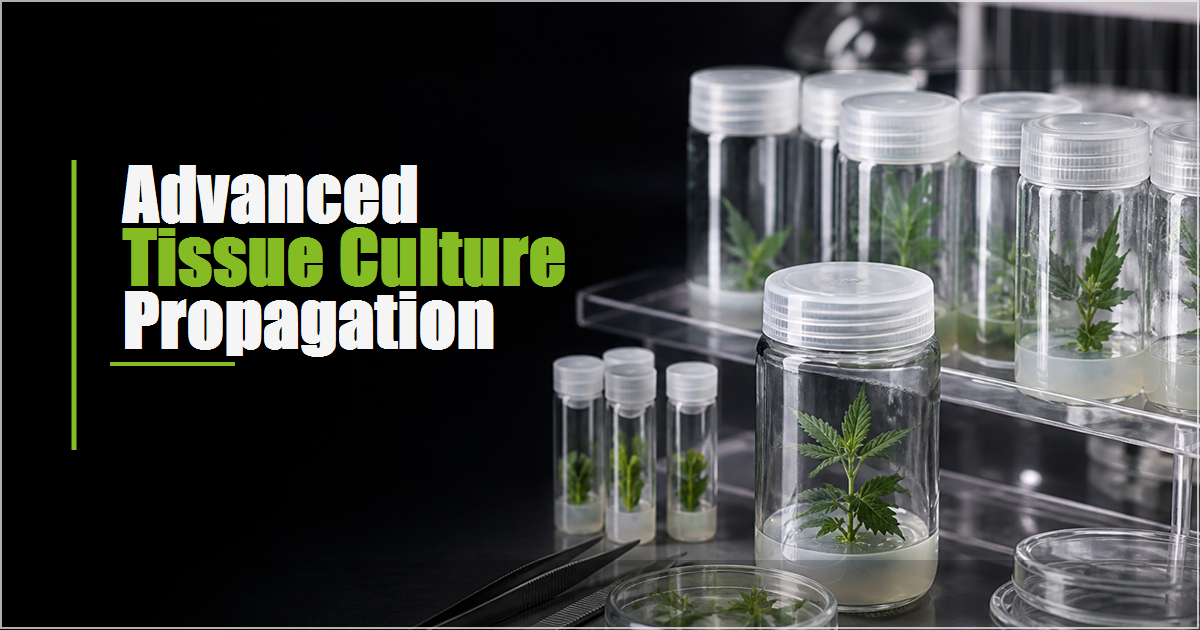
Advanced cannabis tissue culture is less about learning another media recipe and more about building a propagation system you can validate. You need clean source material, genotype-aware protocols, contamination tracking, controlled subcultures, identity records, and recovery data that show whether cultures become healthy plants outside the vessel. If you can’t trace and measure the process, you can’t tell whether it is improving.
Begin With a Defined Program Goal
Decide whether the program is meant for rapid multiplication, long-term germplasm preservation, clean-stock production, research, or recovery of difficult material. Those goals don’t use exactly the same success criteria. A fast multiplication protocol may create too much abnormal growth for preservation, while a slow-storage protocol may be unsuitable for production.
If you need the establishment-through-acclimatization sequence first, start with the foundational cannabis tissue-culture workflow. This article assumes you already understand those stages and need to make them more repeatable.
Qualify Source Plants Before Culture
Visual health isn’t the same as clean stock. Build a source-plant standard that covers identity, vigor, pest inspection, relevant pathogen testing, recent treatments, nutrition, and environmental history. Keep a retained reference plant or another identity check when the value of the genotype justifies it. The same source-selection discipline used in advanced cloning still applies before material enters culture.
Define acceptance and rejection criteria before collection. Otherwise, pressure to save a valuable cultivar can lower the standard after questionable material is already inside the program.
Validate Protocols by Genotype and Stage
Cannabis genotypes can respond differently to basal media, plant-growth regulators, vessel conditions, light, and transfer timing. Treat the protocol as a controlled set of stage-specific variables rather than one recipe applied to every accession.
- Change one defined variable at a time when possible.
- Use enough replicates to separate a pattern from a single good vessel.
- Record the exact media batch, operator, explant source, and transfer date.
- Score shoot quality, multiplication rate, contamination, rooting, and acclimatization survival.
- Keep the control protocol running beside the candidate change.
Published reviews of cannabis micropropagation report substantial genotype-dependent variation and inconsistent protocol performance. That doesn’t make the literature unusable; it means you should use published work to design a test, not to skip validation. See the reviews in Frontiers in Plant Science and Plants.
Track Contamination as Data
Don’t record contamination only as “yes” or “no.” Track when it appeared, what it looked like, which operator and media batch were involved, where the explant came from, and which step preceded the failure. Early surface contamination, contamination that appears after several transfers, and widespread batch contamination point to different problems.
- Early, isolated failures may point to explant preparation or source material.
- Failures clustered by batch may point to media, vessels, or sterilization.
- Failures clustered by operator may point to handling sequence or clean-work technique.
- Late recurring contamination may require deeper source-plant review or diagnostic testing.
Protect Identity Through Every Transfer
Every vessel should connect to an accession, source plant, collection event, protocol version, media batch, and transfer history. Use identifiers that stay unique even if a label is copied incorrectly. At defined checkpoints, reconcile the physical inventory with the records and quarantine anything whose identity is uncertain.
For valuable material, consider a genetic identity check before distribution or after an unusual culture history. A vigorous plantlet isn’t useful if you can no longer prove what it is.
Watch for Culture Decline and Off-Type Growth
More shoots aren’t automatically better. Hyperhydricity, weak elongation, abnormal leaves, poor rooting, declining vigor, and off-type growth can make a high multiplication count misleading. Define how many subculture cycles a line can pass before review, reset, or replacement from retained material.
The practical endpoint is a stable plant after acclimatization, not an attractive vessel. Compare recovered plants with the source for morphology, vigor, and any traits central to the accession’s value.
Measure Acclimatization as Part of the Protocol
Record survival, rooting quality, time to active growth, and losses after transfer to normal conditions. If cultures multiply well but fail during acclimatization, the protocol isn’t commercially or operationally successful. Test humidity transitions, substrate, rooting approach, airflow, and light as deliberately as you test multiplication media.
A Practical Review Cycle
- Review contamination and loss by stage, genotype, batch, and operator.
- Compare multiplication with shoot quality rather than counting shoots alone.
- Review rooting and acclimatization survival together.
- Audit label and inventory discrepancies.
- Identify one limiting variable for the next controlled test.
- Retire changes that improve one metric while damaging the final recovered plant.
Bottom Line
An advanced tissue-culture program should tell you which genotype entered, which protocol it followed, where losses occurred, and whether the recovered plant remained healthy and correctly identified. Build the system around traceability and measurable recovery, then improve one limiting stage at a time. That’s what turns tissue culture from a fragile technique into a propagation process you can trust.