To create and maintain a soil food web for cannabis, build a biologically active medium, feed the microbes with organic matter, protect moisture and structure, avoid harsh disruptions, and monitor the system over time instead of treating soil like an inert container. For advanced growers, the soil food web is not a single product or amendment. It is a managed biological process that supports nutrient cycling, root resilience, and long-term soil performance.
What Is a Soil Food Web?
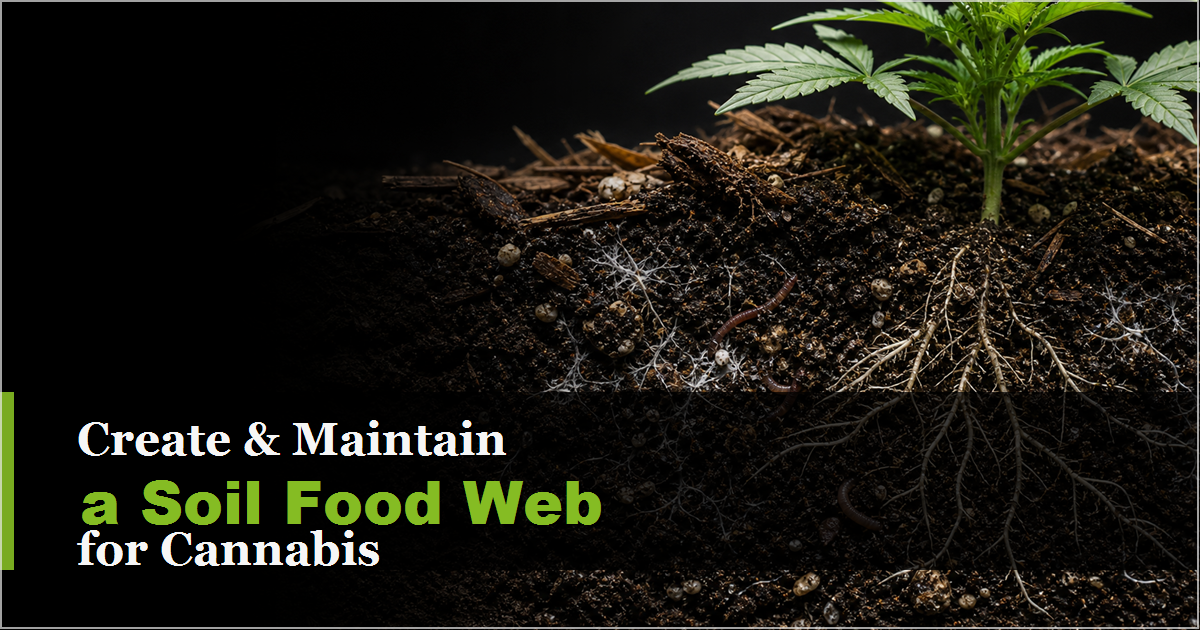
The soil food web is the community of organisms and organic matter that drives biological activity in the root zone. It can include bacteria, fungi, protozoa, nematodes, arthropods, worms, roots, and decomposing material. In cannabis cultivation, the practical goal is to support a living medium that cycles nutrients and buffers stress more effectively than a depleted or sterile mix.
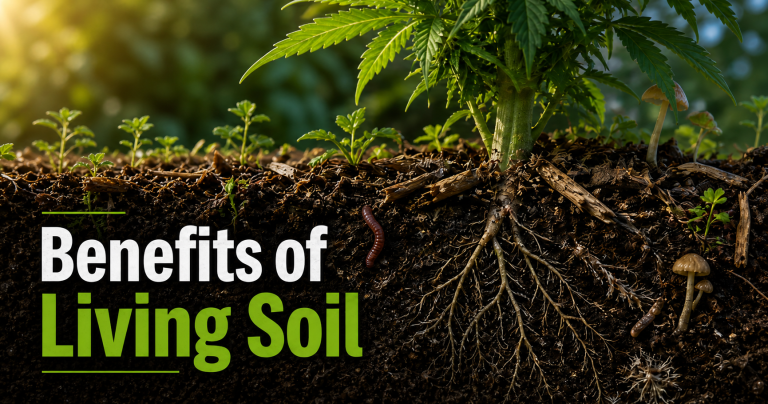
This is the deeper system behind many living-soil practices. If a grower is already seeing the benefits of living soil, maintaining the food web is how that system stays useful past the first cycle.
Why the Soil Food Web Matters for Cannabis
A functioning soil food web helps convert organic inputs into plant-available nutrition, improves root-zone structure, and supports a more buffered environment. That does not mean the plant never needs management. It means the grower is managing a biological system instead of relying only on direct input-response corrections.
- Microbes help break down organic matter
- Fungal networks can support nutrient movement and soil structure
- Organic matter gives biology something to work on
- Stable moisture keeps biological activity from crashing
- Healthy roots feed and shape the microbial community around them
Start With the Right Base Medium
A soil food web needs habitat. That means structure, organic matter, aeration, and mineral balance. A compacted medium with poor drainage will not become biologically strong just because microbes are added to it. The organisms need air, moisture, food, and stable conditions.
Advanced growers usually think about soil as architecture first. If water sits too long or roots cannot breathe, the biology will skew in the wrong direction. Before adding more inoculants, fix the structure that lets roots and microbes function.
Feed the Biology, Not Just the Plant
The soil food web depends on carbon-rich organic matter and a steady supply of decomposable inputs. Compost, mulch, worm castings, cover crop residue, and measured organic amendments can all feed the system when they are used with intention.
Compost teas can help reinforce biology, but they work best when the medium already has structure and food for microbes to use. If the soil is biologically weak because it is dry, compacted, or overcorrected, a tea will not fix the foundation. That is why compost teas in cannabis growing should be treated as support for a working system, not a replacement for one.
Protect Moisture and Air Balance
Microbial life needs moisture, but saturated soil can reduce oxygen and favor the wrong conditions. The goal is not constant wetness. The goal is a stable moisture rhythm that keeps biology active while allowing the root zone to breathe.
Mulch can help protect the surface from drying too quickly, while good drainage keeps the lower root zone from staying waterlogged. In living systems, watering is not just hydration. It is part of biological control.
Avoid Disrupting the Web
A soil food web can be disrupted by over-tilling, heavy salts, repeated drying, aggressive sterilizing products, and constant correction. Advanced growers usually intervene less often but with more purpose. They try to protect the relationships forming in the soil instead of resetting the medium every time a symptom appears.
- Avoid letting the medium swing from soaked to bone dry
- Use amendments in measured amounts instead of piling on inputs
- Protect fungal networks by limiting unnecessary disturbance
- Watch plant response before assuming the soil needs another product
- Keep records so changes can be tied to actual outcomes
A Practical Maintenance Workflow
1. Observe the plant and soil surface
Look for steady growth, clean leaf posture, good moisture behavior, and a soil surface that does not crust, sour, or collapse. The plant is still the clearest signal of whether the system is working.
2. Add organic matter gradually
Top-dress or mulch in small, purposeful amounts. The goal is to keep biology fed without burying the root zone under constant new inputs.
3. Keep moisture consistent
Water in a way that supports both roots and microbes. If the medium is drying too quickly, surface protection may matter more than another amendment.
4. Review the system after each cycle
After harvest, evaluate root quality, soil structure, decomposition, and plant performance. A soil food web is maintained through cycles, so the review after one crop should shape the next.
Common Mistakes
- Adding microbes without giving them habitat or food
- Using compost teas as a rescue tool for poor soil structure
- Letting the medium dry out so far that biology crashes
- Overloading the soil with amendments because the system seems slow
- Ignoring compaction, drainage, and root oxygen
If the system is underperforming, start with structure and moisture before chasing exotic inputs. Many biological problems are really habitat problems.
Bottom Line
Creating and maintaining a soil food web for cannabis means building a living root environment and protecting it through moisture control, organic matter, structure, and restraint. The strongest systems are not the ones with the most inputs. They are the ones where roots, microbes, organic matter, and grower decisions all work in the same direction.