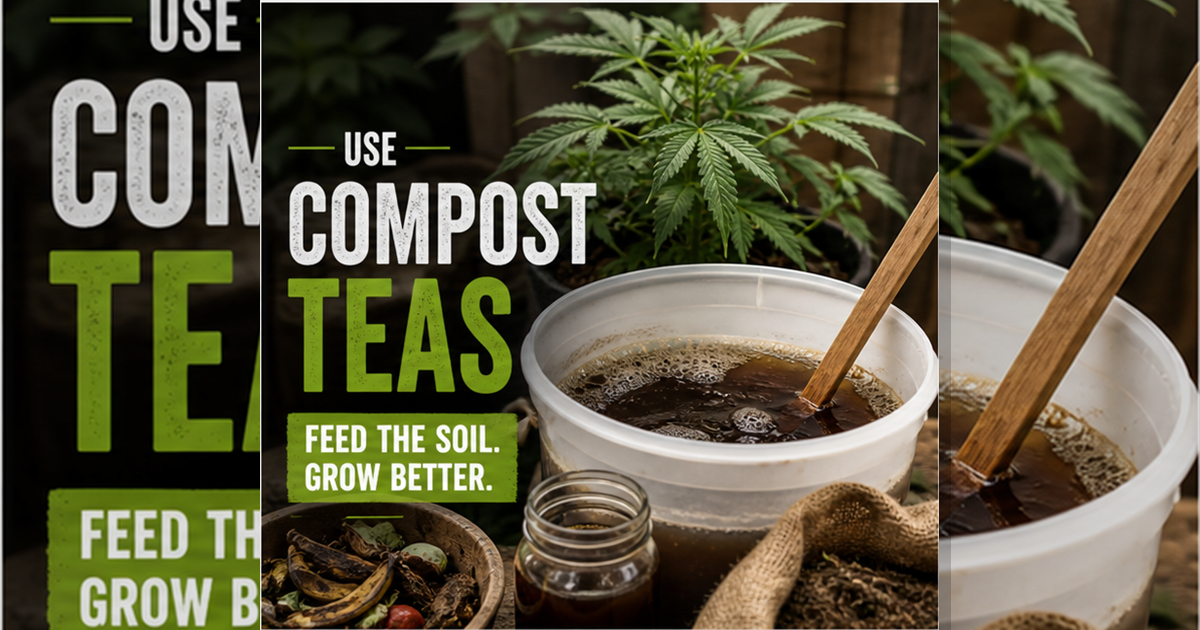
To use compost teas in cannabis growing, treat them as biological support rather than a magic shortcut. A well-made compost tea can help reinforce microbial activity, support root-zone function, and complement a healthy organic system, but it works best when the base soil, watering habits, and plant environment are already in good shape. Compost teas can support a living system, but they can’t correct poor growing conditions on their own.
What Are Compost Teas in Cannabis Growing?
Compost teas are water-based extracts made from compost and related biological inputs. Growers use them to introduce or reinforce microbial life, support nutrient cycling, and improve the biological activity around the root zone or, in some cases, on plant surfaces. The goal isn’t just to “feed” the plant directly. It’s to support the microbial relationships that help the plant function in a healthier environment.
That’s why compost teas are usually discussed alongside systems like living soil. They make the most sense when the grower is already thinking in terms of soil biology, root-zone resilience, and long-term media health instead of quick bottled corrections.
Why Do Advanced Growers Use Compost Teas?
- To reinforce microbial diversity in the root zone
- To support decomposition and nutrient cycling in organic systems
- To help recovery after stress or disruption in the medium
- To complement top-dressing, mulching, and other biological inputs
- To support ongoing microbial activity rather than relying only on feeding corrections
Compost teas can support microbial activity, but applying them too often can make it harder to tell what’s helping and add little value.
What Can Compost Teas Actually Help With?
1. Supporting root-zone biology
Compost teas can help reintroduce or reinforce microbial life around the roots, especially when the grower is trying to keep the medium biologically active rather than sterile.
2. Improving nutrient cycling in organic systems
When the biology is functioning well, microbes help release nutrients from organic matter over time. Compost teas can support that kind of cycling, especially when paired with sound organic management.
3. Supporting the Soil Over Time
In a healthy system, any benefit may build gradually as microbial activity supports the roots over time, rather than appearing as a sudden change in the plant.
What Compost Teas Do Not Do
Compost teas are often oversold. They don’t replace proper soil structure, stable watering, or a sound cultivation environment. They also don’t automatically fix drainage issues, compaction, poor root oxygen, or major nutrient imbalances by themselves.
- They don’t correct every deficiency on contact
- They don’t compensate for poor root-zone conditions
- They don’t turn weak compost into a high-value biological input
- They don’t replace careful observation and system management
If the medium is staying too wet, for example, better structure and drainage will usually matter more than adding another tea on top of the problem.
How Should You Use Compost Teas?
1. Start with a healthy base system
Compost teas work best when the soil already has decent structure, the watering rhythm is stable, and the grower isn’t trying to use biology as a substitute for basic cultivation discipline.
2. Use quality source materials
The biological value of the tea depends heavily on what goes into it. Steeping poor-quality compost in water won’t make it a better source of beneficial microbes.
3. Apply with a clear purpose
Some growers use compost teas as soil drenches to reinforce root biology. Others use them more strategically after disturbance, transplant stress, or a noticeable drop in biological activity. What matters is that the application has a reason behind it.
4. Avoid overdoing it
More isn’t automatically better. Overapplication can create unnecessary moisture swings, input overlap, or confusion about what’s actually helping the plant. A disciplined biological approach is usually more effective than constant “boosting.”
When Do Compost Teas Make the Most Sense?
Compost teas make the most sense in organic or regenerative systems where you’re already managing the soil to support microbial activity. They are especially useful when the grower is trying to support a broader soil food web rather than run the medium like an inert substrate.
That’s one reason compost teas often get grouped with other biologically oriented tools such as mulch layers, top-dressing, and microbe-friendly inputs. The tea is one input alongside those practices, so judge it by how it supports the soil you’re already managing.
What Mistakes Should You Avoid?
- Using compost tea as a shortcut instead of fixing the medium first
- Applying teas too often without a clear reason
- Assuming all compost source material is equally valuable
- Ignoring moisture management after drenching the root zone
- Expecting a dramatic response from an input intended to support soil biology
Advanced growers usually get the best results when they see compost teas as one part of a pattern. If the roots are healthier, the biology is more active, and the medium is more stable over time, then the tea is doing its job even if the effect doesn’t look dramatic in one day.
How Do Compost Teas Relate to the Bigger Organic System?
Compost teas are most useful when they fit inside a broader system built around structure, biology, and restraint. Growers who already care about root-zone function, organic matter, and microbial support usually understand that no single input carries the system. Long-term results depend on how the inputs, medium quality, and your growing practices work together.
That’s also why growers who use compost teas often care about related practices like living soil management and natural biological support strategies such as neem oil in the right contexts. Evaluate each practice by whether it helps maintain healthy growing conditions rather than expecting a miracle from one product.
Bottom Line
The best way to use compost teas in cannabis growing is to apply them as biological support inside a healthy organic system, not as a rescue tool for avoidable mistakes. When the base medium is sound and the grower is managing moisture, biology, and structure well, compost teas can help reinforce root-zone resilience, nutrient cycling, and long-term system health.
1 response