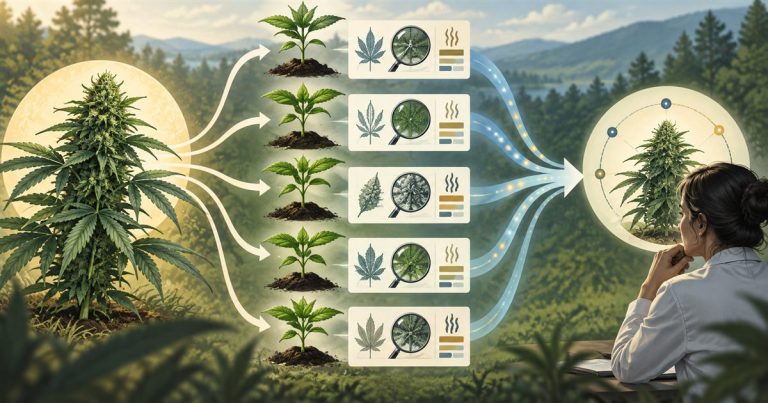
Effective population size in cannabis breeding is the size of an idealized population that would lose diversity and accumulate inbreeding at the same rate as the real breeding population. It’s written as Ne, and it can be much smaller than the number of plants in the room. The useful question isn’t simply “How many plants do I have?” but “How many parents are contributing genes, and how evenly?”
Why the Headcount Can Mislead You
A seed increase may contain hundreds of plants while only a few contribute most of the pollen or seed. Unequal sex ratios, repeated use of one favored parent, family-size differences, selection, and related mating all reduce effective size. That reduction increases random allele loss and the rate of inbreeding.
The consequence is easy to miss because short-term uniformity can look like progress. Over several cycles, however, a narrow contributor base can reduce response to selection and raise the risk of inbreeding depression.
Effective Size Is a Rate, Not a Census
Ne is defined through a genetic process, such as the rate of inbreeding or genetic drift. Different estimators can answer slightly different questions, so an estimate should always travel with its method and time window. A pedigree estimate, a change in allele frequencies, and a linkage-disequilibrium estimate are not interchangeable labels for the same measurement.
A Practical Contributor Audit
- List every intended parent. Record sex, family, source, and known relatedness.
- Record actual contribution. Track pollen pools, seed counts by maternal plant, failed crosses, and discarded families.
- Check contribution balance. Flag any parent or family responsible for a disproportionate share of the next generation.
- Retain lineage identity. Do not merge seed lots until their parental contributions have been recorded.
- Estimate the relevant rate. Use pedigree or genome-wide marker data appropriate to the breeding design.
- Change the mating plan if needed. Add underrepresented families, cap dominant contributors, or redesign crosses before the next cycle.
How Breeders Protect Effective Size
- Use more unrelated or less-related parents when the goal is population improvement.
- Balance seed and pollen contribution rather than relying on open mixing alone.
- Keep family records so one productive family doesn’t silently replace the rest.
- Separate conservation, line development, and commercial uniformity objectives.
- Use recurrent selection with explicit diversity controls.
Open-pollinated cannabis seed can retain broad variation, but the label doesn’t prove that contributions were balanced. A small pollen cloud dominated by a few males can still create a narrow next generation.
What the Number Does Not Tell You
A large effective size doesn’t guarantee desirable traits, accurate identity, or adaptation. A small effective size isn’t automatically an error when a breeder is intentionally building a line, but the tradeoff should be explicit. Selection intensity, genetic gain, uniformity, diversity, and inbreeding are connected decisions.
A Better Decision Record
For each generation, record census size, number of contributing parents, contribution balance, family representation, mating design, and the method used to estimate Ne. Then write one sentence explaining whether the observed narrowing is intentional and reversible. That record makes effective population size operational: it tells the next breeder whether diversity was protected, spent deliberately, or lost without being noticed.