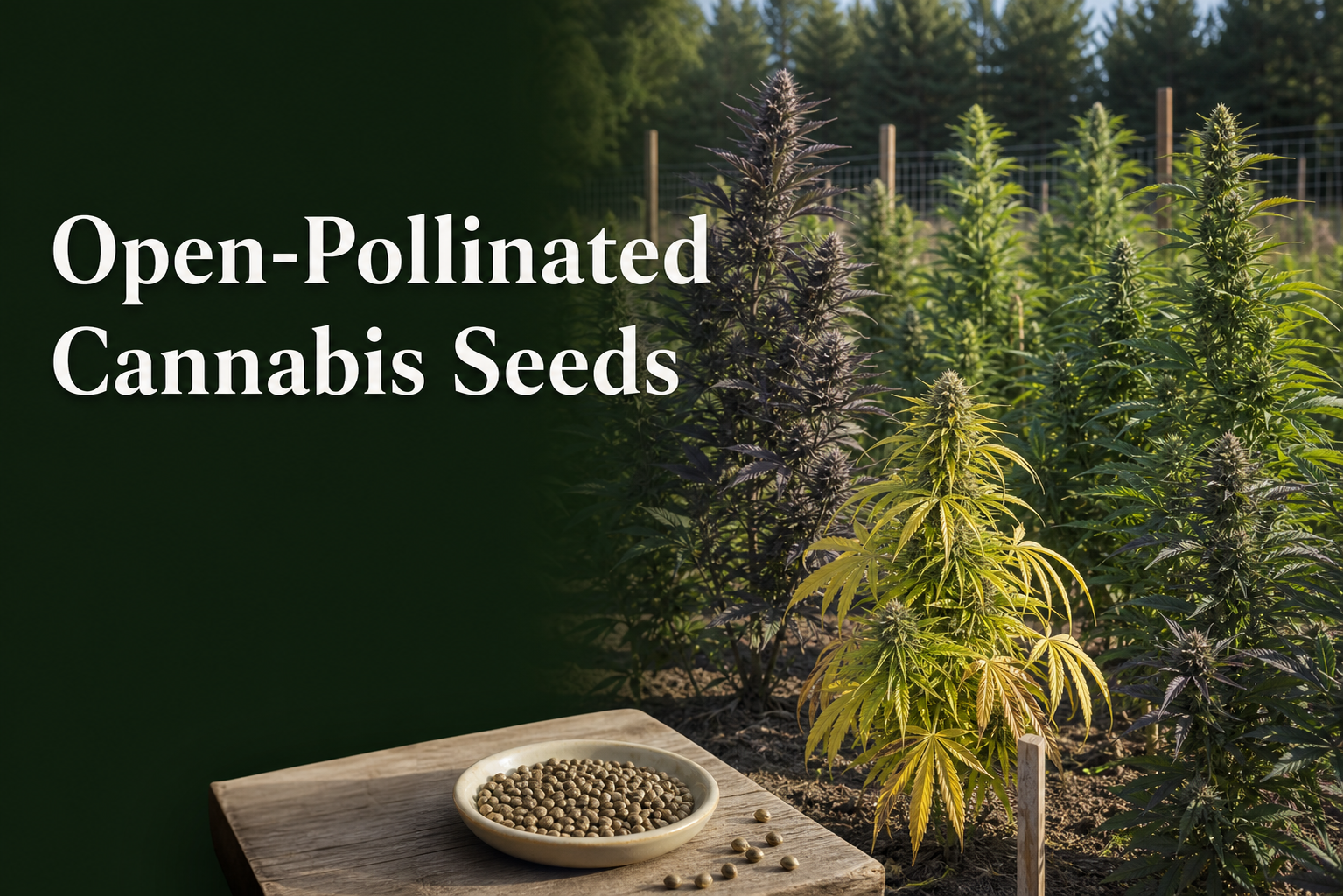
If you're breeding or preserving a line, open-pollinated cannabis seeds [g] can give you more genetic diversity than seeds made from one narrowly selected pairing. You'll have a broader population to evaluate, but you'll also see more variation and need careful pollen control, good records, and enough parent plants.
What Open Pollination Means
In an open-pollinated cannabis population, multiple selected male and female plants contribute to the next generation. Pollination occurs within that defined group rather than through one controlled male-to-female cross.
“Open” shouldn't mean uncontrolled pollen from unknown plants. A well-managed open-pollinated project still isolates the population, confirms parent identity, and prevents outside pollen from entering.
Main Benefits
Open pollination can support:
- Broader genetic diversity
- Preservation of uncommon traits
- More options for future selection
- Reduced dependence on a single parent pair
- Population-level adaptation over repeated generations
This makes the method useful for conservation, exploratory breeding, and maintaining a line without narrowing it too quickly.
The Trade-Off Is Variation
An open-pollinated seed lot may produce noticeable differences in structure, flowering time, aroma, vigor, and environmental response. That variation can be valuable if you're breeding, but it may be inconvenient if you want a uniform canopy or a predictable harvest window.
The method also doesn't guarantee that every desirable trait will remain common. Parent selection and population size influence which traits remain common in the next generation.
Population Size and Parent Balance
Using too few parents can create a genetic bottleneck even when the project is called open-pollinated. If you're preserving a population, your plan should:
- Start with enough unrelated or representative plants.
- Remove clearly weak, diseased, or off-type individuals only according to a documented goal.
- Where practical, prevent one male from contributing most of the pollen.
- Label the generation and parent population.
- Store enough seed to maintain future options.
For long-term organization, use the site's guidance on creating a personal cannabis seed bank and storing cannabis seeds long-term.
Open-Pollinated vs. Stabilized Seeds
Stabilized lines [g] are bred for more consistent expression of chosen traits. Open-pollinated populations intentionally retain a wider range. You can begin with an open population, select promising individuals, and later develop narrower lines.
If you're selecting for a specific chemical profile, appearance isn't enough. Genetic and laboratory data can help track specific traits; the article on high-CBD genetic markers explains how that kind of testing works.
Key Takeaway
The main benefit of open-pollinated cannabis seeds is diversity. That diversity creates breeding and preservation value, but maintaining it requires intentional isolation, enough parents, and disciplined records.

2 responses