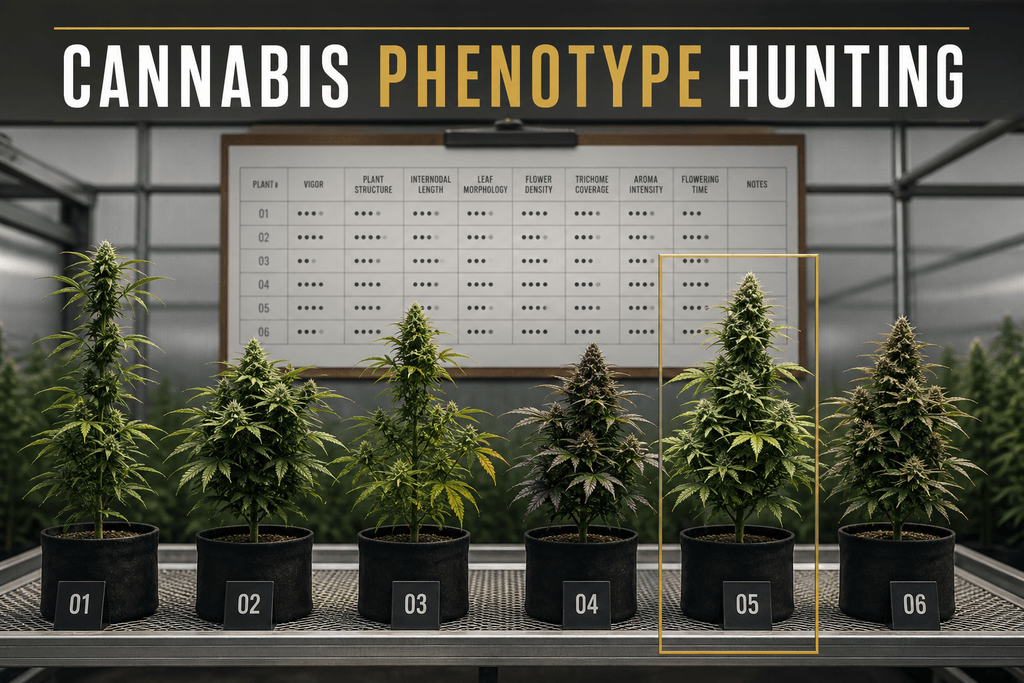
Cannabis phenotype hunting is the process of growing a seed population, measuring individual plants against defined goals, and preserving the best candidates for further testing. A reliable hunt isn’t a beauty contest or a search for the strongest aroma in one room; it’s a staged selection process that controls environmental noise, keeps records, and verifies important traits before a plant becomes breeding stock or a production clone.
Start With a Written Selection Goal
Before germination, decide what the selected plant must do. A goal such as “best plant” is too vague. A practical target might combine:
- A defined flowering window
- Branch structure suited to the production system
- A verified cannabinoid or terpene profile
- Acceptable yield and flower quality
- Resistance or tolerance under a documented challenge
- Reliable rooting and clone performance
Rank the traits before the hunt begins. Otherwise, a visually impressive plant can distract from a weak root system, late finish, unstable expression, or unsuitable chemotype.
Population Size Changes What You Can Find
A small pack can reveal useful plants, but it can’t represent every combination a genetically diverse cross may produce. The rarer the desired trait combination, the more offspring a breeder generally needs to evaluate. That doesn’t mean every project should become enormous; it means the confidence of the conclusion should match the sample size.
The same principle applies to the starting material. Open-pollinated cannabis seeds may preserve broad variation, while a well-designed F1 may be more uniform. Neither is automatically better; they create different selection opportunities.
Run the First Evaluation Under Uniform Conditions
Environmental inconsistency can hide a strong genotype or make a weak one look exceptional. Use the same media, container volume, irrigation approach, light zone, training method, and observation schedule as far as practical. Rotate plants only if the movement itself won’t create another variable, and map position so light or airflow patterns can be reviewed later.
Record each plant from emergence through harvest. Useful observations include vigor, architecture, sex expression, stress response, flowering onset, maturity, disease symptoms, yield components, and laboratory results. The USDA hemp phenotyping handbook is a helpful example of turning observations into consistent descriptors.
Preserve Candidates Before Final Results Arrive
Many decisive traits aren’t known until late flowering, harvest, drying, or laboratory testing. Take and label backup cuttings before flowering when possible, or preserve candidates through a controlled propagation system. The site’s guides to tissue-culture propagation and advanced tissue-culture methods explain why clean preservation can matter when a selected genotype must be retained.
Label failures are breeding failures. Use a durable plant ID that follows every pot, cutting, photo, sample, and result. A name written only on one tray isn’t enough.
Decide Whether You’re Ready to Start
A phenotype hunt is worth starting only if you can keep candidates identifiable, preserve finalists, and repeat the comparison after the first harvest. If space, testing, or backup propagation is missing, narrow the target or delay the hunt instead of pretending one attractive plant has been validated. The practical outcome of the first run should be a short list of candidates and better evidence—not an instant claim that a new line is stable.
A Practical Phenotype-Hunting Workflow
- Define the target and minimum acceptable traits.
- Choose a population size that fits the rarity of the target and available space.
- Germinate and grow the population under mapped, consistent conditions.
- Remove only plants that fail predetermined health, sex, legal, or performance gates.
- Preserve backups of serious candidates before irreversible stages.
- Collect chemical, disease, yield, and sensory data using repeatable methods.
- Rerun finalists from clones in a second cycle.
- Test in the intended production environment before making broad claims.
Why a Second Run Matters
The first run identifies candidates; it doesn’t fully separate genotype from environment. Running preserved clones again shows whether the traits repeat under a new cycle and whether a candidate performs reliably after propagation. Research that characterizes diverse cannabis varieties emphasizes that phenotype selection depends on measured traits rather than names or assumptions; see the study on phenotypic characterization of drug-type cannabis.
Common Selection Mistakes
- Selecting mainly from early vigor and ignoring mature performance
- Changing several cultivation variables during the comparison
- Discarding backups before laboratory results return
- Choosing from aroma or appearance without checking stability and health
- Treating one successful cycle as proof across environments
- Losing chain-of-identity between plants, clones, and samples
What a Successful Hunt Produces
Phenotype hunting works when selection is defined, measured, preserved, and repeated. The real skill isn’t spotting one attractive plant; it’s building enough evidence to know why that plant is worth keeping and whether its performance can be reproduced.