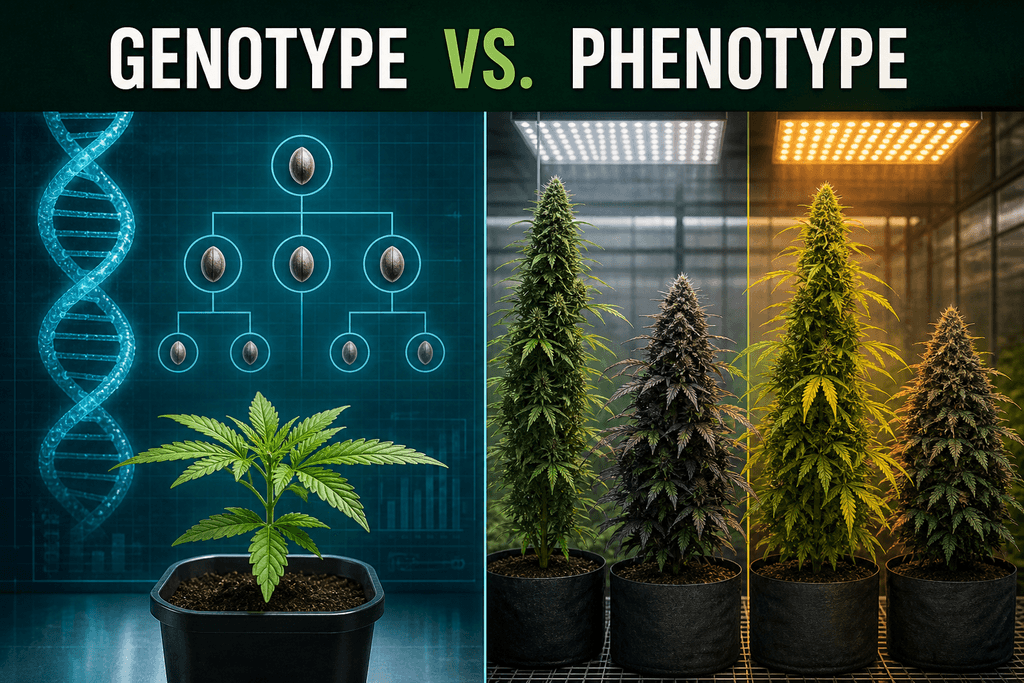
A cannabis plant’s genotype is its inherited genetic makeup, while its phenotype is the set of traits you can observe or measure as that genotype develops in a particular environment. Genetics set the range of possibilities, but light, temperature, nutrition, root conditions, stress, age, and management influence how those possibilities are expressed.
What Is a Cannabis Genotype?
A genotype is the combination of alleles an individual inherited from its parents. It doesn’t mean only the genes that influence cannabinoids or plant shape; it includes the plant’s entire inherited genome. Seed-grown siblings usually have different genotypes because sexual reproduction reshuffles parental genetic material.
A clone carries essentially the same nuclear genotype as its source plant, which is why cloning and tissue-culture propagation can preserve a selected genetic individual. That doesn’t guarantee every clone will look identical, because the environment and plant history still affect expression.
What Is a Cannabis Phenotype?
Phenotype includes visible, chemical, developmental, and physiological traits. Examples include:
- Plant height, branching pattern, and internode length
- Leaf shape, color, and posture
- Flowering time and response to day length
- Cannabinoid and terpene measurements
- Yield components and biomass distribution
- Responses to drought, disease, heat, or nutrient stress
The USDA’s current Hemp Phenotyping and Protocol Handbook demonstrates the breadth of descriptors researchers use to characterize hemp germplasm. A phenotype is more than a casual visual impression; useful phenotyping relies on defined measurements, timing, and conditions.
Why the Environment Changes What You See
A plant can only express traits through its growing conditions. A genotype with the potential for vigorous growth may remain small under restricted roots or inadequate light. Purple coloration might reflect genetics, temperature, nutrient stress, or an interaction among them. A disease-resistance claim may also look strong in one trial simply because disease pressure was low.
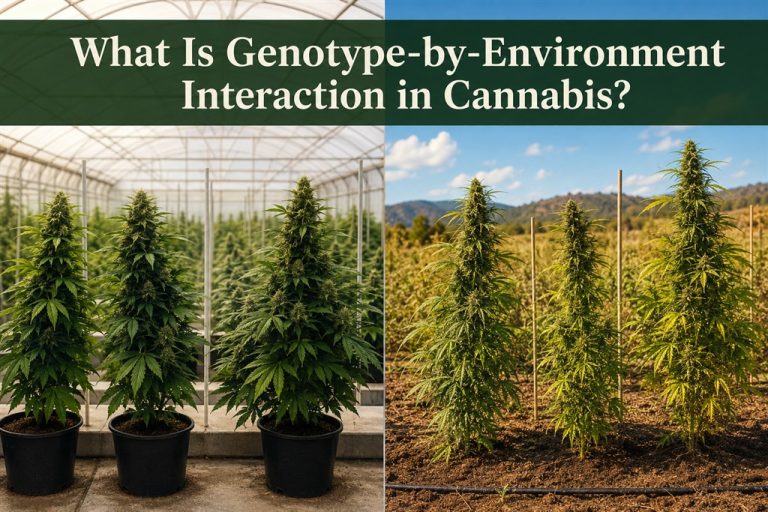
This interaction is often summarized as genotype by environment, or G×E. Current cannabis research is using genomic and environmental data to understand which genetic groups are more likely to perform under particular stresses, but those predictions still need careful field validation. A 2026 study on genotype-environment relationships in cannabis breeding shows why parental selection must consider the target environment rather than genetics in isolation.
A useful diagnostic comparison is to ask what changed and what stayed the same. If several clones of one plant diverge after being placed in different light or root conditions, environment is the leading explanation. If seed-grown siblings differ while sharing the same controlled space, genetic segregation becomes more plausible. Neither comparison proves a cause by itself, but it tells you what to test next.
Why Seed Siblings Can Look Different
Each seed receives a different combination of parental alleles unless the parents are highly inbred and the cross is tightly controlled. That is why an open population can show substantial variation. The site’s explanation of open-pollinated cannabis seeds describes how multiple parents can preserve useful diversity, while landrace seed populations reflect long histories of local selection and adaptation.
Variation isn’t automatically a defect. It may be the raw material a breeder needs, but it can be a management challenge for a grower who needs uniform height, flowering time, or chemotype.
How to Separate Genetic and Environmental Effects
- Standardize the environment. Keep containers, media, irrigation, light, and observation timing as consistent as practical.
- Use replication. One plant can’t show the full range of a seed line or prove a stable response.
- Measure traits at defined stages. A height measurement only has meaning when age and developmental stage are recorded.
- Repeat in another environment. A trait that holds across locations or cycles is more informative than a one-room result.
- Preserve candidates. Retain clones or tissue-culture material until late traits and laboratory results are available.
- Use appropriate tests. Chemical assays and validated genetic markers can answer questions that appearance can’t.
What This Means for Growers
Don’t judge genetics from one stressed plant, and don’t assume a healthy-looking crop proves genetic uniformity. Start with documented seed or clones, keep the environment stable, and record changes over time. The general guide to signs of a healthy cannabis plant can help separate normal development from immediate cultivation problems, but breeding conclusions require a larger and more controlled comparison.
Use the Distinction to Diagnose Variation
Genotype is inherited potential; phenotype is the result you can observe after genetics interact with environment and development. Understanding that distinction prevents growers from blaming every problem on genetics and prevents breeders from treating a promising appearance as proof of a stable inherited trait.
5 responses