Gene expression is the process of using information in a gene to produce functional RNA or, through RNA, a protein. In cannabis research, an expression result usually concerns particular samples, tissues and conditions. “Higher expression” isn’t a complete conclusion until you know what was measured and what it was compared with.
The Gene Can Be Present While Its Activity Differs
Your starting distinction is between having a DNA sequence and using its information. The NHGRI explanation of gene expression describes regulation of when, where and how much gene products are made. The same underlying sequence can therefore be discussed in studies that report different expression measurements.
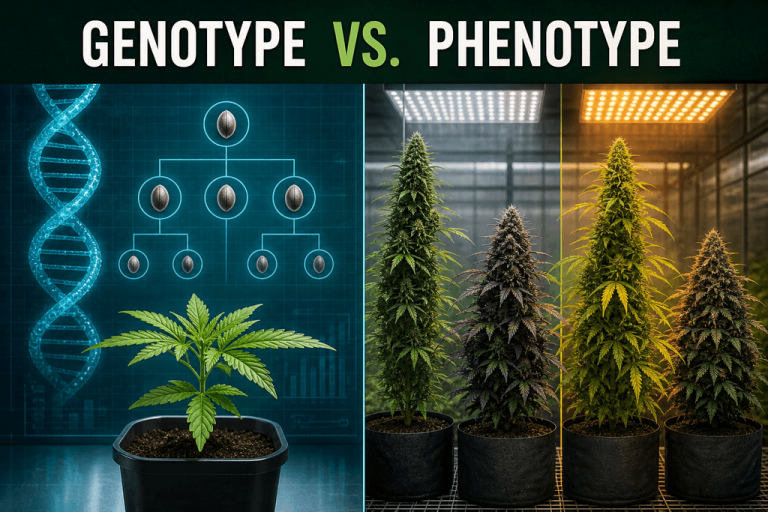
This doesn’t mean an expression difference proves the genome itself has changed. Nor does a gene’s presence show that it is equally active in every tissue or at every sampling time. The distinction builds on genotype versus phenotype, but it focuses on the molecular measurements between DNA information and an observed characteristic.
Restore the Missing Context in “Higher Expression”
When a headline compresses a finding into two words, reconstruct the sentence from the paper:
“The researchers measured [molecule or activity] in [tissue and sample group] at [time or stage] and found a difference relative to [comparison group], using [analysis].”
This is a reading aid, not a formula the original authors must use. Its value is that it makes an incomplete claim visibly incomplete. If you can’t fill a blank from the methods or results, retain the uncertainty instead of borrowing the missing detail from another study.
For instance, a hypothetical report of more RNA from one gene in sampled leaves doesn’t establish that every tissue has more of that RNA. It also doesn’t establish more active protein or more of a final chemical product. Those are different measurements. The illustration is deliberately narrow because that’s how you keep one observation from turning into several unsupported conclusions.
RNA, Protein and Outcome Aren’t Interchangeable
RNA measurements can provide evidence about transcription, the production of RNA from DNA. Protein abundance and protein activity answer further questions. An observed whole-plant characteristic adds another level of evidence, and its relationship to a molecular result needs to be established rather than assumed.
When reading figures, check the axis label before the caption’s interpretation. Is it RNA abundance, a relative expression value, a protein measurement, or an observed characteristic? If the term is unfamiliar, use the Cannabis Seed Glossary for foundational vocabulary, then use the paper’s methods for its exact measurement definition.
Also ask whether the comparison uses independent biological samples or repeated measurements of the same material. Repeating an assay can help assess measurement consistency, but it doesn’t supply the same information as observing additional independent samples. If a statistical conclusion depends on that distinction and the methods are unclear, it’s a good question for the authors or a qualified analyst.
Take a Precise Finding Away From the Paper
You don’t need to turn an expression result into a practical intervention for it to be useful. It may improve understanding of when and where genes are active, or identify a question worth further study. That’s already a legitimate research contribution.
For your next cannabis genetics paper, save the reconstructed sentence beside the original headline. Then add one line naming what wasn’t measured. You’ll leave with a result you can explain accurately, including its limits, instead of an appealing claim about a plant’s permanent genotype that the expression data never established.