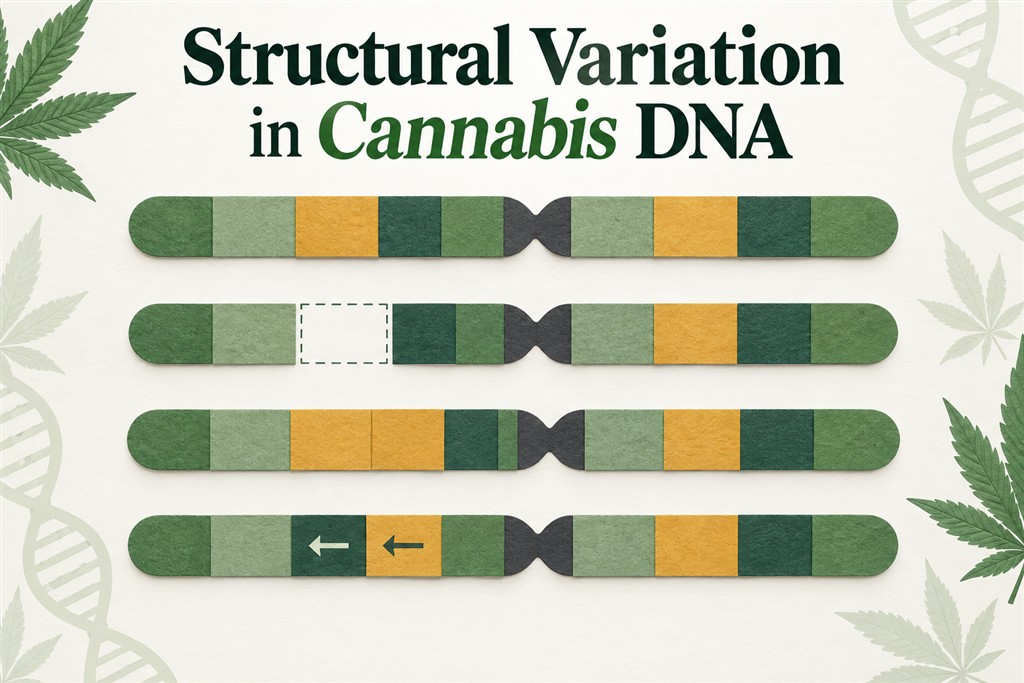
Structural variation is a difference involving a stretch of DNA, such as a deletion, duplication, insertion or rearrangement. In cannabis research, it describes changes larger than a single-letter variant. The term tells you about the DNA’s structure; it doesn’t tell you whether the change has a beneficial, harmful or measurable effect.
Describe What Changed Before Asking What It Does
The NHGRI definition of structural variation uses a conventional boundary of at least 50 DNA bases. Study definitions and detection methods should still be checked, especially when you’re comparing results across papers.
These common descriptions refer to different changes:
- Deletion: a segment is missing relative to the comparison sequence.
- Insertion: a segment is present at a location where the comparison lacks it.
- Duplication: a segment has an additional copy.
- Inversion: a segment occurs in the reverse orientation.
- Translocation: a segment occurs at a different genomic location.
“Relative to the comparison” matters. A reference is a reporting framework, and a difference from it isn’t automatically a defect. Likewise, a larger change isn’t automatically more important than a smaller one. Location, affected sequences and functional evidence determine what researchers can conclude.
A Repeated Segment Isn’t an Extra Chromosome Set
It’s easy to hear “extra DNA” and combine distinct ideas. A local duplication concerns a segment. Ploidy describes the number of complete chromosome sets. The site’s explanation of diploid and triploid cannabis provides that separate vocabulary.
Keeping the scales apart prevents a local result from becoming a claim about the entire genome. If a figure shows one repeated region, describe that region; don’t infer a change in chromosome-set count unless the study independently establishes it.
Use a Change-Description Worksheet
When a cannabis paper reports a structural variant, write a compact description before reading the proposed implications:
- What kind of change is reported, and how large is it?
- Which reference assembly and genomic region define the comparison?
- Which samples carry the reported difference?
- What data support detection, and was it checked with additional evidence?
- Was a biological effect measured, predicted, or left unresolved?
For example, “a duplicated segment was detected in the studied samples” is an observation. “The duplication increases the amount of a gene product” adds a functional claim. That second sentence needs evidence about the product; the first sentence doesn’t supply it on its own.
This worksheet is an editorial reading method. It helps you identify what to ask the authors or a genetics specialist, and it doesn’t replace reanalysis of sequencing data.
What Cannabis Research Adds
The 2025 cannabis pangenome study reported substantial structural variation across its sampled genomes. It supports taking larger DNA differences seriously when describing cannabis diversity, while the effect of a particular difference remains a separate question.
A genome assembly is also a reconstruction from evidence, so a claimed difference deserves scrutiny of the methods used to resolve the region. You can recognize this limitation without assuming every result is an error.
End your reading note by separating “change detected” from “effect demonstrated.” That preserves the distinction between genotype and phenotype and keeps a dramatic-looking DNA diagram from doing more argumentative work than the measurements support.