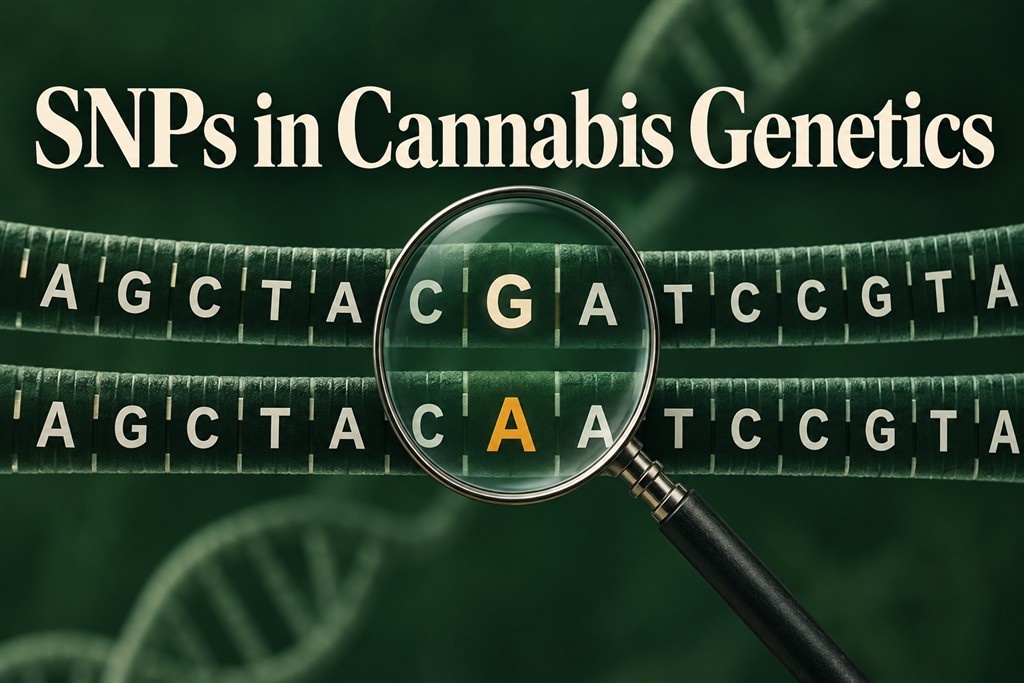
A SNP, pronounced “snip,” is a difference at one DNA-letter position. In cannabis genetics, a SNP can help describe how samples differ, but finding it doesn’t automatically explain a plant’s traits. When you’re reading a genetic report, the useful distinction is between detecting a variant, finding an association, and demonstrating a cause.
What the Single-Letter Difference Means
DNA is commonly written with four letters: A, C, G and T. At a particular position, one chromosome copy might carry A while another carries G. That’s the scale of change meant by a single nucleotide polymorphism. The National Human Genome Research Institute’s SNP definition explains this basic unit of variation; it isn’t a cannabis-specific claim about what any one variant does.
A position can fall within a gene or elsewhere in the genome. Its location helps frame a research question, but the word “SNP” alone doesn’t tell you whether the difference changes a protein, affects regulation, or has no demonstrated functional effect. You don’t need to infer an outcome just because the report has supplied a precise code.
Separate Three Claims That Often Appear Together
Use three columns when taking notes from a paper or report. This is a reading aid, not a scoring system for deciding whether a plant is desirable.
- Observation: the analysis reports a particular DNA letter at a specified position in a sample. Ask how confidently it was read.
- Association: a variant occurs alongside a measured characteristic in the studied group. Ask which group, how the characteristic was measured, and what alternative explanations were considered.
- Causal explanation: evidence supports the variant itself contributing to the characteristic. Ask what additional experiment or analysis distinguishes that explanation from a nearby linked variant or shared ancestry.
A paper may support the first two columns while leaving the third unresolved. That can still be useful research. The problem starts when a summary quietly promotes an association into certainty. Keep genotype and phenotype separate here: a DNA observation and an observed characteristic aren’t the same measurement.
Read a Variant Entry Without Guessing
Imagine a simplified report that says “sample A: A/G at position X.” This is an illustration, not a real cannabis result. Under an ordinary diploid, two-copy interpretation, A/G describes the two reported letters at that site. It doesn’t say which letter is better, and it doesn’t establish a chemical profile, appearance, or health effect.
Before comparing the entry with another report, find the reference assembly and version, chromosome or sequence identifier, and coordinate convention. Then check whether the result came from direct DNA sequencing or an inferred call. If the report doesn’t explain its notation, ask the provider rather than trying to translate unfamiliar symbols from a different testing system.
For unfamiliar terms such as allele or locus, the Cannabis Seed Glossary can help you keep the vocabulary straight while you read the methods.
What You Can Conclude Today
Genetic markers can identify differences without being the cause of the characteristic under discussion. Your next step is to write two sentences: “The report observed…” and “The authors interpret this as…”. If the second sentence claims more than the study tested, retain the observation and leave the interpretation open. For a consequential or disputed result, a genetics specialist should review the underlying methods and data; a single code isn’t enough to settle it.