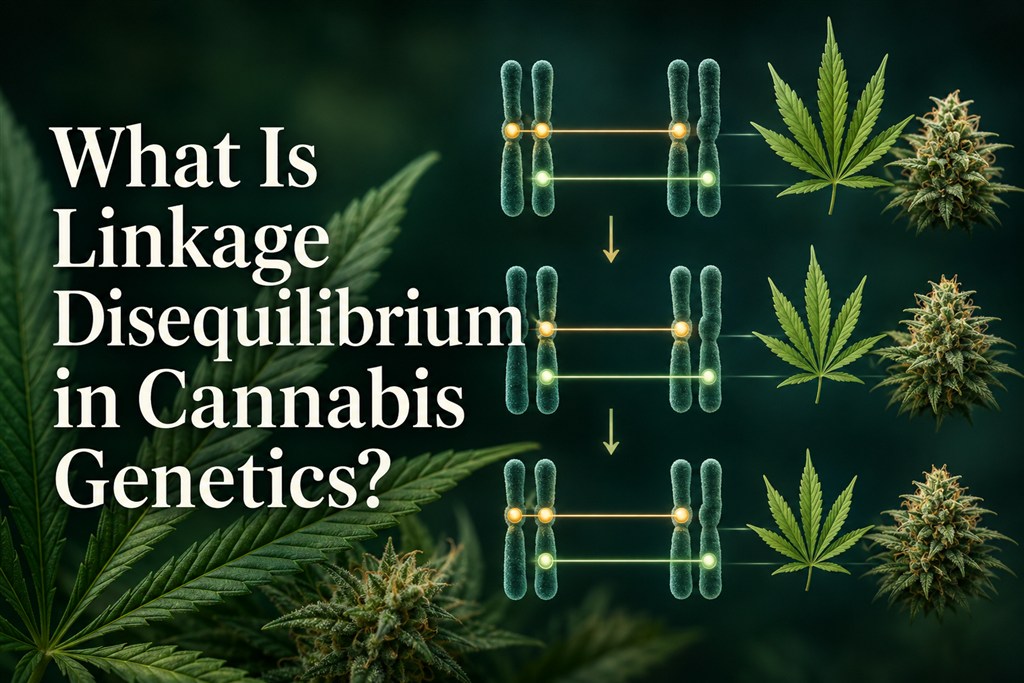
Linkage disequilibrium in cannabis genetics means that alleles at different genomic locations occur together more or less often than random association would predict in a particular population. The association can help researchers map traits, but it doesn’t prove that one marker causes the trait or that the same marker relationship will hold in every cannabis population.
The practical question is always population-specific: how far does the association extend in this germplasm, and what created it?
Physical Linkage and Linkage Disequilibrium Are Related but Different
Genes or markers close together on a chromosome are physically linked and may be less likely to separate during recombination. Linkage disequilibrium, often shortened to LD, is the observed nonrandom association of alleles in a population. Nearby loci often show stronger LD, but population history, selection, relatedness, mating patterns, and small population size can also create associations.
That distinction matters because a marker may predict a trait only by traveling with the causal variant. Recombination can break the relationship, especially across generations or in genetically different material.
Why LD Matters in Cannabis Research
Genome-wide association studies use LD to connect markers with measured traits. If LD decays quickly, researchers need denser markers to cover the genome. If it extends farther, fewer markers may capture broad associations, but locating the causal gene becomes less precise.
A hemp genome-wide association study of fiber quality estimated LD decay and accounted for relatedness and population structure while testing marker-trait associations. That design shows why a significant marker is part of an evidence chain, not a standalone breeding instruction.
What Can Create LD?
- Physical proximity: nearby loci recombine less often.
- Selection: favored allele combinations can become more common together.
- Population bottlenecks: a narrow founding group can preserve accidental associations.
- Population mixture: combining genetically differentiated groups can create genome-wide associations unrelated to one causal mechanism.
- Inbreeding or small effective population size: related mating changes haplotype frequencies and reduces recombination opportunities.
Those causes are why the site’s explanations of inbred lines and open-pollinated populations lead to different expectations about genetic diversity and association patterns.
How LD Changes Marker-Assisted Decisions
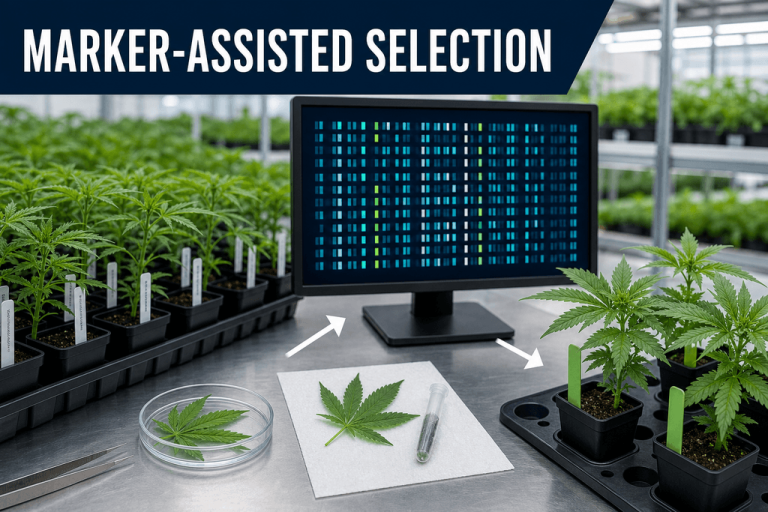
A marker in strong LD with a useful allele may help screen plants before the final phenotype is visible. Before using it, a breeder should ask:
- Was the marker validated in related germplasm?
- How close is it to the likely causal variant?
- What was the association strength and uncertainty?
- Could population structure or family relatedness explain the signal?
- Has the marker been tested in independent offspring or environments?
The site’s marker-assisted selection guide explains how markers supplement, rather than replace, phenotyping. LD is one reason that boundary is necessary: a marker can be informative without being causal or universally portable.
Don’t Read LD as a Quality Score
High LD is not inherently good, and low LD is not inherently bad. High LD can make broad marker associations easier to detect but can reflect a narrow population or make causal resolution difficult. Low LD can require more markers and larger studies while providing finer mapping resolution.
A Working Decision Rule
Use LD as a map of allele association within a defined population. When a marker informs a breeding decision, record the discovery population, validation population, genomic distance, association strength, and phenotype evidence. If those details are absent, treat the marker as a research lead—not proof that a cannabis trait will follow it into the next cross.