An outcross in cannabis breeding is a mating between plants that are less closely related than the plants within the breeder’s current line or family. Breeders use outcrossing to introduce genetic diversity or a trait the existing population lacks, but the first cross is only the beginning: the new trait and the original line’s useful qualities must be evaluated together in the offspring.
The practical question isn’t simply whether two plants are different. It’s whether the outside parent adds something worth the extra variation, testing, and selection that follow.
What Makes a Cross an Outcross?
Outcrossing is defined relative to the population being managed. Crossing two unrelated breeding lines is an outcross even though both plants belong to the same species. Cannabis is naturally capable of extensive outcrossing because pollen can move between separate male and female plants, but a controlled breeding outcross requires known parents and deliberate pollen isolation.
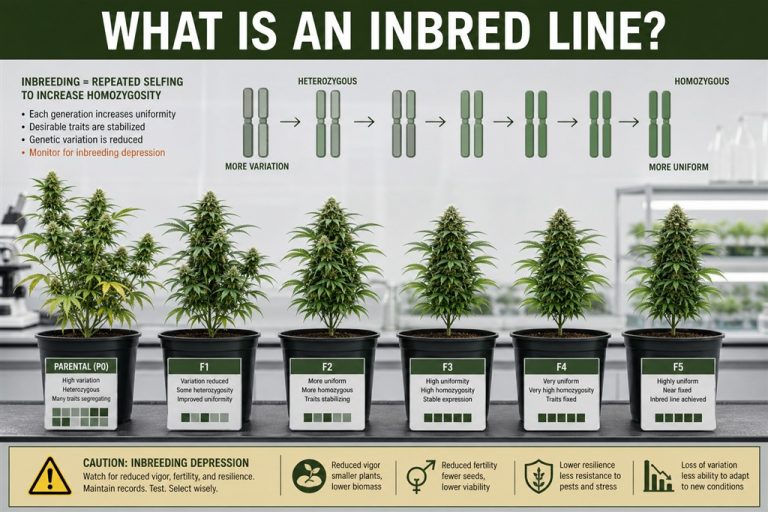
This differs from backcrossing, which repeatedly returns offspring to one parent or a genetically similar recurrent parent. It also differs from developing an inbred line, where the objective is usually to increase homozygosity and reduce segregation.
Why a Breeder Might Outcross
- Add a missing trait. An outside population may carry a useful flowering response, disease tolerance, plant structure, fiber characteristic, or chemical profile.
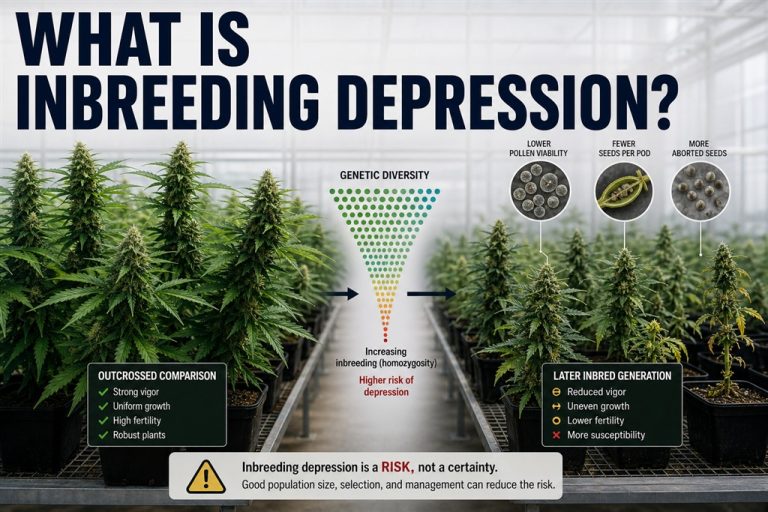
- Restore diversity. A narrow line may need additional alleles after repeated inbreeding or selection.
- Test complementary parents. Two populations may combine useful strengths that neither expresses alone.
- Build a broader base population. A breeder may want variation for several future selection cycles rather than immediate uniformity.
None of those goals guarantees success. A cross can add the target trait while disrupting flowering time, fertility, architecture, or another quality the breeder meant to keep. Research describing cannabis as a predominantly outcrossing crop also documents substantial within-cultivar variation, which is why an outside name alone isn’t evidence of a useful contribution. A 2026 Cannabis sativa hybrid study illustrates both the crop’s variability and the work required to create predictable parental lines.
What to Define Before Making the Cross
- Name the trait gap. Write down what the current population cannot do reliably.
- Set a retention list. Identify the original line’s qualities that must survive the outcross.
- Verify the donor. Evaluate the outside parent under relevant conditions instead of relying on a label or one attractive plant.
- Choose a population size. More segregating traits generally require more offspring to find useful combinations.
- Plan the recovery path. Decide whether the offspring will be intercrossed, selected as a new population, or backcrossed toward the original line.
The distinction between genotype and phenotype matters here. A donor’s visible performance is evidence from one genotype in one environment; it doesn’t reveal every allele the parent carries or predict every combination that will appear in its offspring.
How to Evaluate the First Generations
Start with matched records for both parents and their offspring. Measure the target trait, the qualities on the retention list, fertility, vigor, and any obvious liabilities at defined developmental stages. If the trait is chemical or otherwise invisible, use an appropriate laboratory or validated marker test rather than visual selection.
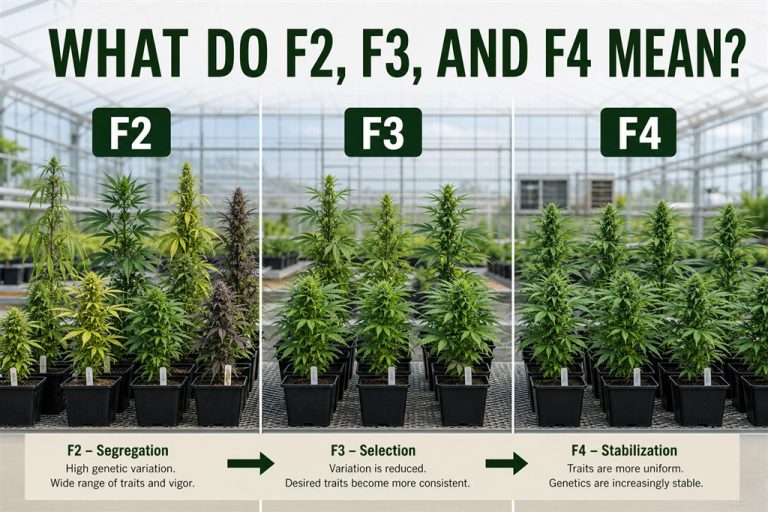
The first generation may look relatively consistent when the parents are uniform, while later generations can reveal much wider segregation. That variation isn’t proof the outcross failed; it’s the material from which useful combinations may be selected. The breeder still needs enough plants, appropriate controls, and more than one environment before calling the result stable.
For a diversity-preserving objective, the site’s article on open-pollinated cannabis seeds explains why using several parents changes the goal from recovering one combination to maintaining a functional population.
A Working Decision Rule
Use an outcross when a defined benefit is unavailable in the current population and you can support the generations needed to recover, test, and stabilize a useful combination. Don’t outcross merely to make a line sound new. If you can’t name the trait gap, the qualities to protect, and the evidence that will decide whether the cross worked, the breeding objective isn’t ready.