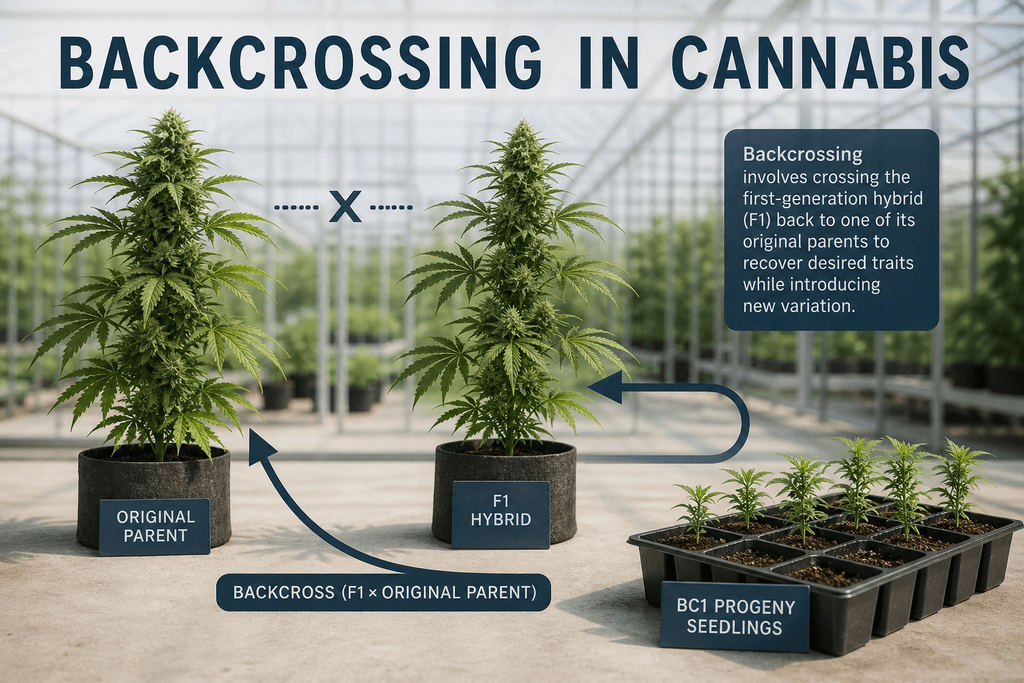
Backcrossing in cannabis breeding means crossing a hybrid offspring back to one of its parents, or to a genetically close version of that parent. Breeders use the method to recover more of a chosen parent’s genetic background while retaining a trait introduced through the other parent, but repeated backcrossing can also narrow diversity and preserve unwanted linked traits.
How a Cannabis Backcross Works
Suppose a breeder crosses parent A, which has desirable plant structure, with parent B, which carries a useful resistance trait. The F1 offspring receives genetic material from both. If an F1 is then crossed back to parent A, the resulting generation is commonly labeled BC1. Repeating the return cross can produce BC2, BC3, and later generations.
The method isn’t simply “cross it back until it looks right.” A useful backcross program requires selection in every generation, because the breeder must confirm that the introduced trait is still present while evaluating whether the rest of the plant is moving toward the recurrent parent.
Why Breeders Use Backcrossing
Backcrossing can help a breeder:
- Introduce a specific resistance, chemotype, flowering, or structural trait
- Recover a valued parent’s overall growth pattern
- Develop a line that is easier to reproduce than a single selected clone
- Test whether a target trait can be retained across generations
- Create material for further selection rather than a finished product immediately
A published cannabis study used a first-generation backcross population to examine morphological and genetic relationships, illustrating how BC1 material can expose useful segregation for research and selection. The study also found that widely assumed trait associations didn’t always share a dependable genetic basis; see the paper on phenotypic associations in Cannabis sativa.
The Recurrent Parent and the Donor Parent
The parent used repeatedly is the recurrent parent. The other parent is the donor of the trait a breeder wants to introduce. Those roles matter because the breeder isn’t trying to blend both parents equally forever; the program has a specific direction.
If you encounter a label such as BX1 or BX3 on a seed description, the number tells you how many recorded return crosses the breeder claims—not how uniform, stable, or superior the seed must be. To make the label useful, you still need to know the recurrent parent, the donor trait, what was selected in each generation, and what testing followed.
That direction should be documented before the cross. If the goal is vague, selecting only by appearance can pull the population toward whichever plants happen to look appealing under one environment. The distinction between visible traits and inherited information is why serious programs combine phenotype records, pedigree, replicated trials, and genetic tests when available.
What Can Go Wrong
Backcrossing has several important limits:
- Linkage drag: the desired allele may travel with nearby unwanted genetic material.
- Genetic bottlenecks: repeatedly using a small number of parents can reduce diversity.
- Trait misidentification: an environmental response may be mistaken for a heritable trait.
- Incomplete recovery: a plant can resemble the recurrent parent without matching its full performance.
- Weak records: a BX label without a verifiable pedigree tells the grower very little.
When maintaining variation is the priority, open-pollinated seed populations solve a different problem by allowing multiple selected parents to contribute. Backcrossing is narrower and more directional.
A Practical Backcrossing Workflow
- Define the target trait and the recurrent-parent traits that must be protected.
- Make the initial cross and grow enough offspring to reveal meaningful variation.
- Measure the target trait using a repeatable method, not appearance alone.
- Select suitable offspring and cross them to the recurrent parent.
- Evaluate the BC1 population for both the target trait and unwanted donor traits.
- Repeat only when the evidence shows the program is moving in the intended direction.
- Preserve seed, clones, and records from decision points so failed selections can be reviewed.
Clonal preservation can be helpful while a breeding decision is still open. The site’s guides to advanced tissue-culture propagation and genetic markers in high-CBD selection show two different ways breeders can retain or test information beyond visual selection.
How to Read a BX Label
Backcrossing is a targeted breeding method, not a shortcut to stability. It works best when the recurrent parent, donor trait, population size, testing method, and stopping point are defined before selection begins. Good records and repeated verification matter more than the number printed after BC.
1 response