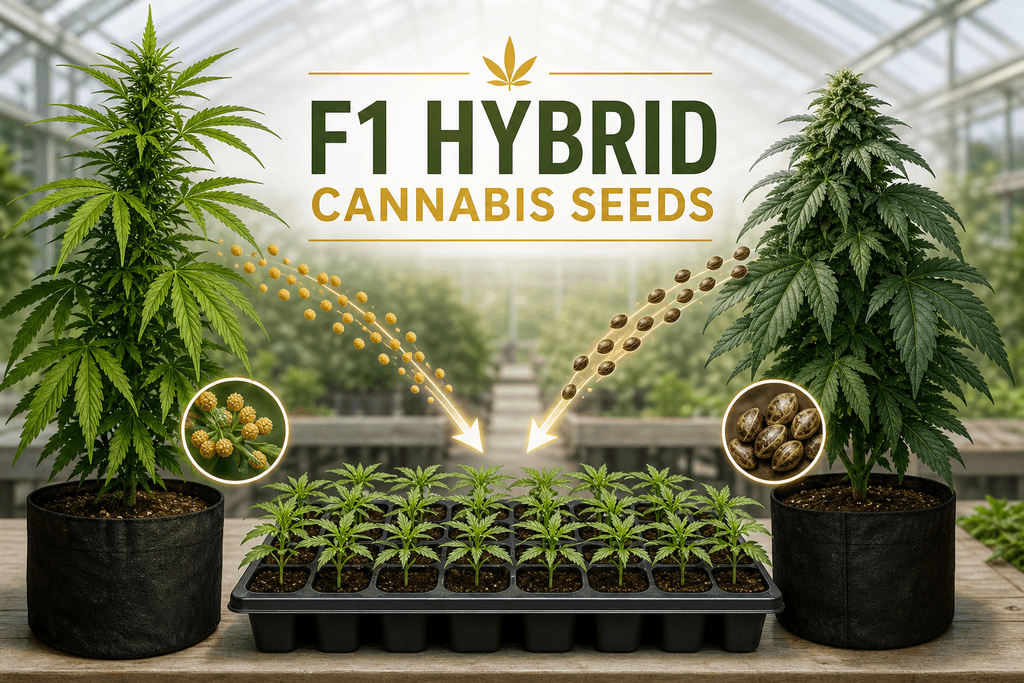
F1 hybrid cannabis seeds are the first filial generation produced by crossing two selected parent lines. A well-designed true F1 can give growers a comparatively uniform population and useful hybrid vigor, but the F1 label alone doesn’t prove that the parents were stable, unrelated, or tested well enough to deliver consistent offspring.
If you’re comparing seed packs, use “F1” as the beginning of the evaluation rather than the conclusion. What matters is whether the breeder can connect the label to a defined pedigree, measured traits, and population-level results that fit the way you intend to grow.
What F1 Means in Plant Breeding
The letter F stands for filial, meaning offspring, and the number 1 identifies the first generation after the parental cross. If breeder line A is crossed with breeder line B, the resulting seeds are the F1 generation. That definition is simple, but its practical value depends on how the parents were developed and evaluated.
In conventional crop breeding, true F1 production generally starts with parent lines that are sufficiently uniform to produce predictable combinations. Cannabis is often highly heterozygous, so a casual cross between two named plants may produce a broad set of outcomes even when the packet says F1. A scientific review of genomics and cannabis cultivar breeding describes why true F1 development requires more deliberate parental work than a one-time cross.
Why Breeders Make F1 Hybrids
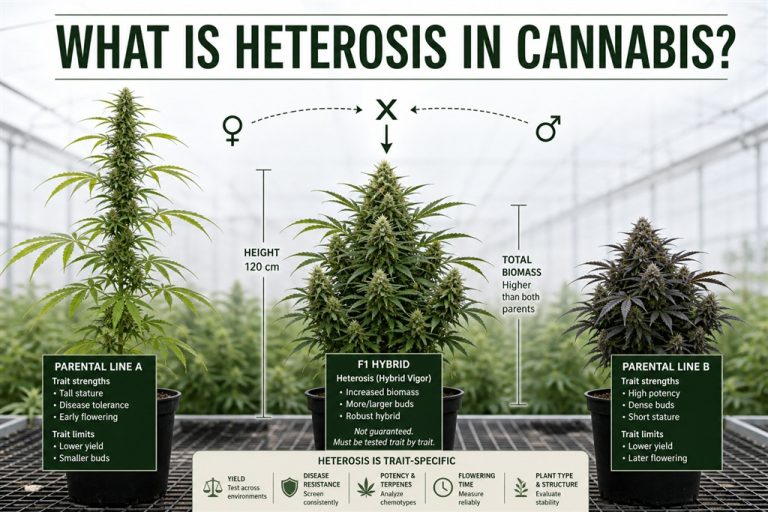
Breeders use F1 crosses to combine complementary parental traits and, in some crosses, capture heterosis, often called hybrid vigor. The goal might be improved uniformity, vigor, flowering behavior, disease response, architecture, or another measurable trait. Heterosis isn’t automatic, though, and a vigorous seedling isn’t proof that every important mature trait will be superior.
An F1 program is most useful when the breeder can explain:
- What the two parent lines are and how they were stabilized
- Which traits the cross was designed to combine
- How many offspring were evaluated
- Whether testing occurred across more than one environment
- How much variation remained in flowering time, structure, and chemotype
Are All F1 Cannabis Plants Identical?
No. Seeds are products of sexual reproduction, so F1 siblings aren’t clones. A strong F1 program may narrow variation enough that the crop looks and behaves consistently for selected traits, but individual plants can still differ. The practical contrast becomes clearer when you compare seed populations with tissue-culture propagation, which preserves a selected genotype instead of reshuffling parental alleles through seed.
Environmental differences also matter. Uneven light, root-zone stress, nutrition, temperature, and disease pressure can make genetically similar plants express different phenotypes. Uniform genetics reduce one source of variation; they don’t remove the need for uniform cultivation.
How F1 Seeds Differ From Other Seed Types
F1 describes a breeding generation, not plant sex or flowering behavior. An F1 lot may also be regular, feminized, photoperiod, or autoflowering. Those labels answer different questions. The guide to feminized versus regular seeds explains sex-related planning, while the overview of autoflowering cannabis seeds addresses age-driven flowering.
Saving seeds from an F1 also changes the genetic picture. The F2 generation can show wider segregation as parental allele combinations reshuffle. That variation can be valuable to breeders searching for new trait combinations, but it usually makes the F2 less predictable for a grower expecting the original F1 pattern.
How to Evaluate an F1 Seed Claim
- Look for a real pedigree. The breeder should identify the parental lines or provide a meaningful description of them.
- Ask what was measured. Uniformity claims should refer to traits such as flowering time, height, chemotype, or disease response.
- Separate generation from quality. F1 is a relationship between parents and offspring, not a general quality grade.
- Keep your own records. Track germination, plant structure, timing, and final traits across the whole population.
- Preserve important material carefully. If a rare seed lot matters, the planning principles in the personal seed-bank guide can help protect the remaining stock.
What the F1 Label Can and Can’t Tell You
An F1 hybrid is the first generation from a defined parental cross. It can offer useful uniformity and vigor when the parent lines and testing support those claims, but the label isn’t evidence by itself. Judge the seed lot by its pedigree, population data, trait consistency, and fit for your growing goals.
2 responses