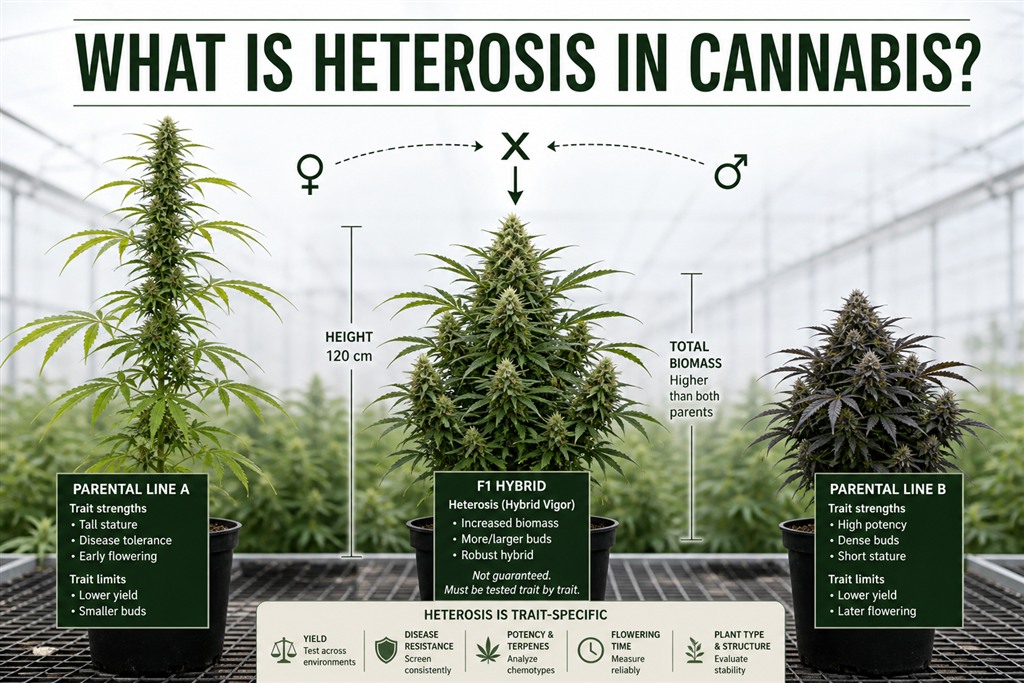
Heterosis in cannabis breeding, often called hybrid vigor, is the improved performance an F1 hybrid may show relative to its parents for a measured trait. It can affect growth, biomass, fertility, stress response, or another characteristic, but it isn’t guaranteed and it doesn’t mean every trait in the hybrid is superior.
The only useful heterosis claim names the trait, the parental comparison, the population, and the test environment. “Vigorous genetics” without those details is promotion, not breeding evidence.
What Counts as Heterosis?
Breeders compare hybrid performance with a defined reference. Mid-parent heterosis measures the hybrid against the average of its two parents, while better-parent heterosis compares it with the stronger parent for that trait. Those are different standards, and a hybrid can exceed the parental average without exceeding the better parent.
A review of genomics and cannabis cultivar breeding describes heterosis as an important goal in hybrid programs built from differentiated parental lineages. The site’s F1 hybrid seed overview explains why an ordinary first-generation cross doesn’t automatically demonstrate that result.
Why Hybrid Vigor Can Appear
Heterosis can arise through several genetic mechanisms. Dominance can mask harmful recessive alleles from one parent with functional alleles from the other. Overdominance describes cases where the heterozygous state performs better than either homozygous state. Interactions among genes can also change the outcome.
These mechanisms are one reason the result depends on the exact cross. Two individually strong parents may not make the strongest hybrid, and a useful result in one lineage doesn’t prove that the same pattern will appear in another.
Heterosis Must Be Measured Trait by Trait
A cannabis hybrid might emerge quickly and build vegetative biomass well while showing ordinary flowering uniformity or an unwanted chemical profile. Seedling vigor can’t stand in for mature yield, resistance, sex stability, or chemotype.
A 2026 study developing uniform F1 cannabis hybrids from inbred lines directly compared hybrid and parental performance. That kind of design is much stronger than looking at one impressive plant because it retains the parental baseline and evaluates populations.
A Practical Heterosis Trial
- Define one or more target traits. Choose measurable outcomes such as emergence speed, height, biomass, flowering time, or fertility.
- Retain both parent lines. The parents are the reference, so grow them beside the hybrid when possible.
- Use adequate numbers. One plant can’t represent a seed population.
- Standardize the environment. Uneven light, substrate, water, or disease pressure can imitate genetic differences.
- Measure the whole distribution. Record average performance and variation, not just the best individual.
- Repeat the comparison. Test another run or environment before calling the response dependable.
The site’s article on genotype and phenotype provides the reasoning needed to keep environmental expression from being mistaken for a genetic conclusion.
What Happens in the F2?
F1 heterozygosity is reorganized when F1 plants produce an F2. Trait combinations segregate, so the F2 usually doesn’t reproduce the F1 as a uniform seed population. That doesn’t make F2 seed useless; it makes it a different tool, often valuable for selection rather than replication.
This is also why cloning and seed saving solve different problems. Tissue-culture propagation can preserve a selected genotype, while sexual reproduction reshuffles alleles.
How to Judge a Hybrid-Vigor Claim
Ask four questions: Which trait improved? Compared with which parent or parental average? Across how many plants? Under which test conditions? If the claim can’t answer them, treat heterosis as unverified. A real hybrid advantage is a measured relationship, not a flattering adjective attached to an F1 label.