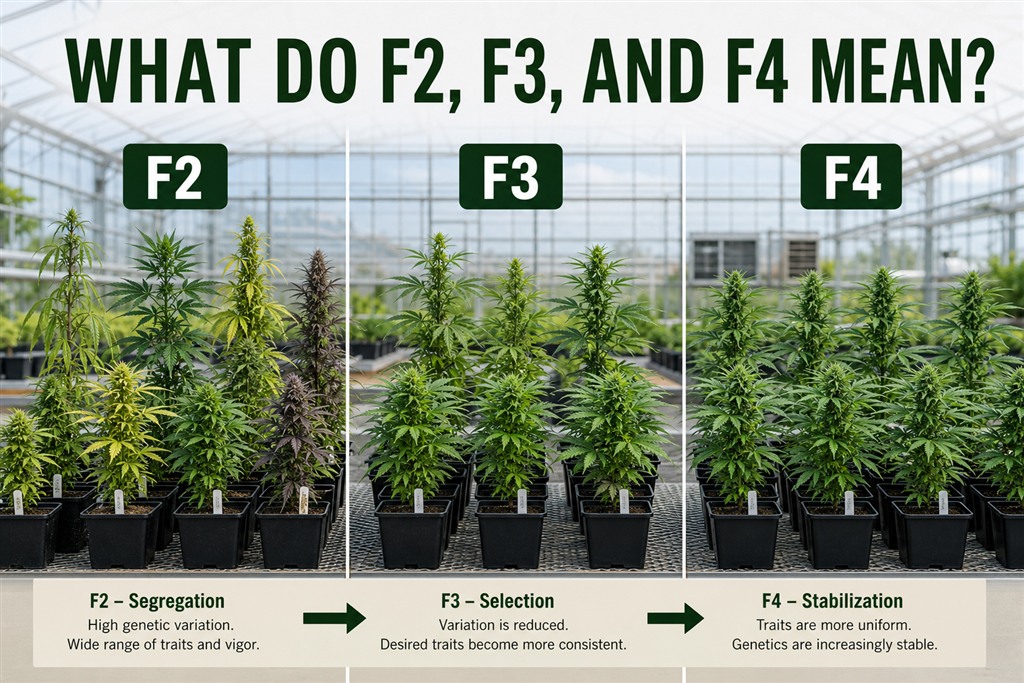
F2, F3, and F4 cannabis seeds identify successive filial generations after an initial parental cross. F2 comes from mating or selfing F1 offspring, F3 comes from F2 descendants, and F4 continues that lineage. Breeders often select parents between generations, but the number itself doesn’t tell you what was selected or whether the line is automatically better, stable, or uniform.
For a grower, the practical issue is expected variation. For a breeder, it’s what was selected, how the mating was made, and whether the records connect the packet to a real line.
Start With the Parental and F1 Generations
Breeders often call the starting parents P1 and P2. Their first offspring are F1. When F1 individuals are crossed with each other, or a selected F1 is selfed where the breeding system allows it, the resulting seed is F2. The site’s guide to F1 hybrid cannabis seeds explains why the F1’s predictability depends heavily on the parent lines.
The F2 is where allele combinations reshuffle and recessive traits can become visible. In a well-defined cross, that segregation can create the range a breeder needs to find new combinations. It can also surprise a grower who expected the F1 pattern to repeat.
What Changes From F2 to F4
F2: The Main Segregating Generation
F2 populations often show wider visible and chemical variation than a well-made F1. A classic study of cannabinoid inheritance in Cannabis sativa used F2 offspring to observe segregation of chemotypes. That finding doesn’t mean every trait follows one simple ratio; many useful cannabis traits involve several genes and environmental effects.
F3: Selected Families Begin to Separate
F3 seed traces back to F2 parents, but selection isn’t guaranteed merely because the generation advanced. In a deliberate program, the breeder can compare families, keep the ones that carry the desired combination, and remove lines that miss the goal. Variation can decline, but only for traits that were selected effectively and inherited consistently.
F4: More Selection History, Not Automatic Completion
By F4, a carefully selected line may be more uniform for target traits, yet other traits can still segregate. The label doesn’t reveal population size, selection pressure, environmental testing, or whether an undesirable bottleneck occurred.
Filial Number Is Not a Quality Score
An F4 isn’t inherently superior to an F2. An F2 may be exactly what an advanced breeder wants for a phenotype hunt, while an F4 may suit a grower seeking more consistency. The right generation depends on the job.
Use the phenotype-hunting workflow when the goal is to explore a segregating population, and keep the difference between genotype and phenotype visible when deciding whether a trait is truly inherited.
How to Read a Generation Label
- Ask how the generation was made. F2 from one selfed F1 and F2 from several intercrossed F1 plants aren’t the same population.
- Identify the selection target. “Worked to F4” is incomplete without the traits being selected.
- Check population size. Small generations can lose useful alleles and exaggerate chance.
- Separate uniformity by trait. Similar height doesn’t prove uniform chemistry, flowering time, or stress response.
- Look for environmental testing. One room can hide genotype-by-environment effects.
- Verify the pedigree. Generation notation is meaningful only when parent and offspring records remain connected.
Don’t Confuse F Generations With Backcrosses or Selfed Labels
F, BC, and S notation describe different relationships. A backcross returns offspring to a parent or parent-like recurrent line, as explained in the guide to backcrossing in cannabis breeding. Selfed-generation labels describe self-fertilized descendants. Converting every breeding step into the next F number erases information that a buyer or breeder needs.
Pick the Generation That Fits the Task
Choose an F2 when you want variation to search, and choose a later selected generation when you need greater consistency for documented traits. In either case, ask for the mating method, selection history, population size, and test conditions. The number tells you where the seed sits in the pedigree, but it doesn’t tell you whether the line meets your needs.