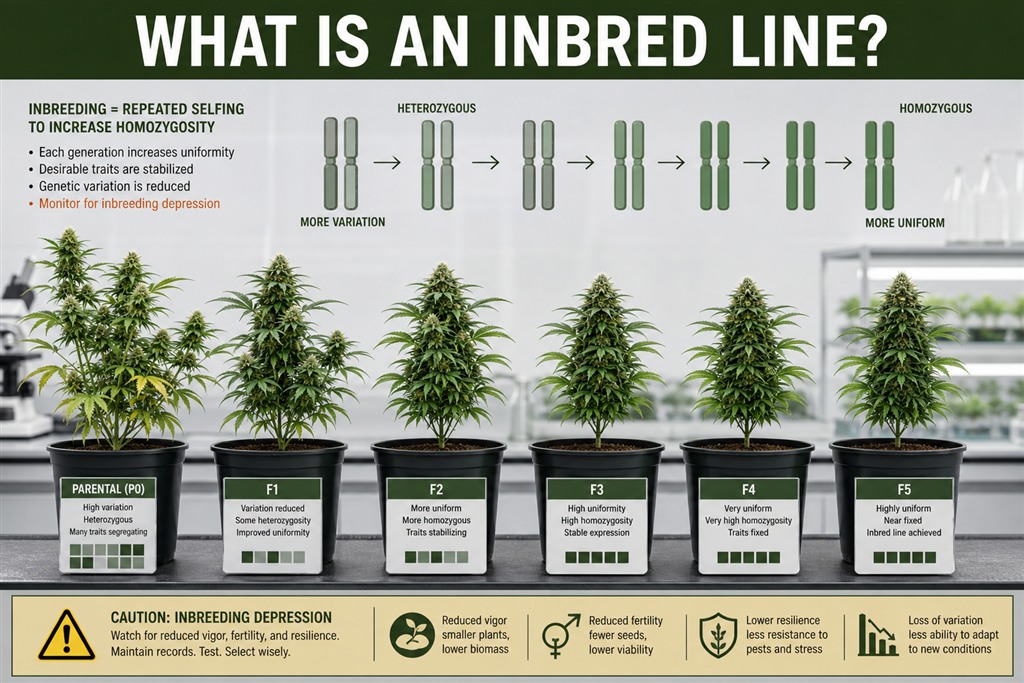
An inbred line in cannabis breeding is a population developed through repeated selfing or close mating to increase homozygosity and make selected traits more consistently inherited. The goal isn’t to make every plant literally identical. It’s to reduce genetic uncertainty enough that the line can be evaluated, maintained, or used as a predictable parent.
That gain in predictability has a cost: inbreeding can expose harmful recessive alleles, reduce vigor or fertility, and narrow the line’s ability to respond to stress. A serious program measures both fixation and fitness instead of treating uniform appearance as proof that the line is finished.
What Inbreeding Changes Genetically
Repeated inbreeding increases the chance that the two copies of a gene are the same, a condition called homozygosity. As more regions become homozygous, offspring tend to segregate less for traits controlled by those regions. This can help a breeder reproduce a particular architecture, flowering pattern, or chemical type more consistently.
The visible result is still a phenotype shaped by genetics, environment, and development. That’s why the distinction between genotype and phenotype matters: similar-looking plants in one room don’t prove that the underlying line is fixed.
How Cannabis Inbred Lines Are Developed
Breeders can increase homozygosity through self-fertilization, sibling mating, or other controlled close crosses followed by selection. Cannabis sex expression makes the logistics line-dependent. Some programs use monoecious material, while others use controlled sex reversal to obtain selfed generations.
A 2026 proof-of-concept study on single-seed descent and uniform F1 cannabis hybrids followed inbreeding across generations and documented both the value and the fertility challenges of the process. The research is important because it tests actual lines rather than assuming that general crop-breeding rules transfer without complication.
What a Breeder Should Measure Each Generation
- Trait consistency: Are the target traits becoming more predictable across offspring?
- Vigor: Are emergence, growth rate, biomass, or stress recovery declining?
- Fertility: Are pollen production, seed set, or reproductive development changing?
- Abnormal expression: Are unexpected floral or developmental traits becoming more frequent?
- Environmental stability: Does the selected pattern hold outside one favorable room or season?
Population size and records matter because a single attractive survivor can hide a broader decline. The tissue-culture propagation guide explains how a selected genotype can be preserved, but preserving one plant isn’t the same as proving an inbred seed line.
Why Inbred Lines Are Used for F1 Hybrids
When two sufficiently uniform parents are crossed, each F1 offspring receives a more predictable allele set from each side. That’s one reason inbred parental lines are central to many true hybrid programs. The site’s explanation of F1 hybrid cannabis seeds shows why parental development is more important than the generation label printed on a packet.
Inbred lines are also useful for genetic research, trait mapping, and controlled comparisons. They reduce some background variation, which can make the effect of a cross or treatment easier to interpret.
Inbred Doesn’t Mean Stable in Every Useful Sense
A line can be genetically uniform yet agronomically weak. It can also be consistent for one trait while still segregating for others. “Stable” should always be followed by a question: stable for what, in how many plants, across which environments, and measured over how many generations?
That’s also why an inbred line shouldn’t be confused with an open-pollinated population. The former deliberately narrows heterozygosity; the latter can maintain a broader population when enough parents contribute and selection is managed carefully.
A Working Decision Rule
Use an inbred line when the project needs a repeatable research or breeding parent and you can support several generations of controlled mating, records, and fitness testing. Don’t pursue inbreeding merely because uniformity sounds desirable. Define the trait to fix, the minimum performance the line must retain, and the stop conditions for fertility or vigor loss before starting the next generation.


2 responses