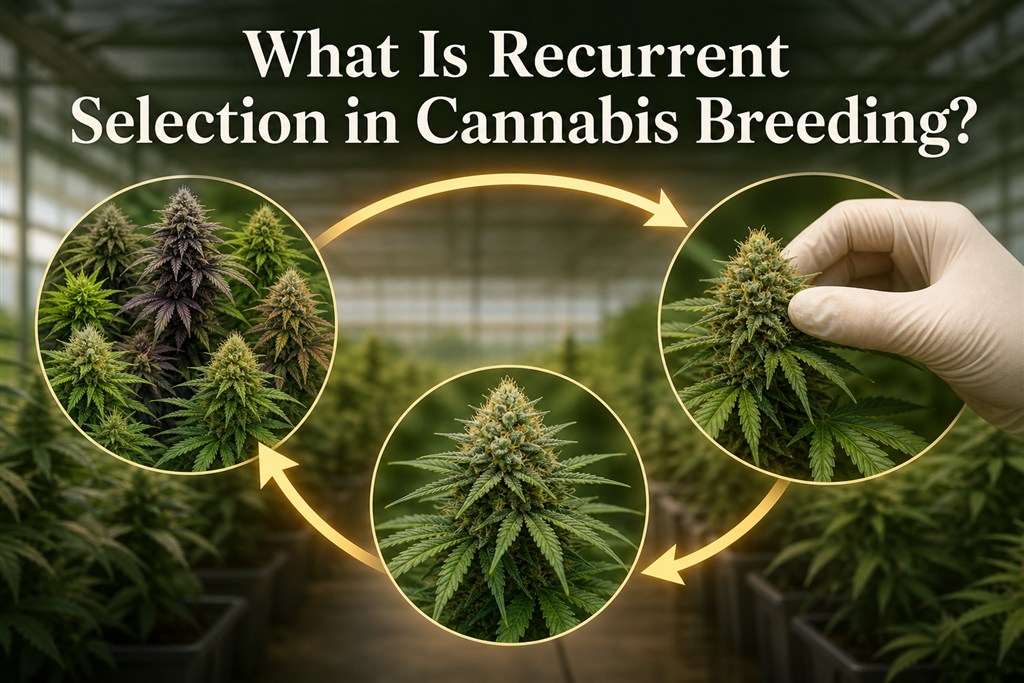
Recurrent selection in cannabis breeding is a repeated cycle of evaluating a population, choosing parents with useful performance, intercrossing those parents, and testing the next population again. The method improves a population over time while retaining more genetic diversity than a program built around fixing one narrow line.
The organizing idea is simple but demanding: selection is a cycle, not a one-time choice of the best-looking plant.
What Happens in One Selection Cycle?
- Define the breeding objective. Name the trait or index and the minimum standards for other important qualities.
- Evaluate the population. Grow enough individuals under conditions that make relevant differences observable.
- Select several parents. Keep the strongest candidates without allowing one family to dominate by accident.
- Intermate the selected parents. Use controlled pollen handling and records so parent contributions are known or intentionally balanced.
- Produce and evaluate the next cycle. Compare the new population with the original baseline or a retained control.
Then the cycle repeats. The response comes from changing allele frequencies across the population, not from making every plant genetically identical.
When Recurrent Selection Fits Cannabis
The method is most useful for population-level improvement: flowering adaptation, plant architecture, biomass, fiber quality, multi-trait resilience, or another objective influenced by many genes. Cannabis research has documented substantial genetic variation in flowering, morphology, and fiber traits. One open study of 28 hemp traits across environments shows why a breeder needs both genetic variance and careful environmental testing before expecting selection to work.
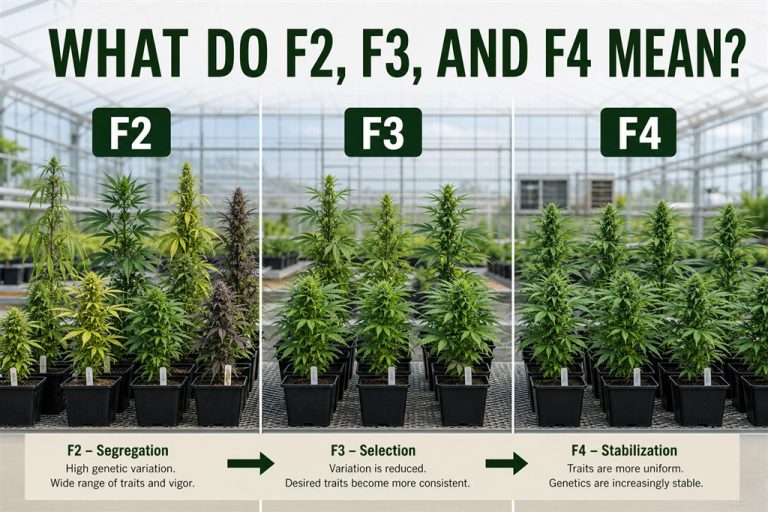
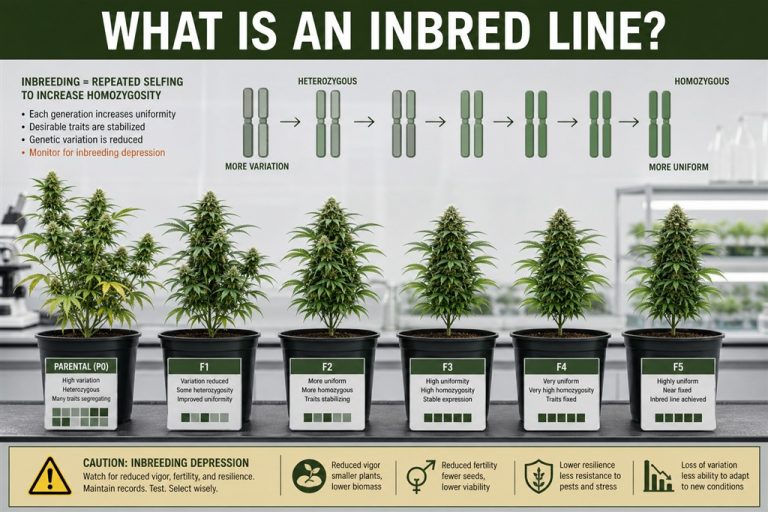
Recurrent selection is less suitable when the immediate goal is a highly uniform commercial F1 parent. That goal is closer to the line-development process described in the site’s inbred-line article. A population program can later supply parents for line development, but the two stages shouldn’t be confused.
How to Keep the Cycle From Becoming Guesswork
- Use a repeatable trait definition. “Best” is not a measurement. Record the stage, unit, method, and conditions.
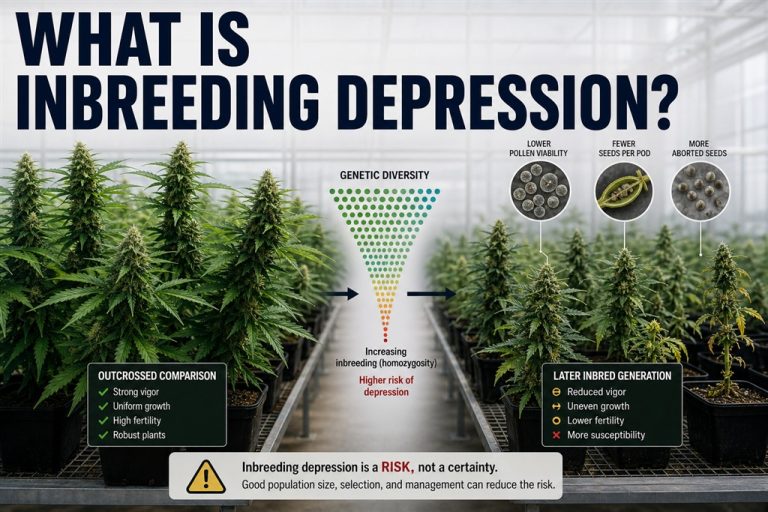
- Protect population size. Selecting too few parents can remove useful alleles and increase relatedness faster than intended.
- Balance family contribution. Several siblings can make a selected group look large while representing little genetic breadth.
- Preserve seed from earlier cycles. A retained baseline makes progress and loss easier to detect.
- Test late traits before mating when possible. Clones, stored pollen, or staged crossing can help when the decisive measurement arrives after flowering.
The site’s explanation of phenotype hunting is useful for understanding candidate evaluation, but recurrent selection asks an additional question: which group of selected parents should contribute to the next population?
Selection Intensity Has a Cost
Choosing only the extreme few may produce faster short-term change, but it also reduces effective population size and can discard useful combinations. A breeder should set selection intensity in relation to the available population, the trait’s reliability, and the need to preserve other qualities.
That tradeoff is especially important when a trait is environmentally sensitive. If selection occurs in one unusually favorable room or season, the chosen parents may reflect that environment more than broad genetic value. Repeating trials, using family information, and comparing cycles under relevant conditions make the decision more defensible.
A Practical Cycle Record
For every cycle, record the base population, number evaluated, selection criteria, number and identity of parents, mating design, seed-lot identity, and comparison results. If genetic markers are validated for the target, marker-assisted selection can supplement phenotype data, but markers don’t replace population performance or environmental validation.
A Working Decision Rule
Choose recurrent selection when the goal is to improve a variable population across repeated cycles and preserve enough diversity for continued progress. Before cycle one, define the baseline, the measured objective, the minimum parent number, and the evidence required to claim improvement. Without those four elements, repeated crossing is activity, not a selection program.