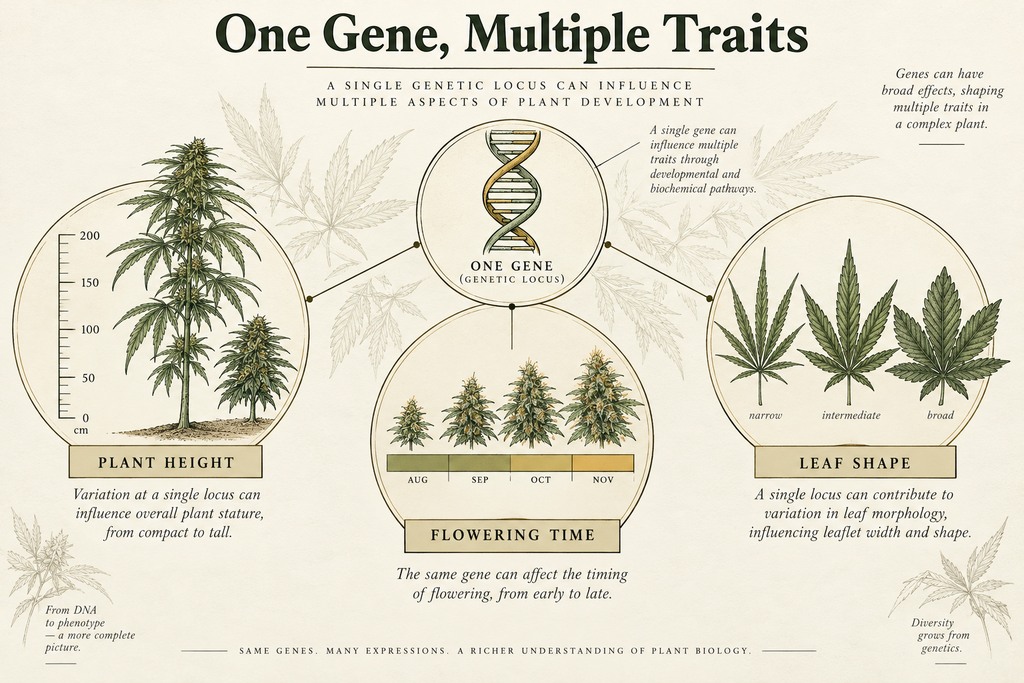
Pleiotropy means one gene influences more than one trait. In cannabis genetics, it can help explain why selecting for one characteristic also changes another, but correlated traits don’t prove pleiotropy. You need to distinguish a shared genetic cause from separate linked genes and from environmental conditions that move both measurements together.
How One Gene Can Affect Several Traits
A gene involved in a biological process can affect several downstream outcomes. That’s the idea behind pleiotropy. It differs from a polygenic trait, where many genes contribute to one characteristic, and from epistasis, where effects depend on interactions among loci.
For a breeder, the important consequence is a possible selection tradeoff. Improving the characteristic you value might also change a characteristic you need to retain. The second effect can be beneficial, harmful, or irrelevant depending on the breeding objective.
Why Trait Correlation Isn’t Enough
Suppose earlier flowering and shorter mature height occur together in a hypothetical family. You can’t conclude that one gene causes both. Earlier transition could reduce time for vegetative growth; separate genes could be inherited together; or differences in environment could influence both traits.
That example also shows why the measurement date matters. Comparing all plants on the same calendar day answers a different question from comparing them at the same developmental stage. Write down which comparison fits your objective before interpreting trait correlations.
Keep the distinction between genotype and phenotype in view. A visible relationship can be real and useful while its genetic explanation remains unresolved.
Pleiotropy and Linkage Lead to Different Expectations
With genetic linkage, separate loci are inherited together more often than expected under independent assortment. Recombination may sometimes separate their effects. With genuine pleiotropy, simply searching for a crossover between two nearby genes won’t separate outcomes caused by the same causal variant.
The explanation of linkage disequilibrium describes how associations among variants can complicate interpretation. A marker associated with two traits might tag one causal change, several linked changes, or population history.
Don’t promise that a larger seed family will break a tradeoff. It can provide more opportunities to detect useful combinations, but success depends on the underlying architecture and on how the traits are measured.
How to Investigate the Relationship
- Measure both traits on the same identified plants. Preserve units, stage, sampling method, and missing observations.
- Repeat under comparable conditions. If possible, use replicated trials to determine whether the relationship persists.
- Look for informative offspring. Plants that separate the traits can challenge a simple shared-cause hypothesis, although measurement error and environmental effects still need checking.
- Use mapping evidence carefully. Overlapping associated regions don’t alone establish one causal gene. Fine mapping or functional work may be needed.
- Record the costs of selection. Compare progress in the primary trait with any loss in the secondary trait rather than ranking on one score.
What Cannabis Research Adds
A genome-wide association study of cannabis agronomic and morphological traits provides a research context for studying trait associations and candidate genomic regions. Such studies help formulate hypotheses; they don’t make every correlation a demonstrated pleiotropic mechanism.
If a region has been mapped, the article on quantitative trait loci explains why a region-level finding needs further work before becoming a causal claim. If a breeding decision depends on identifying the cause, ask a plant geneticist to assess the study design and the competing explanations.
Keep Both Traits in the Selection Decision
If selecting for your preferred trait repeatedly brings an unwanted change with it, include both in the decision now. You don’t have to identify the mechanism before deciding the tradeoff is unacceptable. Genetic evidence can then help you decide whether to pursue recombinants, change the target, or accept a tradeoff you can measure.
Keep the two measurements together for each plant you evaluate. That record lets you see whether an apparent improvement still meets your objective once the second trait is counted.