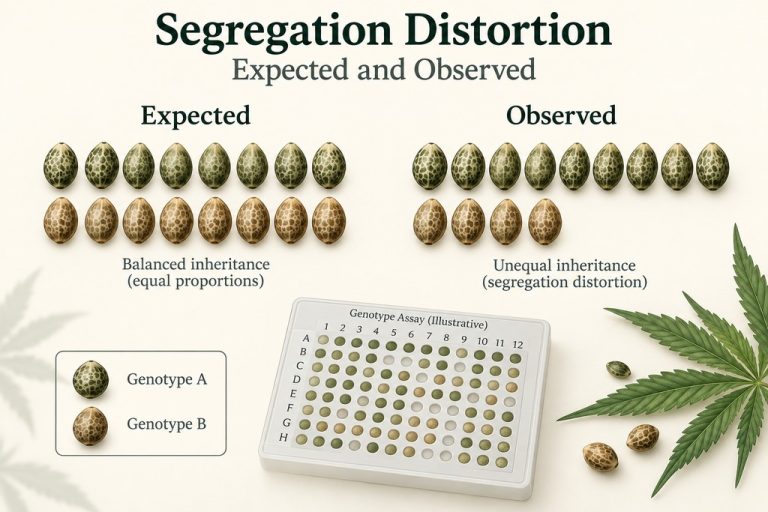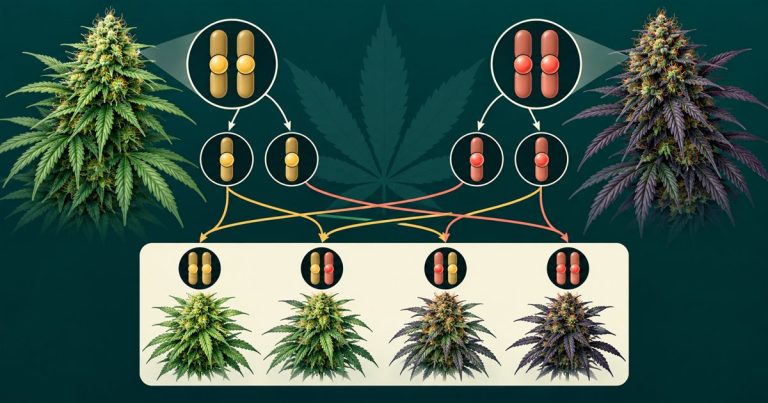
Marker validation in cannabis breeding tests whether a DNA marker predicts the intended trait reliably enough in new plants, families, and environments to support a real selection decision. Discovery finds a promising association; validation asks whether that relationship survives outside the dataset where it was found. Until it does, the marker is a candidate, not a dependable breeding tool.
Why Discovery Is Not Validation
A marker can appear associated with a trait because it’s near a causal variant, because it identifies ancestry, or because the discovery sample was small or unrepresentative. Recombination may weaken the relationship in another cross, and allele frequencies can make a useful marker uninformative in a different population.
This is why marker-assisted selection depends on validated markers rather than interesting statistical results alone.
Four Layers of Validation
- Technical validation: the assay produces repeatable calls, controls behave correctly, and different operators or batches agree.
- Identity validation: marker position, allele labels, genome build, and sample identity are correct.
- Association validation: the marker-trait relationship repeats in an independent population with appropriate structure and relatedness controls.
- Decision validation: using the marker improves selection efficiency without unacceptable false positives, false negatives, or diversity loss.
A Practical Validation Workflow
- Lock the marker, allele definition, assay, and trait protocol before examining the validation result.
- Select an independent population that resembles the germplasm where the marker will be used.
- Include positive, negative, duplicate, and no-template controls where the assay requires them.
- Collect phenotype or chemical data without using the marker result to influence scoring.
- Calculate sensitivity, specificity, predictive values, missing-call rate, and uncertainty.
- Stratify results by family, ancestry, environment, and relevant allele frequency.
- Set the supported use: screening, exclusion, confirmation, or research only.
Population Structure Can Create False Confidence
If a trait and marker are both common in one ancestry group, the marker may appear predictive without being biologically close to the cause. Review the site’s population-structure explanation before treating a mixed panel as one random population. Independent-family and cross-population validation are especially important when a marker originated in association mapping.
SNP Identity and Genome Build Matter
A marker name isn’t enough. The same coordinate can refer to a different base after an assembly change, strand orientation can reverse allele labels, and nearby variants can interfere with an assay. Keep the chromosome, coordinate, reference and alternate alleles, genome assembly, flanking sequence, assay chemistry, and version together. The site’s SNP overview explains why a variant label must remain attached to genomic context.
What a Validation Report Should Say
- which trait and decision the marker is intended to support;
- where the marker came from and whether it is causal or linked;
- which independent populations and environments were tested;
- assay failure and discordance rates;
- sensitivity, specificity, predictive values, and confidence intervals;
- known unsupported populations or conditions;
- which confirming phenotype or laboratory test is still required.
The Decision Rule
Use a marker only for the population, trait, environment, and purpose supported by its validation evidence. Revalidate after a major assay change, genome-build change, or move into unrelated germplasm. The most credible marker claim is not the broadest one; it is the one that states exactly what was tested, where it worked, where it failed, and what evidence must still come from the plant.