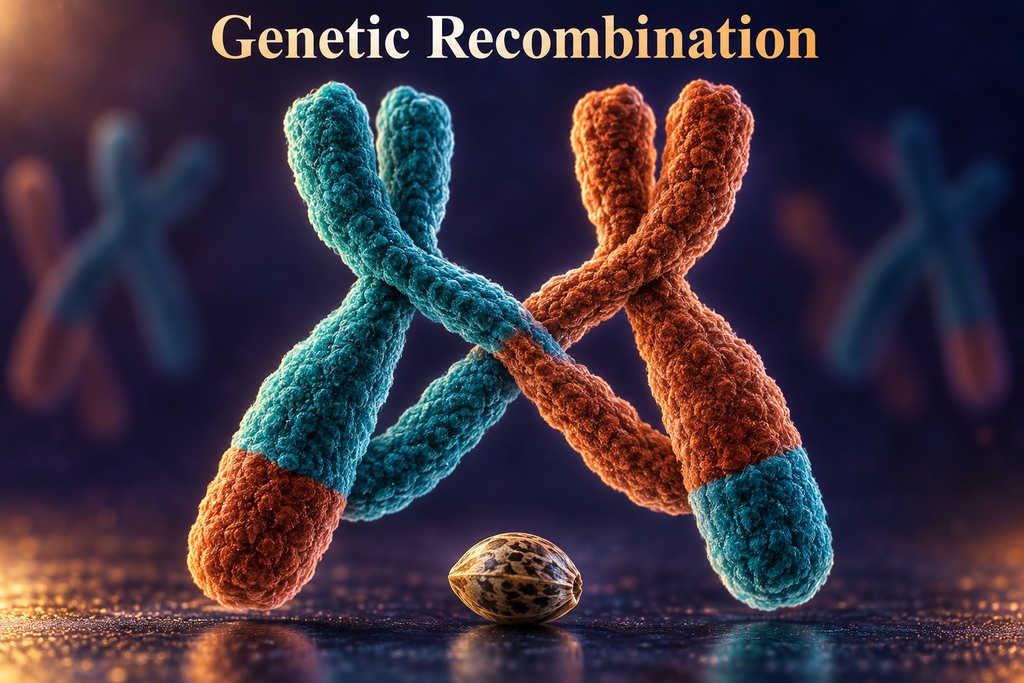
Genetic recombination creates new combinations of inherited DNA, including when homologous chromosomes exchange segments during meiosis. In cannabis breeding, it can separate some linked variants or bring them into new combinations. A cross creates that opportunity, but it doesn’t guarantee that a particular seed will carry the combination you’re looking for.
What Gets Exchanged?
In a normal diploid example, homologous chromosomes carry corresponding regions inherited from the two parents. During meiosis, crossing over exchanges segments between nonsister chromatids. Gametes can therefore carry a chromosome made of segments from both parental copies.
OpenStax’s genome-mapping explanation describes the relationship between recombination and linkage analysis. Independent assortment also reshuffles chromosome combinations, but exchanging segments within a chromosome and assorting different chromosomes are distinct processes.
Neither process is the same as creating a new mutation. Recombination rearranges inherited variation that is already present.
Why Nearby Variants Can Be Hard to Separate
Genetic linkage means loci tend to travel together because they’re on the same chromosome. A crossover between them can create a new combination, but the chance depends on the region and the cross.
Physical distance in base pairs and genetic distance in centimorgans describe different things. A centimorgan is a measure based on recombination, and a short interval of roughly one centimorgan corresponds to approximately 1% recombinant gametes under the mapping conditions. That local approximation isn’t a universal conversion from DNA length.
Structural differences can complicate pairing and recombination, so don’t assume every region is equally easy to reshuffle. A 2025 cannabis pangenome study documented substantial structural variation and discussed suppressed recombination in specific genomic regions. Those findings don’t supply a recombination rate for every breeding cross.
How a Useful Combination Can Be Missed
Suppose two desired alleles are on opposite parental chromosome copies in a hypothetical plant. Some offspring may receive the desired combination after recombination. A small family could miss that outcome even if it’s biologically possible.
If the trait isn’t reliably visible, you may need an appropriate assay to confirm the inherited combination. The distinction between genotype and phenotype helps you separate what the offspring inherited from how those variants are expressed.
Evaluate a Recombination Claim Before Planning Around It
- Identify the target variants or regions. Ask which variants or regions are meant to carry each desired trait.
- Confirm the parental arrangement. Determine whether desired variants are together or on opposite homologous copies.
- Ask where the rate came from. A genetic map from another population may not describe your cross.
- Retain all informative offspring records. Missing calls and unrecorded losses can bias the apparent frequency.
- Verify candidate recombinants. Check identity, genotype quality, and the actual phenotype before selection.
Groups of variants inherited together are often described as haplotypes. Population-level association, discussed in linkage disequilibrium, can suggest which combinations are common, but it doesn’t substitute for observing transmission in your family.
What to Do With the Result
If you find a confirmed recombinant with the intended phenotype, evaluate it further rather than assuming the combination will breed true. Other loci, environmental sensitivity, and subsequent segregation still matter. If you don’t find one, the explanation may be sampling, assay limitations, or a genuinely difficult genomic interval.
A plant breeder or geneticist can help translate a mapping estimate into an appropriate family design. Before planning the cross, write down the combination you want, what you know about the parents, and how you’ll recognize and confirm the offspring that carry it.