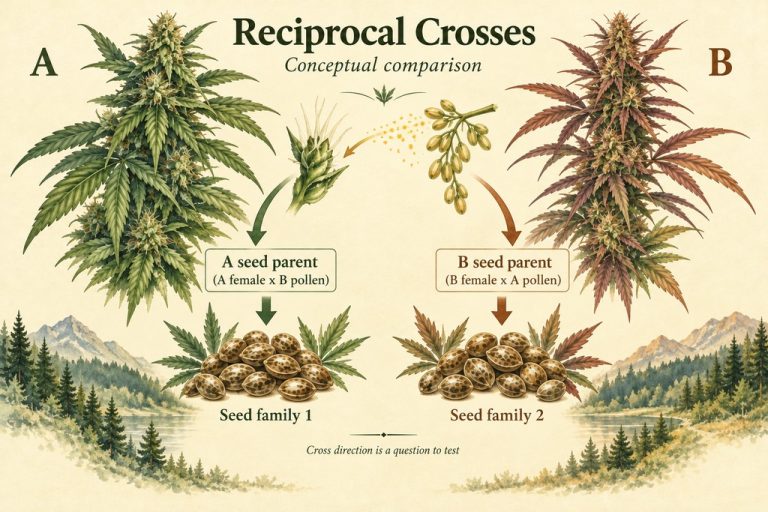
Family selection in cannabis breeding uses information from related groups of offspring to support selection. Instead of judging a parent or candidate only by its own appearance, the breeder compares how its siblings, half-sibs, full-sibs, or progeny perform under a defined design. Family information can make noisy traits easier to evaluate, but it can also increase relatedness quickly if the best family replaces the whole population.
What Counts as a Family
A family must be defined by recorded parentage. Full-sib families share both parents; half-sib families share one known parent; selfed or inbred families follow another design. In an outcrossing cannabis population, uncontrolled pollen can make an assumed family different from the genetic family, so pollination records and parentage checks matter.
Among-Family and Within-Family Selection
Among-family selection advances groups with strong average performance. Within-family selection chooses the best individuals inside each family. Combining both approaches can protect representation while still making progress.
The right balance depends on the trait. Family means can reduce environmental noise when individual measurements are unreliable, but a family average can hide a rare exceptional plant or a serious segregation problem.
A Practical Trial Design
- Define the question. Name the trait, units, decision threshold, and target environment.
- Create connected families. Use shared parents or checks so family comparisons aren’t isolated.
- Randomize and replicate. Distribute family members across blocks, benches, rooms, or sites rather than growing each family in one location.
- Measure consistently. Blind assessors to family identity where practical and keep timing and equipment calibrated.
- Separate effects. Estimate family, individual, block, and environment contributions with an appropriate model.
- Select with diversity controls. Cap contributions or retain multiple families when one group dominates.
- Confirm the next generation. Use a test cross or further progeny evaluation when the parent claim remains uncertain.
When Family Information Helps Most
- traits measured late or destructively;
- traits with substantial environmental noise;
- selection decisions about a parent rather than a single production plant;
- recurrent improvement of an outcrossing population;
- situations where repeated clonal or multi-site testing is limited.
Family evidence doesn’t remove the need to understand heritability. It changes the information used for selection and may improve accuracy, but the result still belongs to the tested population and environment.
Common Mistakes
- confounding each family with one bench, room, or planting date;
- calling open-pollinated offspring full siblings without controlled parentage;
- selecting the largest family because it had more chances to produce an extreme plant;
- advancing only one top family and unintentionally shrinking diversity;
- reporting a family mean without its sample size and variation.
Connect the Family Result to the Program
Family selection works naturally inside recurrent selection: evaluate families, choose contributors, intermate them, and repeat. Record both the improvement you measured and which families contributed to it. A useful family report shows the mean, within-family spread, number tested, environments, selected individuals, and contribution allowed in the next cycle.
A Decision That Preserves Options
If the top family is truly superior, the data should show that advantage across replication rather than one favorable location. Advance strong individuals, but keep enough independent families to protect future response. Family selection is most valuable when it strengthens a parent decision without turning one successful family into the entire gene pool.