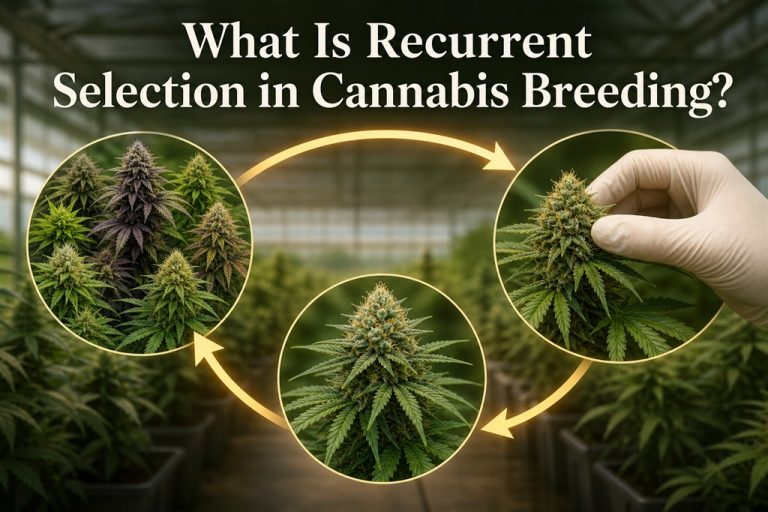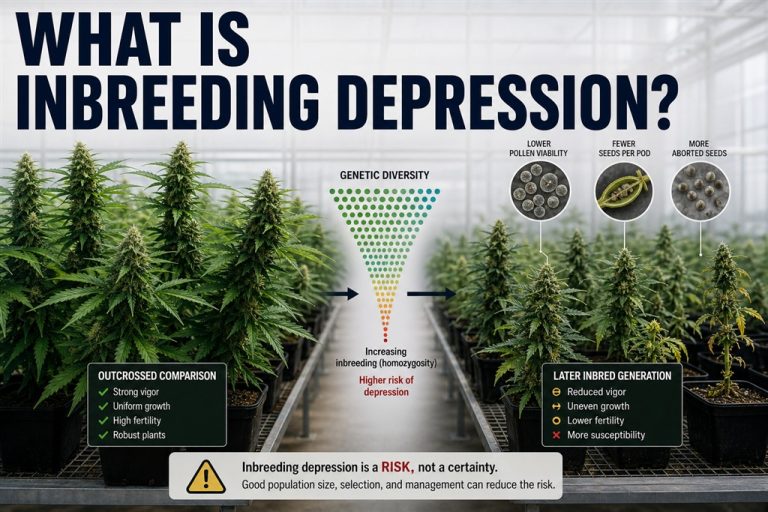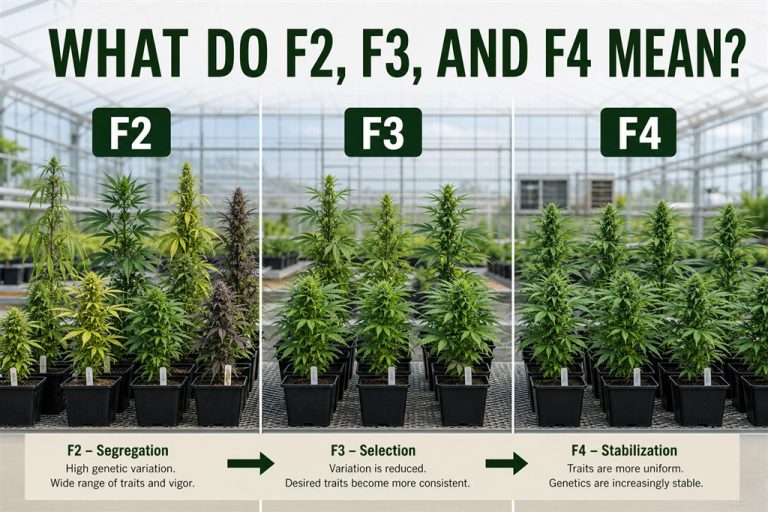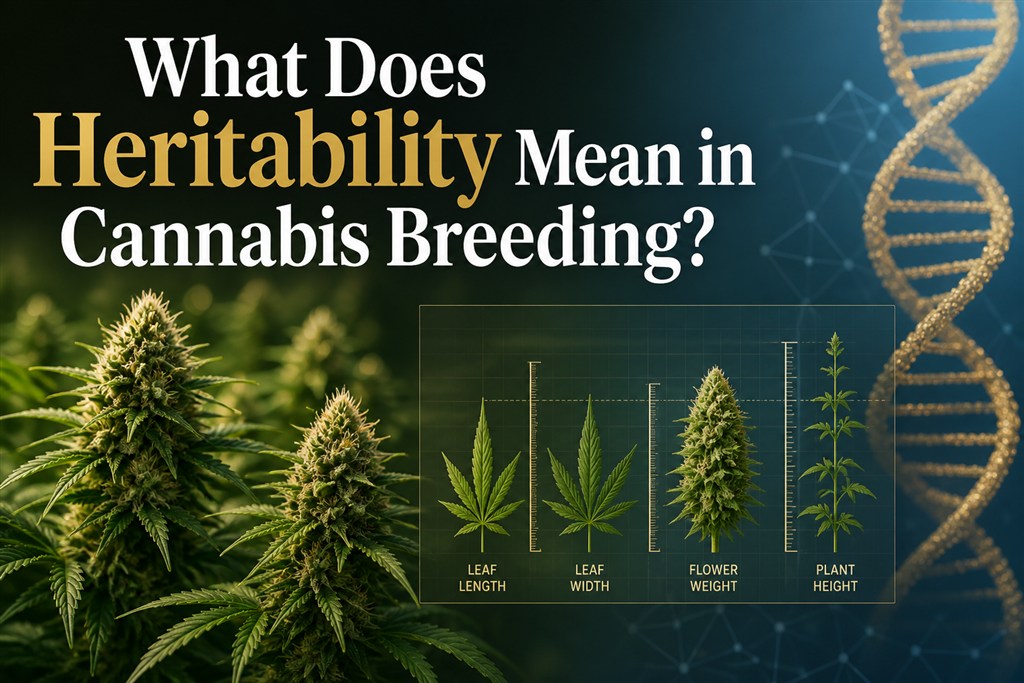
Heritability in cannabis breeding describes how much of the observed variation in a particular trait, within a particular population and set of environments, is associated with genetic differences among the plants. It is not the percentage of a trait “caused by genes,” and it doesn’t tell you how much of one plant’s performance will automatically pass to its offspring.
The practical value of heritability is narrower and more useful: it helps a breeder judge how reliably phenotype can guide selection in the population being tested.
Why Heritability Is Population-Specific
A heritability estimate depends on the genetic diversity in the tested population, environmental variation, measurement error, trial design, and the environments included. Change those conditions and the estimate can change. A value reported for one hemp panel, room, season, or trait definition should not be copied onto another breeding population as though it were a fixed property of cannabis.
This is why the distinction between genotype and phenotype is the starting point. Heritability partitions variation across a group; it doesn’t separate genetics and environment perfectly for one individual.
Broad-Sense and Narrow-Sense Heritability
- Broad-sense heritability includes all measured genetic variance: additive effects, dominance, and interactions among genes.
- Narrow-sense heritability focuses on additive genetic variance, the component most directly related to resemblance between parents and sexually produced offspring.
Broad-sense estimates can be useful when evaluating replicated genotypes or clones. Narrow-sense heritability is usually more relevant when predicting response to selection in a seed population. The two values answer different questions, so an unexplained heritability number is incomplete.
What Cannabis Research Shows
A multi-environment study of morphological, flowering, and fiber traits in hemp found meaningful genetic contributions for some traits while also measuring environmental and genotype-by-environment effects. The result isn’t a universal ranking of easy and difficult cannabis traits. It demonstrates why breeders need trait-specific estimates from controlled, replicated data.
Cannabis chemical traits can also have complex inheritance. Research on cannabinoid inheritance found additive and nonadditive contributions and warned that concentration traits are more complex than a single-locus explanation. That complexity makes one parent-offspring comparison a weak basis for a heritability claim.
How Heritability Changes a Selection Plan
When a trait shows useful narrow-sense heritability under relevant conditions, selecting superior parents may produce a more predictable response. When heritability is low, the breeder may need more replication, family testing, multiple environments, better measurement, or indirect selection through a correlated trait.
Low heritability does not mean the trait is unchangeable or that genes do not matter. It means observed differences are a noisy guide to transmissible genetic value in that dataset. High heritability does not mean the environment is irrelevant or that progress is guaranteed.
A Defensible Estimation Workflow
- Define the trait, developmental stage, and measurement method.
- Use a population relevant to the breeding decision.
- Replicate genotypes or families where the design permits.
- Test environments that represent the intended production conditions.
- Fit a model that separates genetic, environmental, interaction, and residual variance appropriately.
- Report the estimate with its population, environments, design, and uncertainty.
- Validate the predicted response in the next generation.
If the program relies on visible selection, the site’s phenotype-hunting guide explains why clones, repeated measurements, and late-trait evidence strengthen candidate comparisons. If the program uses DNA information, marker-assisted selection still requires a validated relationship between a marker and the trait in relevant germplasm.
A Working Decision Rule
Use heritability to decide how much confidence to place in phenotype-based selection, not to label a trait as genetic or environmental. Before acting on an estimate, ask: which population, which environments, which definition, which variance components, and how much uncertainty? If those answers are missing, the number isn’t ready to guide a breeding decision.