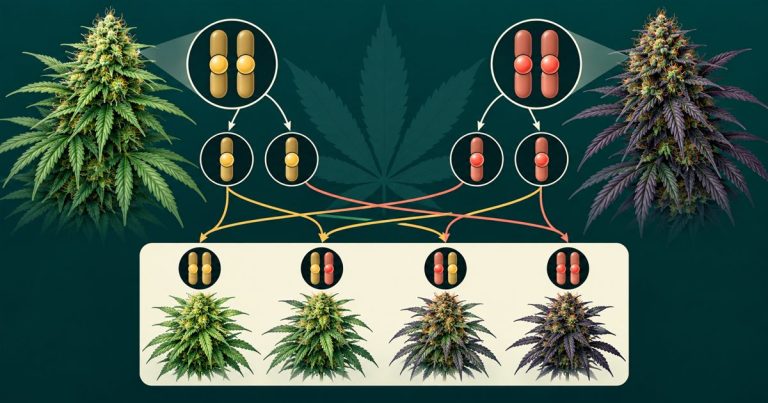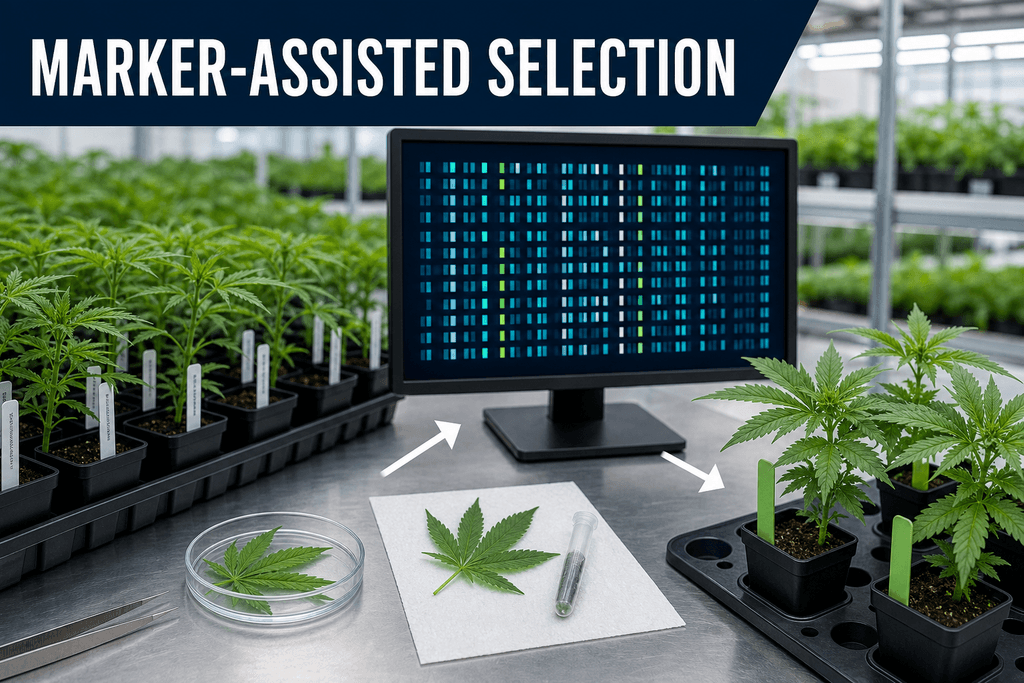
Marker-assisted selection in cannabis breeding uses validated DNA markers associated with target alleles or traits to help choose breeding plants. It can screen seedlings before late traits are visible and make selection more efficient, but a marker is only useful when its relationship to the trait has been demonstrated in relevant germplasm. It doesn’t replace phenotyping, field trials, or chemical testing.
What a Genetic Marker Does
A genetic marker is a detectable DNA variation that helps identify a genomic region, allele, or genetic relationship. Single-nucleotide polymorphisms, often called SNPs, are common markers. Breeders may use a marker that sits within a functional gene or one that is close enough to a target gene to be inherited with it most of the time.
The important word is validated. A marker associated with a trait in one population may be weak or uninformative in another because allele frequencies, population structure, and recombination differ. The site article on genetic markers for high-CBD cannabis shows how synthase-related markers can help with chemotype questions while still requiring chemical verification.
How Marker-Assisted Selection Works
A basic MAS workflow connects molecular data to an actual breeding decision:
- Define a measurable target trait.
- Build or use a population where the trait segregates.
- Collect dependable phenotype data and DNA data.
- Identify and validate marker-trait associations.
- Genotype new offspring for the validated marker.
- Advance plants with the desired marker state.
- Confirm the trait through phenotyping, laboratory testing, and multi-environment trials.
Current cannabis research is moving toward more integrated marker systems. A 2026 study used genomic and morphophysiological features to classify flowering-time groups and reported markers relevant to photoperiod breeding; see the PubMed record on integrated genomic markers for cannabis flowering time.
Where MAS Can Help Cannabis Breeders
- Sex-linked selection before reproductive structures are visible
- Cannabinoid chemotype screening tied to well-characterized synthase loci
- Tracking a major resistance allele through a crossing program
- Confirming parentage or line identity
- Recovering a recurrent parent’s genetic background during backcrossing
- Reducing the number of plants carried into expensive late-stage testing
MAS is strongest for traits influenced by one or a few loci with large effects. Complex traits such as yield, broad stress tolerance, aroma, or overall quality often involve many genes and strong environmental effects. For those traits, a small marker panel may explain only a fraction of performance.
Why Phenotyping Still Matters
A DNA result tells you which marker state a plant carries; it doesn’t show how the whole plant performs. Recombination can separate a marker from the causal allele, and a favorable allele may express differently across genetic backgrounds or environments. Breeders still need consistent measurements of flowering, structure, disease response, chemistry, yield, and propagation behavior.
The USDA’s hemp phenotyping handbook illustrates the structured trait data needed to make germplasm and marker results useful. Without good phenotype data, a genomic association can become a confident-looking number attached to a poorly defined trait.
MAS, Genomic Selection, and Genetic Testing Aren’t the Same
Marker-assisted selection usually follows particular markers linked to particular traits. Genomic selection uses many markers across the genome to predict breeding value for complex traits, which requires a large, well-phenotyped training population. Identity testing may use markers to distinguish cultivars or confirm relationships without predicting performance at all.
These tools complement preservation rather than replacing it. If a selected plant is important, maintain clean material through cloning or advanced tissue-culture methods while testing proceeds. And if the program uses diverse source material, the landrace cannabis seed overview explains why locally adapted populations may contain useful variation that isn’t captured by a narrow commercial panel.
If you’re evaluating a genetic-test result rather than running a breeding program, trace the claim in order: marker, associated allele or region, validation population, predicted trait, and confirming phenotype. A missing link doesn’t make the test worthless, but it limits the conclusion you can safely draw from it.
Questions to Ask About a Marker Claim
- Was the marker validated in this cultivar group or only a different population?
- Does it tag a causal gene or a nearby region?
- What percentage of trait variation does it explain?
- How often does recombination break the association?
- Was performance confirmed in the intended environment?
- Is an independent chemical, disease, or field test still required?
When a Marker Result Deserves Trust
Marker-assisted selection can help cannabis breeders make earlier and more focused decisions, especially for well-validated, large-effect traits. Its value comes from the chain of evidence connecting marker, allele, phenotype, population, and environment. Use markers to strengthen selection, not to skip the plant-level proof that makes a breeding claim credible.