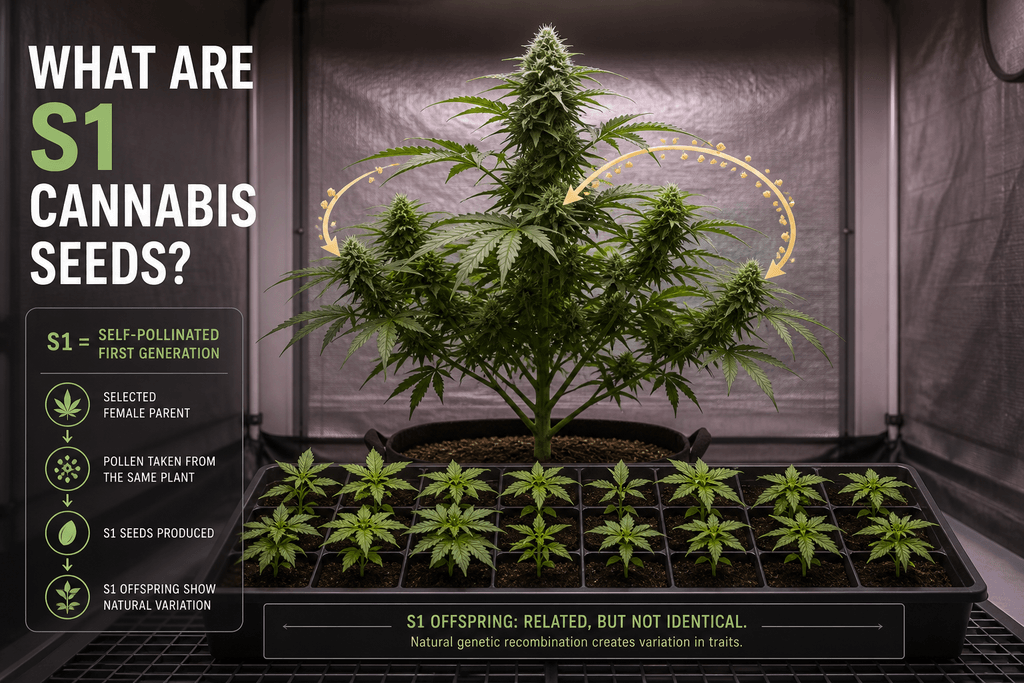
S1 cannabis seeds are the first selfed generation produced when a plant is fertilized with pollen carrying the same genotype, usually by applying pollen from a sex-reversed clone to the original female clone or an identical clone. S1 offspring can reveal and fix some hidden alleles from the parent, but they aren’t genetic copies and may show substantial variation.
What the S1 Label Means
The S stands for selfed and the 1 identifies the first selfed generation. In a typical cannabis S1 project, a selected female genotype is cloned. One copy is induced to form pollen, and that pollen fertilizes the original genotype or another clone of it. Because both gametes come from the same genetic individual, the cross is a self.
This differs from an F1, which results from crossing two distinct parents. It also differs from cloning, because seed formation includes meiosis and recombination. The site’s tissue-culture propagation guide covers preservation of a selected genotype without creating sexually recombined offspring.
Why S1 Offspring Aren’t Identical to the Parent
A cannabis parent can carry different alleles at many locations in its genome. Selfing reshuffles those alleles. For a simple locus where the parent is heterozygous, offspring may inherit two copies of one allele, one of each, or two copies of the other. Across the whole genome, that creates a range of related but distinct S1 genotypes.
Selfing tends to increase homozygosity, which can make some traits more consistent while exposing recessive alleles that weren’t obvious in the parent. Those recessive combinations may be desirable, neutral, or harmful. A controlled study of selfed cannabis generations discusses S1 and later selfing in the context of line development and hybrid vigor; see the HortScience breeding study.
Are S1 Seeds Feminized?
S1 seed made with pollen from a genetically female plant is generally produced as feminized seed because the cross doesn’t introduce a Y chromosome from a male parent. Still, the label doesn’t guarantee perfect sex stability. A responsible breeder evaluates intersex expression across the S1 population and under realistic environmental stress.
If you’re comparing the practical uses of different seed-sex formats, review the benefits and drawbacks of feminized versus regular seeds. S1 describes the breeding relationship; feminized describes the expected sex outcome.
Why Breeders Produce S1 Seeds
- To preserve a useful representation of a clone-only genotype in seed form
- To expose recessive traits carried by the parent
- To increase homozygosity for selected alleles
- To create material for selection and later line development
- To evaluate how much useful or harmful variation the parent carries
S1 seed can be valuable, but it isn’t a sealed copy of the mother. If the exact phenotype must be retained, preserve the clone directly and store seed as related breeding material. The site’s personal seed-bank workflow can help organize seed lots, while clonal preservation requires a separate identity and health system.
For a buyer, the useful question is not simply whether the seeds are S1. Ask whether you want related variation to select through or a reliably close recreation of a named parent. An S1 population can serve the first goal, but only population records can show how closely it serves the second.
What to Evaluate in an S1 Population
- Germination and vigor: record weak seedlings instead of quietly excluding them from the story.
- Uniformity: measure flowering time, architecture, and other target traits across the full population.
- Recessive problems: watch for reduced vigor, abnormal growth, or undesirable expressions.
- Sex stability: inspect plants throughout flowering and under normal production stresses.
- Chemotype: use laboratory testing rather than assuming offspring match the parent’s profile.
- Repeatability: rerun selected candidates from clones before making strong claims.
Common Misunderstandings
- “S1 means clone in seed form.” It doesn’t; S1 offspring are recombined individuals.
- “S1 means stable.” Stability depends on the parent, target traits, and testing.
- “Every hidden trait becomes fixed.” Selfing changes allele frequencies, but outcomes vary across loci and offspring.
- “Feminized means intersex-proof.” Sex type and sex stability aren’t the same claim.
The broader explanation of what feminized cannabis seeds are provides the starting context, but S1 seed deserves its own pedigree and population data.
How to Judge an S1 Seed Claim
S1 seeds are first-generation selfed offspring from one selected genotype. They can preserve useful alleles, expose recessive variation, and support line development, but they won’t reproduce the parent as identical plants. Treat S1 as a breeding-generation label and ask for evidence about the population’s uniformity, health, chemotype, and sex stability.