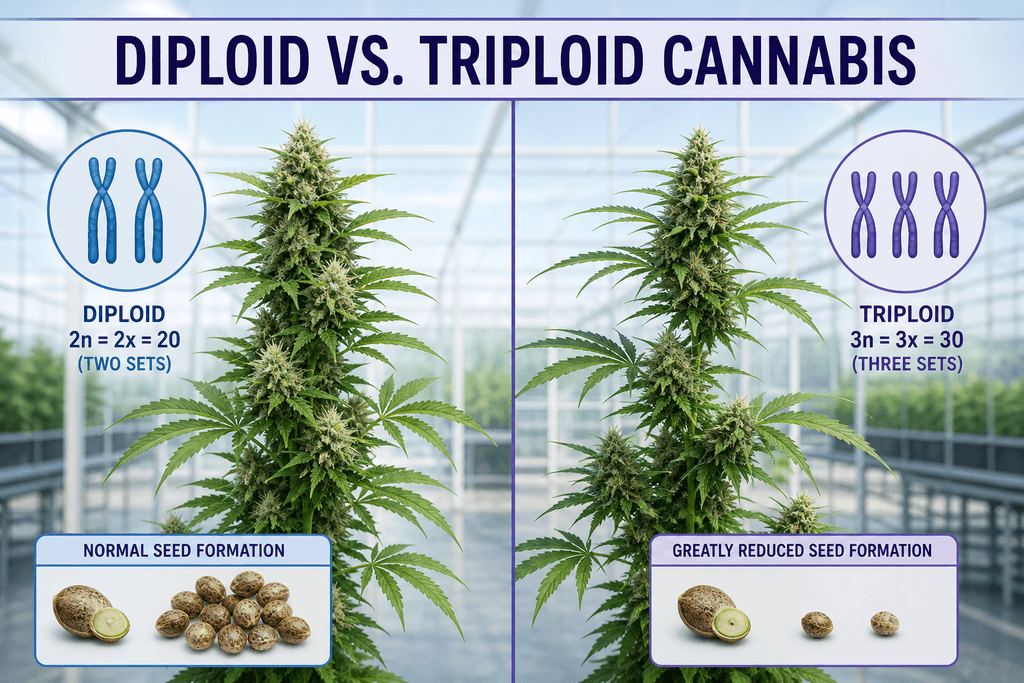
Diploid cannabis normally has two sets of chromosomes, while triploid cannabis has three. The odd chromosome number disrupts normal meiosis and usually reduces fertility substantially, which can make triploids useful where seed formation from stray pollen is a concern. Reduced fertility isn’t the same as guaranteed sterility, and triploid plants still need direct performance testing.
What Ploidy Means
Ploidy describes how many complete chromosome sets a cell carries. Typical Cannabis sativa is diploid, commonly written as 2n = 2x = 20. A triploid has three chromosome sets, commonly 2n = 3x = 30. Tetraploids have four sets and are often used as one parent in making triploid seed.
These categories describe chromosome number, not quality, potency, sex, or flowering type. A triploid isn’t automatically feminized, autoflowering, high-yielding, or resistant to disease.
How Breeders Produce Triploid Cannabis
A common route is to create a tetraploid parent and cross it with a diploid parent. The tetraploid can contribute a gamete with two chromosome sets, while the diploid contributes one, producing triploid offspring. Because inducing and confirming polyploidy requires specialized methods, triploid seed production belongs in a controlled breeding program rather than an informal grow-room experiment.
Researchers use tools such as flow cytometry and chromosome counts to confirm ploidy. Appearance alone isn’t dependable. A primary study comparing diploid, triploid, and tetraploid versions of an F1 hemp cultivar documented chromosome numbers, crossing compatibility, fertility, and yield; see the triploid hemp study.
Why Triploids Usually Produce Fewer Seeds
During meiosis, chromosome sets must pair and separate into gametes. Two sets can divide comparatively evenly, but three sets create irregular pairing. Many resulting gametes are unbalanced and nonviable, so seed production is greatly reduced.
In the cited study, triploid females produced less than 2% of the seed yield observed in diploid females under the tested crosses. That’s strong evidence for reduced fertility in that material, but it doesn’t justify saying every triploid is absolutely sterile in every environment and crossing situation.
Potential Advantages of Triploid Cannabis
- Greatly reduced seed formation after unintended pollination
- Lower risk of viable offspring escaping from a production field
- A distinct breeding tool for managing fertility
- Possible changes in morphology or chemistry that can be evaluated as traits
Polyploidization can change cell size, growth, rooting, fertility, and secondary metabolism, but effects aren’t uniformly beneficial. Earlier cannabis research on polyploidization for genetic improvement found several altered traits, including reduced rooting success in the tested polyploid material. That is why ploidy should be treated as one biological variable, not a performance guarantee.
Important Limitations
- Triploid doesn’t mean pollen-proof. Reduced seed set lowers risk but doesn’t remove the need for pollen management.
- Propagation may differ. Rooting and vigor must be tested in the actual cultivar.
- Claims need confirmation. Ploidy should be verified by an appropriate laboratory method.
- Performance is genotype-dependent. Chromosome number alone doesn’t predict cannabinoid profile, yield, or quality.
- Breeding use is constrained. Low fertility makes triploids poor choices when the goal is to save and reproduce seed.
How Triploids Compare With Familiar Seed Labels
Ploidy and seed-sex labels answer different questions. Feminized cannabis seeds are produced to strongly favor female offspring, while triploid describes chromosome sets. Male and female seed outcomes concern sex expression, not ploidy. A commercial seed lot could combine more than one of these attributes, but each claim needs its own evidence.
When Triploid Seed Fits the Goal
Triploid seed is most relevant when avoiding seed formation has unusual production value and the supplier has line-specific fertility and performance data. It is a poor fit when you plan to reproduce the crop from saved seed, when dependable clonal propagation has not been demonstrated, or when the purchase rests only on broad promises of greater potency or yield. In those cases, chromosome count doesn’t resolve the decision you actually need to make.
Questions to Ask Before Using Triploid Seed
- Was the seed lot’s ploidy confirmed, and by what method?
- What fertility tests were performed with this specific line?
- How did the line perform in the target environment?
- Were rooting, flowering time, yield, and chemistry compared with a diploid control?
- Does the production plan depend on saving seed later?
The Decision in Plain Language
Diploid cannabis has two chromosome sets; triploid cannabis has three and is usually far less fertile. That can be valuable in seed-sensitive production, but triploidy isn’t a universal upgrade or a promise of complete sterility. Verify ploidy, examine line-specific trial data, and keep ordinary pollen controls in place.