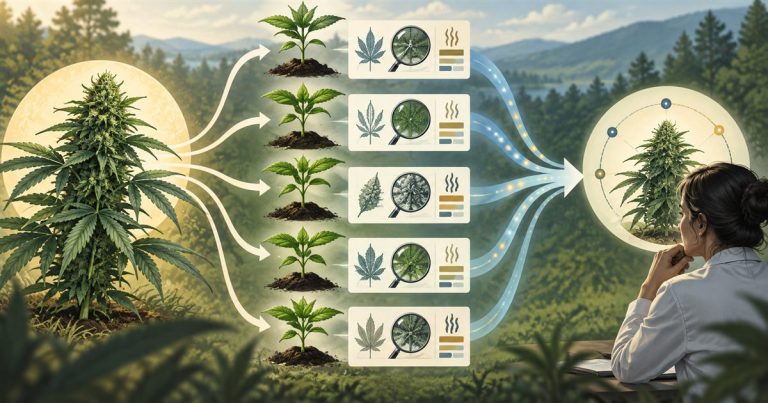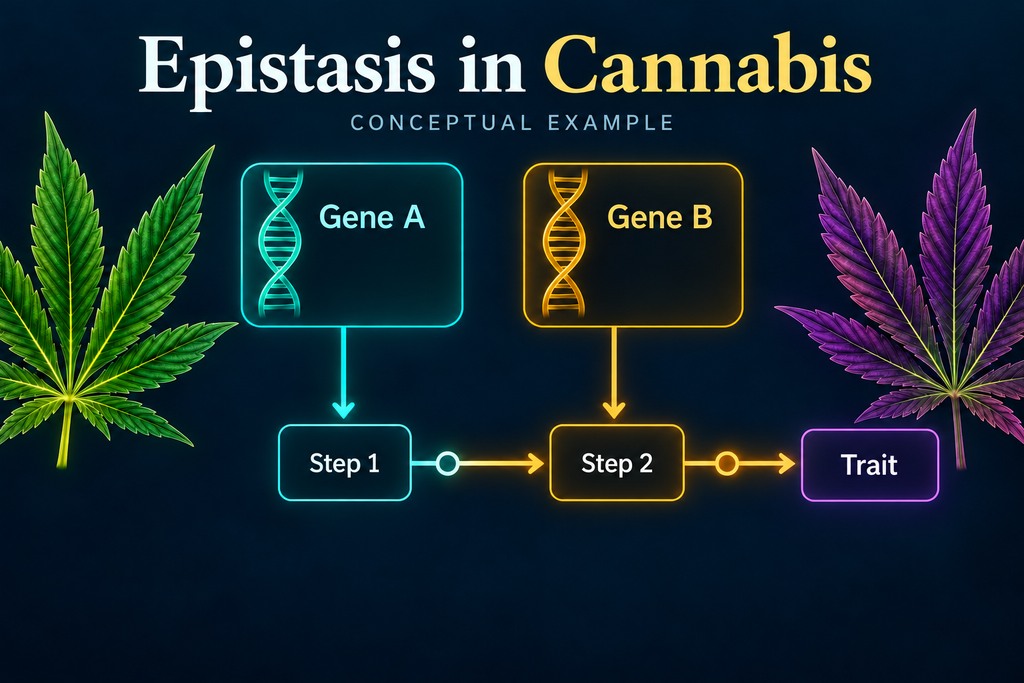
Epistasis is an interaction in which the effect of a gene depends on one or more other genes. In cannabis breeding, that means an allele that looks useful in one genetic background may behave differently after a cross. The practical question is whether the combination, rather than either allele alone, explains the trait you’re measuring.
Why an Allele Can Behave Differently After a Cross
Epistasis concerns interactions between loci, which are positions in the genome. Dominance concerns the relationship between alleles at the same locus. These aren’t interchangeable explanations, and a trait that fails to follow a simple ratio doesn’t establish either one by itself.
The NHGRI definition of epistasis includes one gene modifying another gene’s expression. In practice, researchers also test statistical interactions: does the measured effect of one variant change across genotypes at another locus? A statistical interaction can suggest a biological relationship, but it doesn’t automatically reveal the mechanism.
If you’re starting from a dominant-recessive prediction, first check the assumptions behind Mendelian inheritance. A misidentified parent or an inconsistent phenotype score can create an apparent exception without a new genetic explanation.
A Combination Can Matter More Than the Separate Scores
Consider a hypothetical pigment pathway. One locus affects pigment production and another affects its transport into the tissue you score. An allele that increases production won’t necessarily deepen visible color if transport is blocked. You might miss the production allele’s contribution by measuring it only in that blocked background.
This is an illustration, not evidence that those two particular loci control cannabis coloration. To test that possibility, compare the relevant genotype combinations under comparable conditions. Measuring the production allele in only one background wouldn’t tell you whether it works in another.
Gene interactions also depend on how you measure the outcome. An interaction on a percentage scale may differ from one on a transformed scale, so the phenotype definition and analysis model belong with the result.
What Would Support an Epistasis Claim?
A useful claim names the loci, the genotype combinations, the measured trait, the population, and the conditions. It also shows that the interaction improves explanation beyond the separate main effects. Sparse genotype groups and testing many pairs can make a striking finding less reliable than it appears.
A mapped region isn’t a confirmed interacting gene. The distinction matters when interpreting a quantitative trait locus: nearby variants may be tracking the same inherited segment rather than independently causing the response.
How to Check a Suspected Interaction
- Define the phenotype before comparing groups. Use the same tissue, developmental stage, measurement method, and units.
- Confirm identity and genotype quality. Retain parentage, sample labels, missing-call rates, and assay limitations.
- Count each genotype combination. Report thin or absent groups rather than treating them as strong comparisons.
- Compare a main-effects model with an interaction model. Have a qualified quantitative geneticist choose an appropriate method and account for relatedness and multiple testing.
- Test the finding in another relevant population. Replication should include the background where you intend to select, not merely more plants from the discovery family.
- Record where the finding holds. Keep the trait definition, backgrounds tested, uncertainty, and validation result attached to the claim.
Keep Environmental Explanations in View
If the same genotype performs differently across environments, the first question may concern genotype-by-environment interaction. Epistasis and environmental sensitivity can coexist, but a changed growing condition isn’t proof of a gene-by-gene interaction.
For your next breeding decision, treat an epistasis finding as a reason to preserve and test the relevant combinations. Don’t discard a parent or promise a predictable seed outcome from an interaction discovered in one small family. Before using it to select parents, ask whether the interaction has been checked in the background you plan to use. If it hasn’t, that comparison comes first.