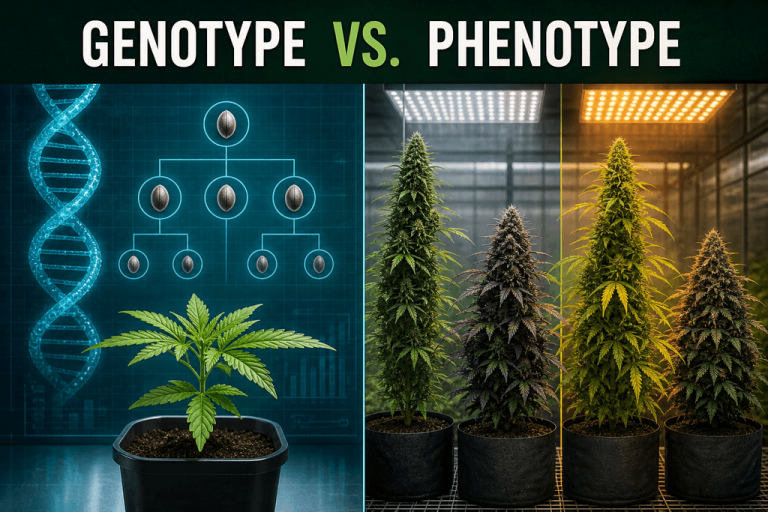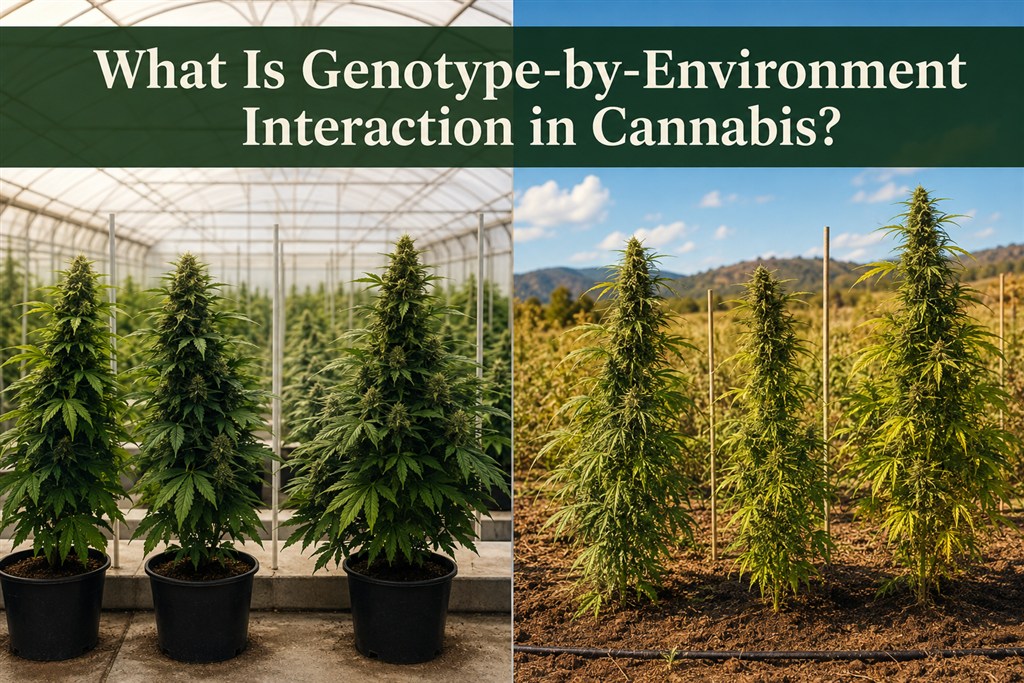
Genotype-by-environment interaction in cannabis, written G×E, occurs when different genotypes respond differently to changes in environment. It is more than every plant growing better in a good room and worse in a poor one. G×E matters when the size—or even the order—of the differences among genotypes changes across locations, seasons, or controlled conditions.
For a breeder or grower, the consequence is direct: the plant that ranks first in one environment may not rank first in another.
Environment and G×E Are Not the Same Effect
An environmental effect shifts many plants in a similar direction, such as reduced growth during a cold period. A genotype-by-environment interaction appears when genotypes shift by different amounts. One line may remain relatively stable while another gains greatly in one environment and loses greatly in another.
The site’s article on genotype and phenotype explains the basic relationship. G×E takes the next step by comparing several genotypes across several environments instead of interpreting one plant in one setting.
What Counts as an Environment?
- Location and latitude
- Year or season
- Photoperiod and light intensity
- Temperature and humidity pattern
- Soil, substrate, irrigation, and fertility program
- Disease, pest, or other stress pressure
- Greenhouse, indoor room, or outdoor field management
A multi-environment hemp study found that seed yield reflected genotype, environment, and their interaction, making stability testing necessary before recommending a cultivar broadly. Another open study of hemp flowering, morphology, and fiber traits quantified genetic, environmental, and G×E components rather than treating cultivar performance as context-free.
Two Types of Breeding Value
A breeder may want broad adaptation or specific adaptation. Broadly adapted material performs acceptably and consistently across a target range. Specifically adapted material performs especially well in a narrower environment, even if its ranking falls elsewhere.
Neither objective is automatically better. The correct choice depends on where seed will be used. A controlled indoor line may prioritize repeatability under a narrow production system, while a regional outdoor population may need stability across variable seasons. Landrace populations provide useful context for how long-term local selection can shape environmental adaptation without guaranteeing uniform performance.
A Practical Multi-Environment Workflow
- Define the target environment set. Include the conditions the future population is actually expected to face.
- Use the same genotypes or connected families. Clones, common checks, or well-designed family structures help comparisons remain connected.
- Standardize measurements. Record traits at consistent stages and use the same protocols.
- Replicate within environments. Separate local noise from repeatable response.
- Compare both mean and stability. A high average can hide severe environment-specific failure.
- Inspect rank changes. Crossovers often matter more operationally than small scale differences.
- Validate the next generation. Confirm that the selection decision survives new seed and a new cycle.
The process resembles a more controlled version of phenotype hunting, but its unit of judgment is the response pattern across environments, not the most attractive plant in one room.
Avoid Universal Claims From One Trial
One successful trial can show that a genotype performed well under those conditions. It cannot establish broad stability, climate adaptation, or superiority everywhere. Likewise, one failure may reveal poor fit rather than universally weak genetics.
A Working Decision Rule
Test G×E whenever a breeding claim will be used beyond the environment in which it was discovered. Decide in advance whether the goal is broad stability or specific adaptation, then measure the same genotypes across a defensible target set. If a performance claim has no environmental boundary, assume the evidence is incomplete.