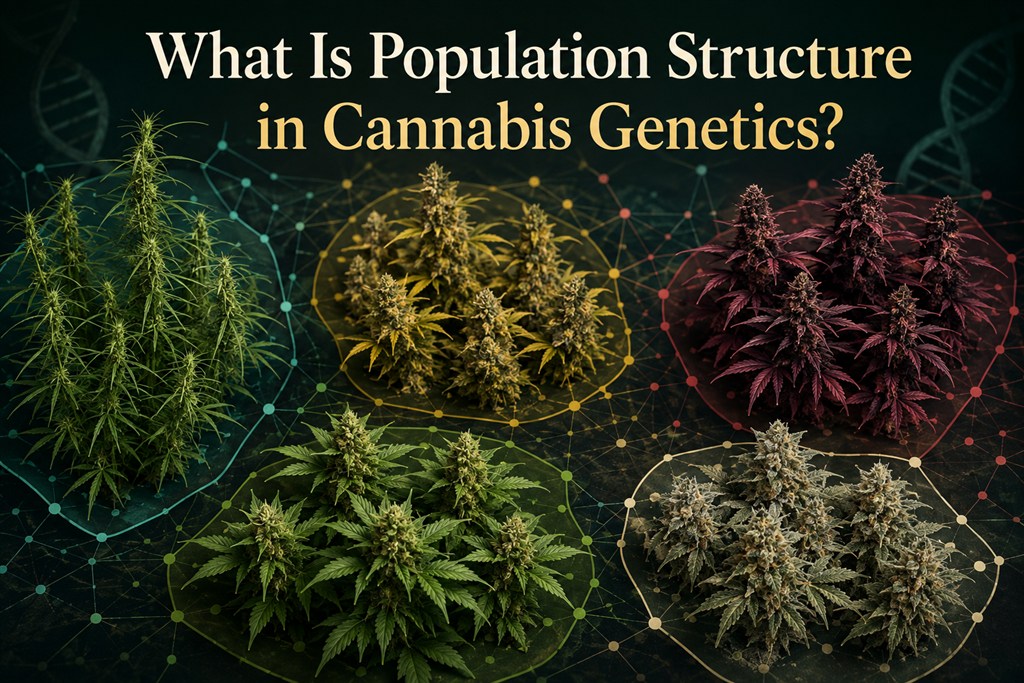
Population structure in cannabis genetics is the presence of genetically differentiated groups within a larger sample. Those groups may reflect geography, breeding history, market selection, ancestry, or a narrow founder population. Structure matters because apparent marker-trait relationships can actually be ancestry relationships unless the analysis separates the two.
The practical warning is straightforward: a population is not one random pool merely because every sample is labeled Cannabis sativa.
How Population Structure Forms
- Geographic separation limits gene flow and allows regional allele frequencies to diverge.
- Human selection favors different fiber, seed, flowering, architecture, or chemical traits in different breeding groups.
- Founder effects occur when a new population begins with a small subset of available diversity.
- Repeated related crossing concentrates ancestry within a breeding line.
- Introgression moves parts of one population into another through crossing and selection.
Large genomic studies have found clear structure among hemp, drug-type, landrace, and feral cannabis accessions while also showing admixture and complicated naming. A widely cited open study of the genetic structure of marijuana and hemp found that common commercial labels did not always reflect measured genetic identity. More recent work on feral U.S. Cannabis sativa germplasm reported regional differentiation, diversity patterns, and cannabinoid-related allele frequencies.
Why Structure Can Confuse Trait Mapping
Suppose one ancestry group is generally taller and also carries a particular marker more often. A simple analysis may associate the marker with height even if the marker itself has no functional role. The marker is identifying ancestry, and ancestry carries many differences at once.
Genome-wide association studies therefore estimate relatedness and population structure before claiming a marker-trait relationship. The site’s marker-assisted selection article explains why a marker must be validated in relevant germplasm before it guides selection.
What Structure Means for a Breeding Program
Population structure can be useful. It helps a breeder choose genetically differentiated parents, preserve underrepresented diversity, avoid accidental family concentration, and build mapping panels with intentional breadth. It can also reveal that two differently named sources are closely related or that one label contains several genetic groups.
The concept connects to both landrace cannabis seeds and open-pollinated populations. Geographic history can create structure, while population management determines whether that diversity is maintained, mixed, or narrowed.
A Practical Structure Audit
- Document provenance. Record source, generation, geography, breeder history, and known crosses.
- Sample broadly. One plant cannot represent the diversity within a seed lot or population.
- Use genome-wide markers. A few trait markers cannot describe overall relatedness reliably.
- Visualize several models. Principal components, ancestry estimates, and relationship matrices answer related but different questions.
- Check sensitivity. Cluster boundaries can change with sampling, marker filters, and model assumptions.
- Connect structure to the decision. Parent choice, conservation, association mapping, and identity testing require different thresholds.
Labels Are Hypotheses, Not Genomic Proof
A cultivar, regional, indica, sativa, hemp, or market label may carry useful historical or practical context, but it shouldn’t be treated as a complete genomic classification. The genomic sample, reference panel, and question being asked determine what structure can support.
Likewise, genetic distance does not establish quality. A distant parent may add diversity and unwanted traits at the same time; a close parent may be appropriate for a narrow line-development goal. Structure informs the choice—it doesn’t make the choice for the breeder.
A Working Decision Rule
Assess population structure before using a mixed cannabis panel for association mapping, diversity claims, or parent selection. Record who was sampled, how ancestry was estimated, and how structure affected the final decision. If a conclusion depends only on cultivar names or market categories, treat it as a starting hypothesis rather than verified genetic identity.