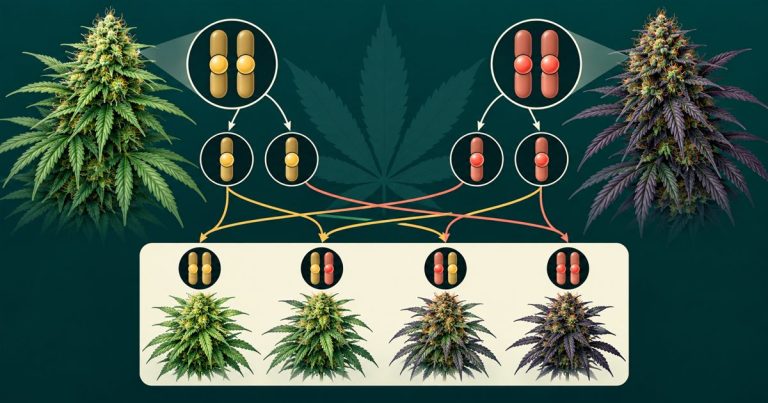
Genotype imputation in cannabis genetics is the statistical inference of marker states that weren’t directly observed. It can fill sporadic missing calls or project a low-density genotype panel onto a denser marker set by comparing the sample with a suitable reference panel. Imputed genotypes are estimates, not new laboratory measurements, so their quality must be tested before they support association mapping or selection.
How Imputation Works
Nearby variants are often inherited together as haplotypes. Imputation methods use those shared chromosome patterns, allele frequencies, relatedness, and sometimes pedigree information to infer missing states. A candidate that matches a reference haplotype at observed markers may be assigned probabilities for unobserved markers between them.
The output may be a dosage or probability rather than a hard genotype call. Converting every probability into a definite call can erase the uncertainty the method was designed to preserve.
Why Cannabis Reference Choice Matters
Imputation depends on the relationship between the reference and target samples. A panel built from one narrow breeding population may not represent haplotypes in a different hemp, drug-type, landrace, or admixed population. Population structure, marker order, genome build, and allele coding can all affect performance.
The reference genome is also part of the provenance. Marker coordinates from different assemblies can’t be merged safely merely because their chromosome labels look similar.
A Safe Imputation Workflow
- Harmonize the data. Confirm genome build, marker position, strand, allele labels, and sample identity.
- Filter direct genotypes. Address low call rate, duplicate discordance, impossible inheritance, and obvious sample contamination first.
- Choose a relevant reference. Document ancestry, sample size, marker density, and relationship to the target population.
- Mask known calls. Hide a representative subset of observed genotypes, impute them, and compare predictions with the truth.
- Measure by frequency class. Common-variant accuracy can hide poor performance on rare alleles.
- Apply quality thresholds. Retain probabilities or dosage metrics and exclude weakly imputed markers from downstream decisions.
- Revalidate downstream results. Confirm important associations or selection markers with direct genotyping in an independent set.
What Accuracy Should Mean
A high percentage of correct calls can be misleading when the major allele is very common. A method could assign that allele to everyone and appear accurate while failing on the variants that matter. Useful evaluation includes correlation or dosage accuracy, concordance by allele frequency, and performance within ancestry or family groups.
Common Uses and Boundaries
- combining compatible datasets genotyped at different densities;
- reducing genotyping cost when a representative high-density reference exists;
- preparing a complete marker matrix for genomic prediction;
- increasing marker coverage for discovery analysis.
Imputation can’t repair a mislabeled sample, an incorrect coordinate build, or a missing haplotype in the reference. It should never turn a SNP association into a causal claim by itself.
The Record to Keep
For every imputed dataset, retain the target and reference populations, genome assembly, software and version, parameters, pre-imputation filters, masked-call test, quality metric, threshold, and number of markers retained. That record lets another researcher distinguish direct evidence from inferred data and decide whether the dataset is fit for the next analysis.