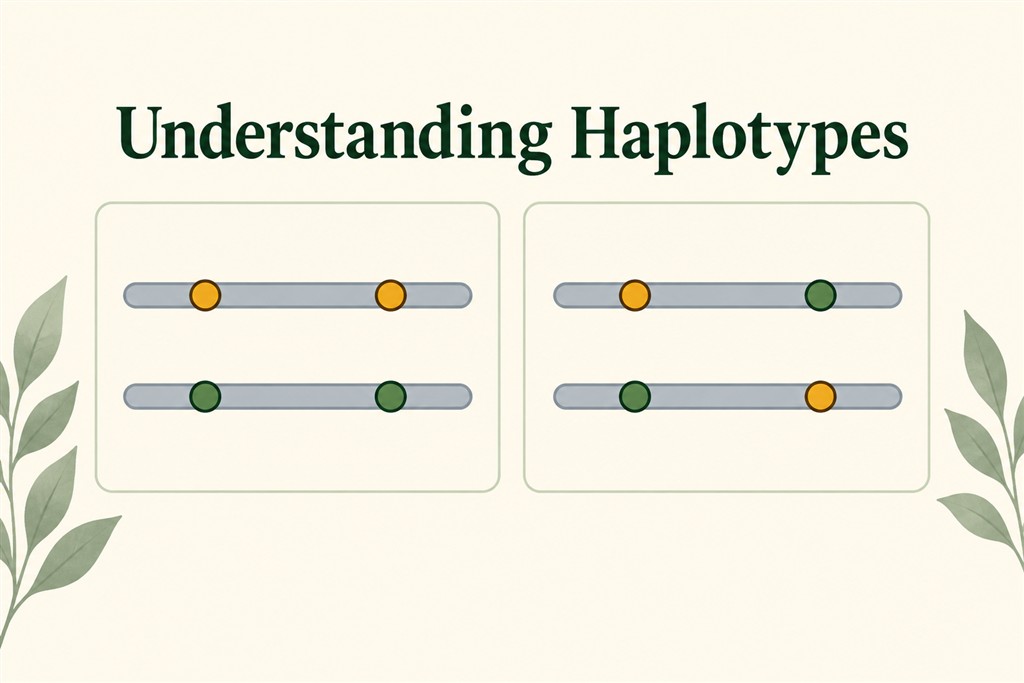
A haplotype is a group of DNA variants carried together along one chromosome copy. In cannabis research, it helps answer a question that a list of variants may leave open: which changes sit together on the same copy? Knowing that arrangement adds information, but it doesn’t by itself predict a plant’s characteristics.
If you’ve looked at a report and thought it already showed the whole genetic picture, this distinction can feel unnecessarily technical. It becomes much clearer when you draw the two copies separately.
The Same Genotype Can Hide Different Arrangements
Consider two sites on a paired chromosome segment in a simplified diploid example. At the first site the reported letters are A/G, and at the second they’re C/T. Both of these arrangements fit that report:
- One copy carries A–C, and the other carries G–T.
- One copy carries A–T, and the other carries G–C.
The letters at each site haven’t changed, but their same-copy combinations have. An unphased genotype doesn’t necessarily tell you which arrangement is present. Phasing is the work of resolving that arrangement.
The two-copy example is a teaching illustration, not a universal description of every cannabis sample. If a paper involves a different chromosome-set count, first clarify its diploid or triploid context. Otherwise, the drawing you’re using to interpret the result may start with the wrong assumption.
Why Researchers Keep the Copies Separate
The NHGRI explanation of haplotypes describes variants that tend to be inherited together. A haplotype may cover a short region or a larger stretch containing multiple genes. It isn’t another name for an entire named strain.
In cannabis genetics, keeping chromosome copies separate helps researchers describe variation without collapsing different sequences into one representation. A 2026 cannabis genome resource explicitly reports haplotype-resolved assemblies. That tells you how the resource represents chromosome copies; it doesn’t certify the biological effect of every difference it contains.
Nor does “inherited together” mean inseparable forever. Recombination can change combinations across generations. Treat a haplotype as a description tied to a region and an analysis, rather than a permanent package of promised traits.
Check What a Report Actually Resolved
Start with the methods or figure legend and look for three details:
- The region: which chromosome segment and reference version does the reported haplotype cover?
- The basis for phasing: was the arrangement supported by sequencing reads, family information, statistical inference, or a combination?
- The uncertainty: does the report describe unresolved regions or confidence limits?
You don’t need to choose a laboratory method to ask these questions. You’re checking whether the interpretation depends on information the report actually provides. If it only lists genetic markers at separate sites, don’t silently join them into a same-copy sequence.
Use the Arrangement for the Question It Answers
A phased result tells you more about how variants are arranged. Evidence about how a genotype relates to phenotype is a further question, and it needs its own measurements and support.
For your next report, sketch two lines and place only the variants whose arrangement is actually resolved. Leave uncertain positions marked as uncertain. That small habit makes the missing information visible and gives you a precise question for the author or a genetics specialist: “What evidence places these variants on the same copy?”