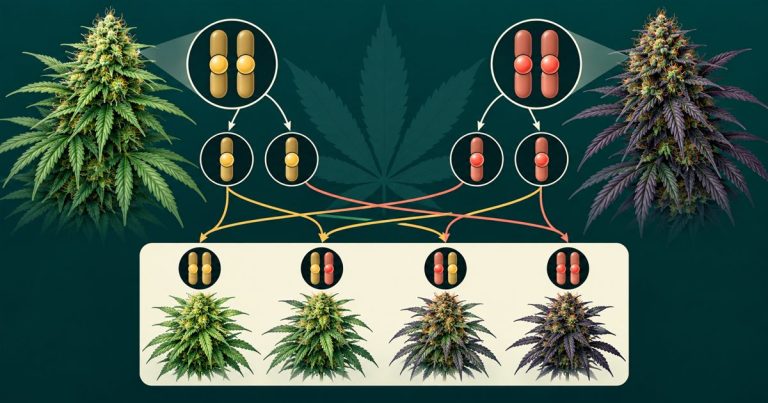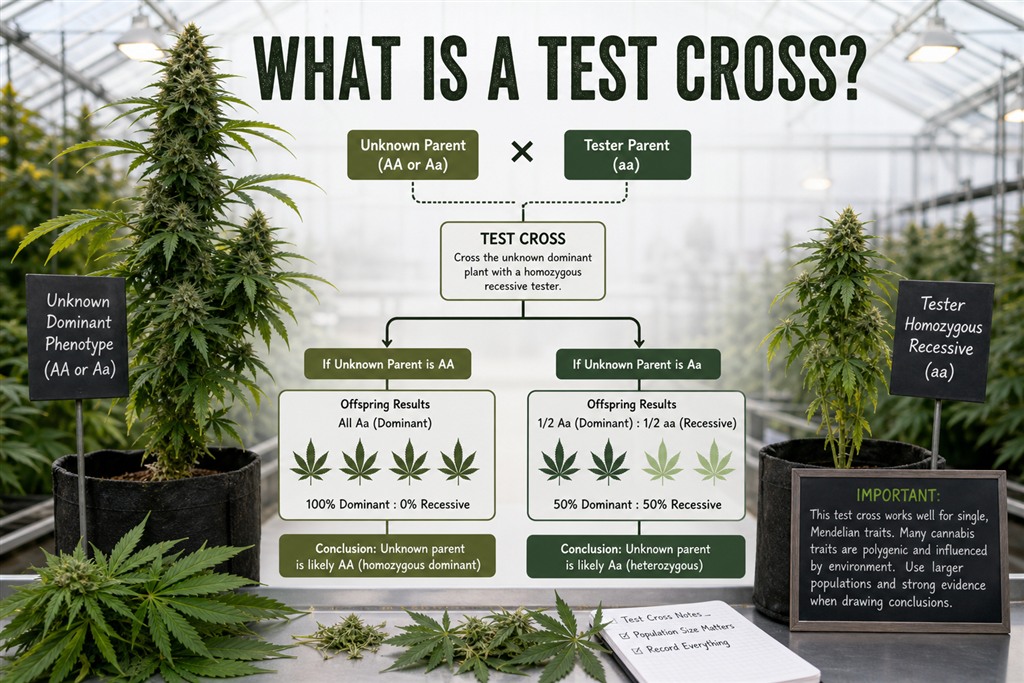
A test cross in cannabis breeding mates an individual with an unknown genotype to a tester carrying a known genotype, classically a homozygous recessive one. The offspring can reveal which allele the unknown parent contributed. The method is powerful for a simple, well-defined trait, but most commercially important cannabis traits are too complex to interpret from one small family and a neat Mendelian ratio.
A test cross helps you narrow down the possible genotypes of a parent. It doesn’t “prove the genetics” of a whole plant; it answers a specific inheritance question under a defined model.
The Classic Test-Cross Logic
Suppose a dominant-looking plant could be AA or Aa for one gene, and the tester is aa. If all sufficiently numerous offspring show the dominant trait, AA becomes more likely. If dominant and recessive offspring appear near a 1:1 ratio, the unknown parent is consistent with Aa.
That logic depends on important assumptions:
- one major gene controls the observed distinction;
- dominance is understood correctly;
- the phenotype can be scored accurately;
- the tester really is homozygous recessive;
- the sample is large enough to interpret; and
- environmental effects don’t obscure the classes.
Where Cannabis Makes the Method Harder
Plant height, yield, aroma, flowering time, stress resistance, and many chemical traits can involve multiple genes and environmental effects. A binary “good or bad” score flattens that complexity and can make an offspring group look more decisive than it is.
The site’s guide to genotype and phenotype explains why the same genotype can look different across environments. For complex traits, a test cross becomes one part of a larger evidence packet rather than a stand-alone answer.
A Cannabis Example With a Stronger Genetic Foundation
Cannabinoid chemotype offers a useful historical example because controlled crosses and F2 populations helped researchers test a major-locus model. The study on CBD and THC chemical-phenotype inheritance connected observed chemical classes with alleles and linked markers. Its strength came from pedigrees, chemical analysis, and population results—not from judging one plant by smell or appearance.
Modern genetic markers can add evidence, but they also need validation in the population where they’ll be used. The site’s overview of high-CBD genetic markers shows why a marker is evidence about inheritance, not a replacement for chemical testing.
How to Design a Useful Test Cross
- State the genetic question. Name the exact trait and the competing genotypes.
- Validate the tester. Confirm the tester’s genotype or establish it through a reliable pedigree and prior progeny data.
- Make and label the cross cleanly. Control pollen, preserve parent identity, and prevent accidental contamination.
- Choose a sample size before seeing results. Small families can miss a recessive class by chance.
- Define the scoring method. Use objective measurements or laboratory analysis when appearance isn’t enough.
- Compare the observed distribution with the model. Treat mismatches as information, not as plants to ignore.
- Repeat or validate. Confirm important conclusions with another family, environment, marker, or assay.
The USDA’s Hemp Phenotyping and Protocol Handbook is a useful model for defining traits and measurements consistently before interpreting genetic differences.
Test Cross, Backcross, and Progeny Test Aren’t Synonyms
A test cross is designed to reveal genotype through a known tester. A backcross returns offspring to a parent or parent-like recurrent line, usually to recover that background while retaining a target trait. A progeny test is the broader practice of judging a parent through its offspring. One mating can serve more than one purpose, but the terms describe different questions.
Know What the Cross Can Actually Prove
Use a test cross when the inheritance model is specific enough that offspring classes can distinguish the possibilities. If the trait is polygenic, environmentally sensitive, or poorly measured, expand the design instead of forcing a simple ratio. The next step is to write the expected outcomes before making the cross; if you can’t do that clearly, the genetic question isn’t ready for a test cross.