Mendelian inheritance describes predictable patterns that can appear when a trait is strongly influenced by one gene with distinguishable alleles. The framework is useful in cannabis genetics, but many traits growers and breeders care about aren’t controlled by one simple dominant-recessive pair.
What Segregation Means
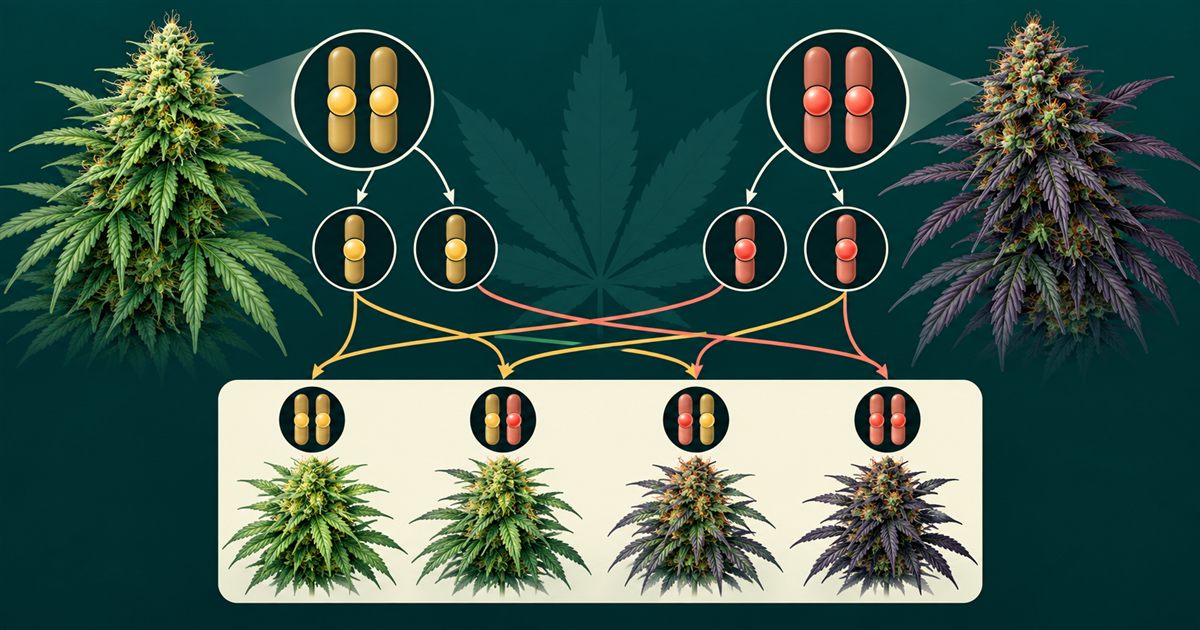
In an ordinary diploid example, an individual carries two copies of a gene—one inherited from each parent. Those copies separate during gamete formation, so each gamete receives one allele. Fertilization combines one allele from each parent in the offspring.
A Punnett square lists possible combinations under stated parental genotypes. It predicts expected proportions across many offspring under the model. It doesn’t guarantee the outcome of a particular seed or a small family.
Dominant Does Not Mean Better or More Common
A dominant allele affects the observed trait when one copy is present under the relevant conditions. Recessive means two copies are generally needed for that modeled phenotype. Neither word tells you whether the allele is beneficial, frequent, strong, or commercially desirable.
The terms also describe the relationship for a specific trait definition. One allele can show dominance for one measurement while other effects remain additive, incomplete, context dependent, or unknown.
Use a Test Cross for a Narrow Question
If an individual shows a dominant phenotype, appearance alone may not reveal whether it carries one or two copies of the dominant allele. The site’s explanation of test crosses in cannabis breeding shows how offspring can provide evidence about that hidden genotype under a simple inheritance model.
The model must fit before the ratio means anything. Misclassified phenotypes, small family size, viability differences, pollen contamination, and more complex genetics can all disturb a textbook expectation.
When a Mendelian Model Is Too Simple
- Several genes contribute to the measurement.
- Environmental conditions shift the phenotype.
- Alleles show incomplete dominance or codominance.
- Genes interact with one another.
- The phenotype is recorded inconsistently or at the wrong stage.
For continuously varying outcomes, start with the site’s article on quantitative traits. For differences between inherited sequence and observed outcome, review genotype versus phenotype.
A Ratio Is a Hypothesis Check, Not a Verdict
Suppose a cross is expected to produce two phenotypic classes in a 3:1 ratio. Rather than expecting a small family to match the ratio perfectly, ask whether the observed counts are reasonably compatible with the model given the sample size and study design. Statistical testing may be needed, and an apparent mismatch can point to either biology or a problem with the assumptions.
How to Read the Claim Responsibly
Write down the proposed gene, alleles, parental genotypes, phenotype definition, expected offspring pattern, observed counts, and alternative explanations. If the source skips from a visible cannabis trait directly to “dominant genetics” without that evidence, the conclusion is unsupported.
Mendelian inheritance is most helpful as a precise model with testable expectations. It should clarify a narrow genetic question, not flatten complex cannabis traits into a slogan. For consequential breeding decisions, have a qualified geneticist or plant breeder review the model and family data.