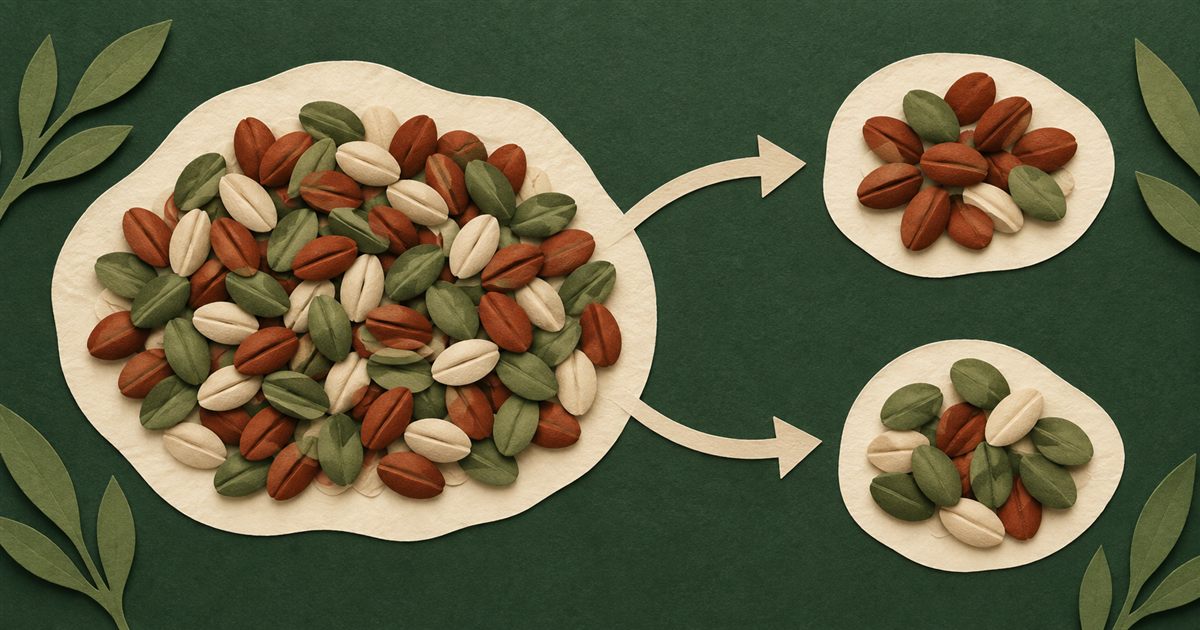
Genetic drift is random change in allele frequencies from one generation to the next. In cannabis breeding or seed preservation, drift matters most when only a small, unrepresentative set of plants contributes to the next generation. The change can happen without any allele being more useful or better adapted.
Chance Can Change a Population
Imagine a jar containing equal numbers of green and amber tokens. If you blindly draw ten tokens to represent parents, the colors probably won’t remain exactly equal. Repeating that small sample over generations can make one color common or even remove the other by chance.
The tokens illustrate random sampling rather than model a real cannabis population. Selection changes reproduction according to a criterion; drift changes frequencies because the individuals that reproduce are a finite sample.
Why Small Parent Numbers Increase Drift
When many unrelated plants contribute comparable numbers of offspring, chance differences tend to average out. When very few parents contribute—or one parent contributes most of the seed—the next generation represents a narrower sample of the previous population.
The site’s overview of open-pollinated cannabis seeds explains why using multiple parents can preserve diversity. That doesn’t make an open population immune to drift: uneven flowering, pollen contribution, seed collection, or survival can still concentrate ancestry.
Drift Is Not the Same as Inbreeding
Drift and inbreeding often become more important in small populations, but they describe different things. Drift is random frequency change. Inbreeding describes mating among relatives and the resulting rise in homozygosity. A small population can experience both, which is why the terms are sometimes blurred.
Inbreeding depression concerns reduced performance associated with harmful recessive alleles becoming homozygous. Drift can remove, retain, or increase alleles without regard to whether their effects are beneficial or harmful.
A Preservation Record That Makes Drift Visible
- Record how many candidate plants were available and how many actually contributed.
- Track parent identity or family when the preservation goal requires it.
- Note whether contributions were balanced or dominated by a few plants.
- Keep generations and seed lots separate instead of pooling undocumented material.
- Document any intentional selection so it is not later mistaken for random change.
These records don’t calculate drift by themselves, but they help you check whether the next generation represents the population you meant to preserve.
How to Read a Diversity Claim
If a seed lot is described as preserving a population, ask “how many contributors, from which source generation, and with what contribution pattern?” A large final seed count doesn’t prove a large effective breeding population; thousands of seeds can descend from very few parents.
You can’t eliminate drift, but you can avoid mistaking seed descended from a few undocumented parents for a representative sample of the original population. For a formal conservation or breeding program, a population geneticist or experienced plant breeder should help set contribution targets and monitoring methods.