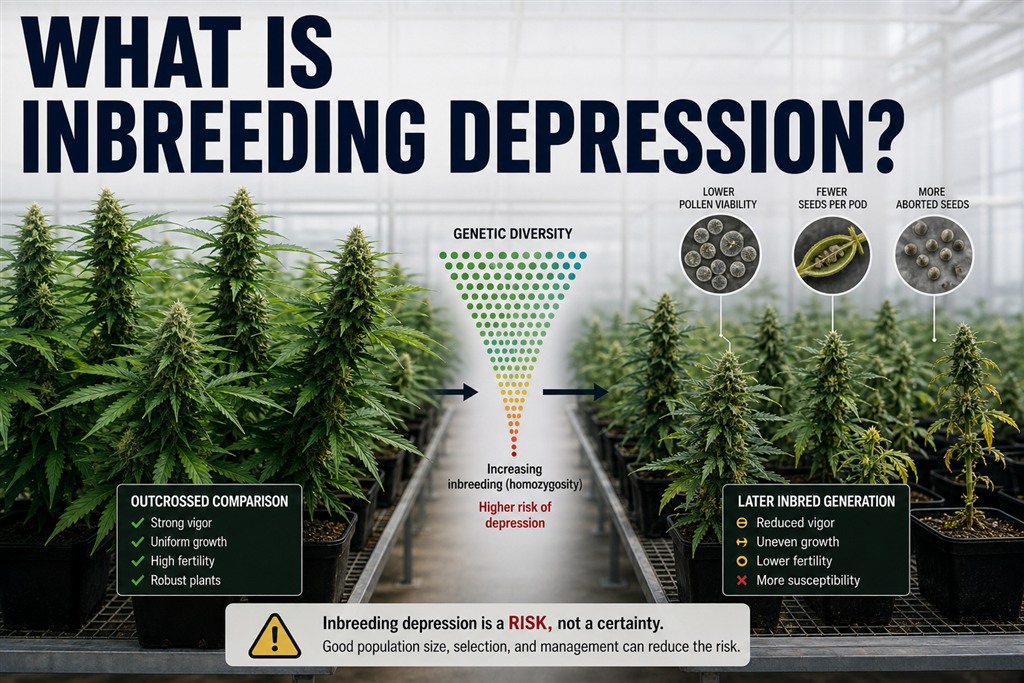
Inbreeding depression in cannabis is a decline in fitness-related performance that can appear as close mating increases homozygosity. Depending on the line, it may show up as lower vigor, reduced fertility, abnormal development, poor seed set, or weaker stress performance. It is a risk to measure, not a guaranteed fate of every inbred generation.
The practical mistake is waiting for one dramatic symptom. Breeders need a baseline and generation-by-generation records, because several modest declines can matter before a line looks obviously unhealthy.
Why Inbreeding Depression Happens
Close mating makes identical allele pairs more common. That can expose partially recessive harmful alleles that were masked in heterozygous plants. Inbreeding also reduces heterozygosity at loci where the mixed state provides an advantage. Both processes can lower fitness, although their importance differs among lines and traits.
Research on hemp hybrids has reported depression in selfed populations, while newer work shows that outcomes aren’t uniform across all cannabis material. A 2026 single-seed-descent study in Cannabis sativa documented line- and sex-system differences in fertility, floral abnormalities, and the ability to continue inbreeding.
Signals Worth Tracking
- slower or less even emergence;
- reduced vegetative growth or biomass;
- lower pollen production or viability;
- poor seed set or fewer viable seeds;
- unusual floral development;
- higher loss under ordinary environmental stress; and
- greater variation in a line expected to be stabilizing.
None of these signs proves inbreeding depression by itself. Nutrient problems, uneven roots, disease, light differences, and temperature stress can produce similar symptoms. Use the site’s guide to genotype versus phenotype to structure the comparison instead of diagnosing from appearance alone.
How to Separate Genetic Decline From Grow-Room Noise
Grow the current generation beside a retained reference whenever possible. Standardize substrate, water, light, container size, and timing. Randomize positions or rotate plants to reduce bench effects, and record the whole population rather than its best and worst members.
Then repeat the comparison. A line that performs poorly in one run may have encountered a management problem, but a consistent decline across generations and environments is stronger evidence that the breeding process is changing fitness.
Can Selection Remove the Risk?
Selection can remove some harmful combinations and retain stronger individuals, but it can’t guarantee that a narrow line will remain vigorous. Small population size can accelerate random allele loss, and selecting only for the visible target trait may preserve hidden reproductive or stress problems.
The alternative isn’t to avoid all line breeding. It is to define a minimum performance floor. If fertility, vigor, or another protected trait falls below that floor, the breeder can pause, increase population size, reconsider the mating design, or outcross deliberately. The guide to backcrossing shows one directional mating method, while open-pollinated seed illustrates a different population-maintenance goal.
A Generation-by-Generation Control Plan
- Set a baseline. Measure the starting population before narrowing it.
- Name protected traits. Include vigor and fertility alongside the trait being fixed.
- Use enough plants. Avoid making the whole line depend on one convenient survivor.
- Keep a reference. Retain seed or living material from earlier generations when practical.
- Compare under matched conditions. Separate genetic signal from environmental noise.
- Define stop rules. Decide in advance what level of decline triggers a redesign.
The Decision Isn’t “Inbreed or Don’t”
Inbreeding can help build predictable parents for true F1 hybrid programs, but predictability is useful only if the line retains enough fitness to reproduce and perform. The responsible decision is to pursue a specific breeding objective while measuring the costs at every generation.