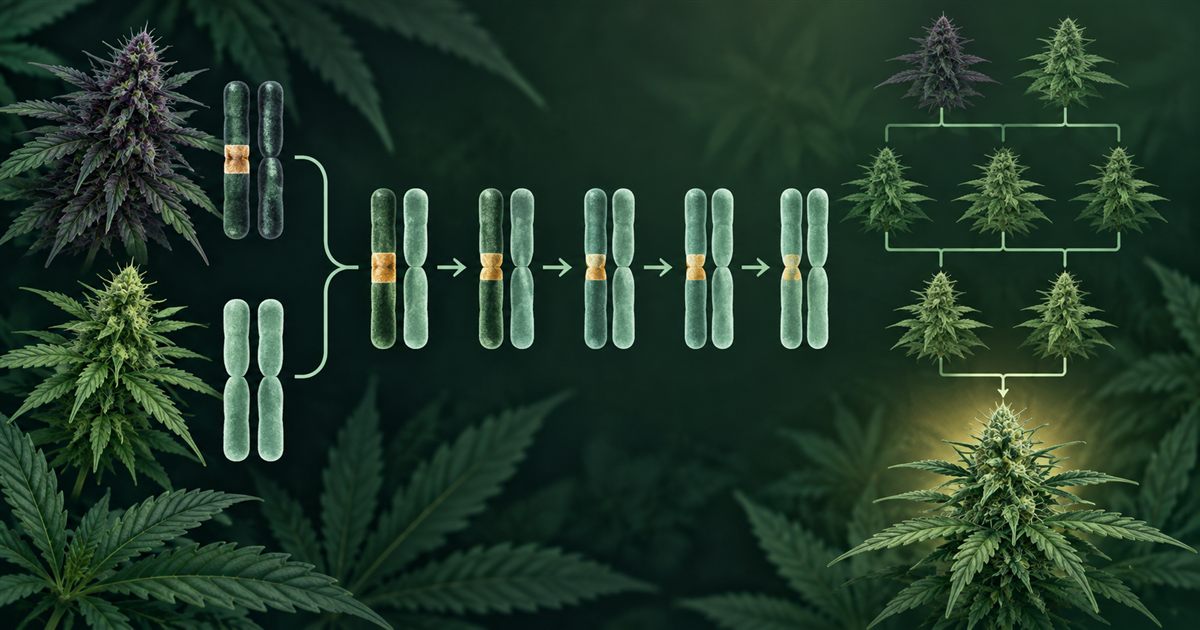
Introgression is the movement of genetic material from one population or line into another through crossing followed by repeated reproduction or backcrossing. In cannabis breeding, the word describes ancestry entering a recipient background; it doesn’t prove that a desired trait moved successfully or remained free of unwanted linked DNA.
How Introgression Differs From One Cross
A single hybrid can carry DNA from both parents, but introgression describes the longer process by which some donor ancestry persists in another population. Breeders may cross a donor with a recipient, then repeatedly cross selected descendants back to the recipient while tracking the region of interest.
The site’s article on backcrossing in cannabis breeding explains the mating pattern. Introgression is the ancestry outcome that the pattern may produce.
Donor, Recipient, and Target Region
A clear introgression claim should name three things:
- Donor: the source population or line contributing the genetic material.
- Recipient: the population or line into which that ancestry is being incorporated.
- Target: the chromosome region, marker, or phenotype being followed.
Without those roles, “introgressed genetics” can become a vague synonym for mixed ancestry. The term is most informative when the generations and evidence are documented.
Why Linkage Drag Matters
A selected marker may travel with nearby donor DNA because linked positions are inherited together. That surrounding segment can include neutral, useful, or unwanted variants. Recombination can shorten the segment over generations, but the outcome depends on the distance, population size, and selection design.
This is where linkage disequilibrium becomes practical. A marker can help track a region while still being an imperfect stand-in for the functional sequence change.
A Three-Layer Evidence Check
- Ancestry evidence: Do markers or sequence data support donor ancestry in the recipient?
- Phenotype evidence: Was the claimed trait measured under a suitable and repeated design?
- Causal evidence: Is the donor region itself shown to explain the change, or is that still a working hypothesis?
A breeding program may have strong ancestry evidence and promising phenotype observations while the causal mechanism remains unresolved. Recording those layers separately is more accurate than calling the project complete.
Do Not Treat Introgression as a Purity Claim
Introgression isn’t evidence that a line is genetically pure, superior, stable, or uniform. It also doesn’t tell you whether the introduced region will behave the same way in a new background. Genotype and phenotype remain distinct, and interactions among genes and environment can change the observed result.
When reading a pedigree or research claim, your next step is to write down the donor, recipient, generations, tracked evidence, and unresolved linked region. If those details are absent, treat the introgression claim as incomplete. A qualified plant breeder or geneticist should review high-stakes lineage or trait claims.