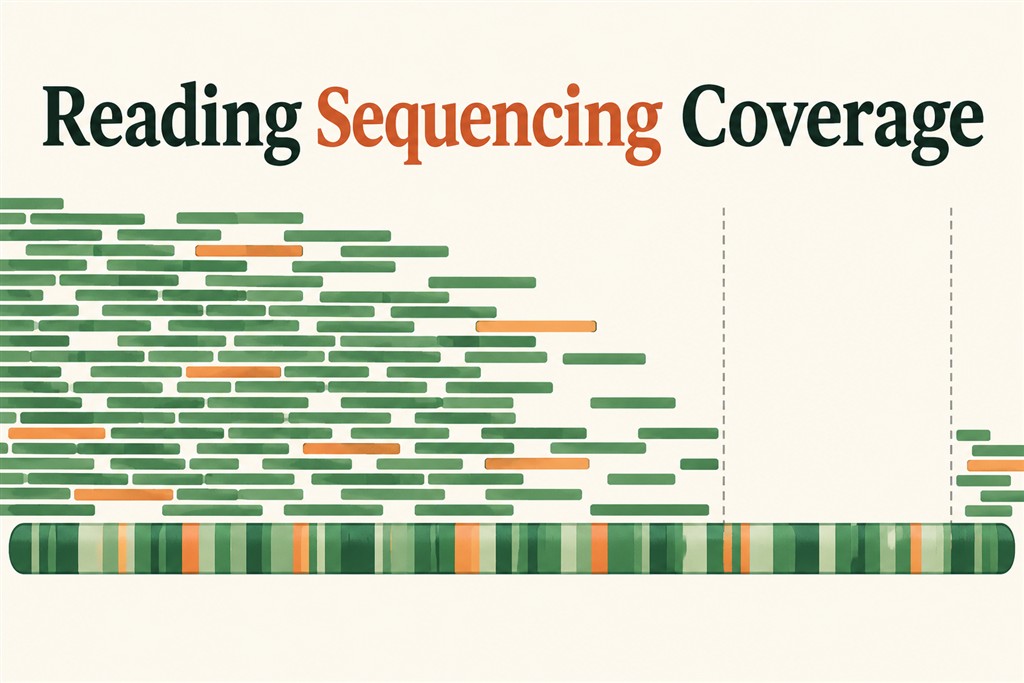
Sequencing coverage describes how DNA has been read across a genome or target region. Depth concerns how many reads cover a position; breadth concerns how much of the region is covered at a stated depth. In cannabis genetics, a high average depth doesn’t guarantee that the particular position you’re interested in was read reliably.
Depth and Breadth Answer Different Questions
The National Cancer Institute’s depth-of-coverage definition explains the count of sequencing reads at a nucleotide. That general sequencing concept applies here; it doesn’t supply a cannabis-specific quality threshold.
DNA sequencing reports sometimes shorten several measurements to “coverage,” so read the definition used in the methods. A mean describes an average across positions. Breadth asks what fraction of the target meets a specified coverage condition. You need to know both the target and the condition before a percentage is interpretable.
Illumina’s sequencing glossary explicitly notes that an average doesn’t reveal which bases were below a threshold or weren’t read. This is a useful measurement distinction, not a recommendation for a particular platform.
A Small Example Makes the Average’s Limit Clear
Imagine four positions with read depths of 12, 12, 12 and 0. The average is 9, but the fourth position has no reads. Now compare depths of 9, 9, 9 and 9: the average is still 9, yet all four positions have coverage.
These are invented arithmetic examples, not real cannabis data or recommended depths. Their point is that the same mean can hide different local evidence. If your question concerns the fourth position, the two summaries are plainly different.
Missing Data Isn’t Agreement With the Reference
A missing or uncallable result means the analysis didn’t provide a usable answer under its rules. It doesn’t mean the sample matches the reference sequence. A variant-only list may omit positions for several reasons, so absence from that list shouldn’t automatically become “no difference.”
That distinction matters when you encounter a confident description of cannabis genetics based on a short report. Before interpreting a marker, establish whether it was actually assessed and whether the report distinguishes an observed reference call from missing information. For allele and genotype vocabulary, the Cannabis Seed Glossary can support that reading.
Ask About the Region Behind the Claim
Use these questions to assess a sequencing statement without prescribing a laboratory setup:
- Does the reported number describe raw reads, aligned reads, or filtered usable reads?
- Is it an average for the whole genome or for the exact target?
- What fraction of the target met the study’s stated depth criterion?
- Was the position behind the conclusion callable, and what quality evidence supports it?
- How did the analysis handle repeats, ambiguous alignment and missing data?
More reads can’t automatically resolve every alignment or analysis problem. A bioinformatics specialist can evaluate the local evidence when a consequential interpretation depends on it. There’s no universal depth number in this article because adequacy depends on the question, technology, region and analysis.
And once a DNA call is reliable, its meaning remains a separate step. A well-read genotype doesn’t by itself establish a phenotypic outcome.
Keep Two Numbers and One Question
When you summarize a genomics result, preserve the reported mean depth and breadth definition, then ask whether the relevant region had usable evidence. If the paper only supplies an average, say so. That’s a more informative reading than either accepting a large number as a guarantee or rejecting a study because one summary doesn’t answer every question.