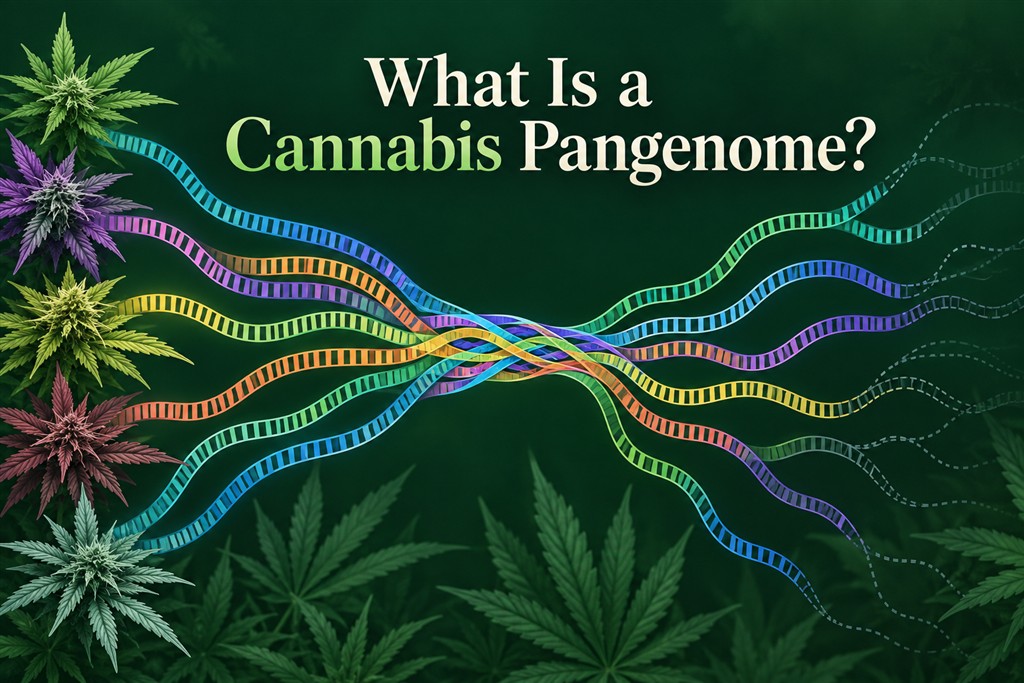
A cannabis pangenome brings together genomic information from multiple cannabis individuals to represent more variation than a single reference can show. It can reveal shared and differing DNA regions, but it isn’t automatically a complete inventory of the species. To understand what a pangenome tells you, start with which samples it includes.
Why One Sequence Can’t Carry Every Difference
A single reference gives researchers a common comparison point. A pangenome broadens that view by retaining alternative sequences or arrangements from additional samples. Some resources use graphs, with branching paths representing different sequence possibilities; others organize multiple assemblies in different ways.
The useful shift is from asking only “How does this sample differ from the reference?” to asking “What variation is represented across these samples?” Neither question requires the resource to describe every cannabis plant in existence.
A 2025 primary cannabis pangenome study combined 193 genomes from 144 biological samples and reported extensive genetic and structural variation. Those different counts matter: a genome representation and a biological sample aren’t interchangeable counting units.
Read the Sample List Before the Headline Number
A large resource can be valuable while leaving important groups underrepresented. More sequences from a narrow set of related samples won’t answer exactly the same questions as broader sampling. For a reader, the priority is to understand the scope of the map before using it as a statement about the whole species.
Use this short scope check:
- Count the right unit. Does the number describe individuals, assemblies, chromosome copies, or sequence variants?
- Identify the represented groups. What origins or genetic groups do the authors actually document?
- Find the omissions. What do the authors say remains missing or undersampled?
- Keep the conclusion within that scope. Does the claim concern the included samples, or does the paper provide support for a broader inference?
In a 2026 cannabis pangenome resource, the authors specifically note that additional genotypes are needed and that the region of origin remains undersampled. That limitation is useful information about where the research can improve, rather than a reason to dismiss the resource.
“Absent” Needs a Clear Subject
When you read that a sequence is absent, ask: absent from what? A particular assembly, the sampled individuals, or the species as a whole? These statements require different evidence.
Consider a hypothetical resource built from a limited sample collection. A sequence missing from that collection hasn’t thereby been shown absent from every unsampled population. Assembly and detection limitations can also affect what is represented. Before interpreting an absence biologically, look for the authors’ quality checks and stated limits.
The same discipline applies to genetic diversity. Familiar names don’t necessarily tell you which genetic groups a resource includes. If a paper uses ancestry or population vocabulary you haven’t encountered, consult the Cannabis Seed Glossary and return to the study’s own definitions.
Write a Conclusion the Resource Can Support
A useful reading note is: “This resource represents these samples, reveals these kinds of variation, and leaves these groups or regions unresolved.” Fill it with information from the paper rather than assumptions from its title.
That gives you a sound basis for understanding new genomics work without expecting it to predict every plant’s behavior. If the claim moves from a sequence difference to an observed characteristic, evaluate the separate genotype–phenotype evidence. A broader genomic map improves what researchers can examine; an outcome still needs to be demonstrated.