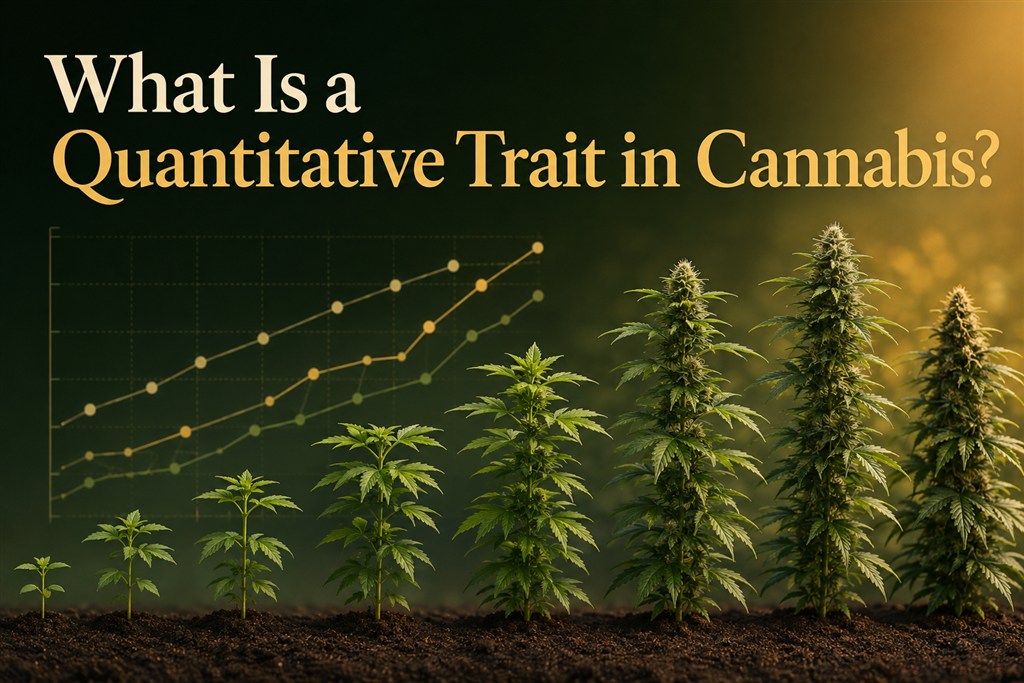
A quantitative trait in cannabis is a measurable characteristic that varies across a range rather than falling into a few clear categories. Plant height, flowering time, biomass, fiber dimensions, and many chemical concentration traits are quantitative because multiple genes, environment, development, and measurement all contribute to the observed value.
The useful distinction is not simply “many genes.” It is that the breeder must work with distributions, replication, and defined measurements instead of expecting one clean Mendelian ratio.
Quantitative Versus Qualitative Traits
A qualitative trait often forms discrete classes, such as the presence or absence of a clearly defined characteristic under a simple genetic model. A quantitative trait produces continuous or ordered variation: 72 days versus 78 days to flowering, or one plant height compared with another.
The boundary isn’t always absolute. A trait can be recorded as categories even when the underlying biology is continuous, and a major gene can strongly influence a quantitative measurement while smaller genetic and environmental effects remain. The site’s article on genetic markers for high-CBD cannabis shows why a useful marker can inform a chemical-type decision without predicting every concentration value.
Why Quantitative Traits Need Population Evidence
One exceptional plant shows that a phenotype occurred; it doesn’t reveal the population mean, the range of siblings, the repeatability of the trait, or the expected offspring response. A breeder needs enough plants to see the distribution and enough control to distinguish genetic differences from environmental noise.
A Cannabis sativa QTL study mapped genomic regions associated with agronomic and biochemical traits using a bi-parental population. The study is useful because it treats complex traits as combinations of measurable phenotypes and genomic regions, not as labels inferred from appearance.
What a Quantitative Trait Locus Means
A quantitative trait locus, or QTL, is a genomic region statistically associated with variation in a measured trait. A QTL may contain one causal gene, several linked genes, or markers that travel with the actual causal variant in the studied population.
A QTL is not a universal switch. Its estimated effect can depend on population structure, allele frequency, environment, sample size, measurement quality, and the genetic background in which it was detected. That is why marker-assisted selection should use validated associations rather than a marker borrowed from unrelated germplasm.
How to Measure a Quantitative Trait Well
- Write an operational definition. Specify exactly what is measured, when, and with which unit.
- Standardize the comparison. Align age, developmental stage, sampling position, and environmental conditions.
- Use replication and controls. Separate repeatable differences from one-plant or one-room noise.
- Record the full distribution. Means alone can hide tails, family structure, and unstable variance.
- Repeat in relevant environments. A useful breeding trait must be interpreted where the future population will be grown.
- Preserve selected genotypes when needed. Clones can allow later chemistry or stress testing before a final parent decision.
Avoid Turning Labels Into Measurements
Words such as “high yield,” “fast flowering,” or “compact” are not quantitative data until the breeder defines the reference, unit, stage, and conditions. Even a laboratory value needs sampling context because tissue, maturity, handling, and analytical method can affect the result.
The site’s genotype-versus-phenotype explanation provides the essential boundary: the measured phenotype is the result of inherited potential interacting with environment and development.
A Working Decision Rule
Treat a cannabis characteristic as a quantitative breeding trait when the decision depends on how much, how soon, how often, or how consistently it appears. Define the measurement before selecting plants, keep the full population distribution, and validate the result across offspring or environments. If the only evidence is a descriptive label, the trait hasn’t yet been measured well enough to breed predictably.