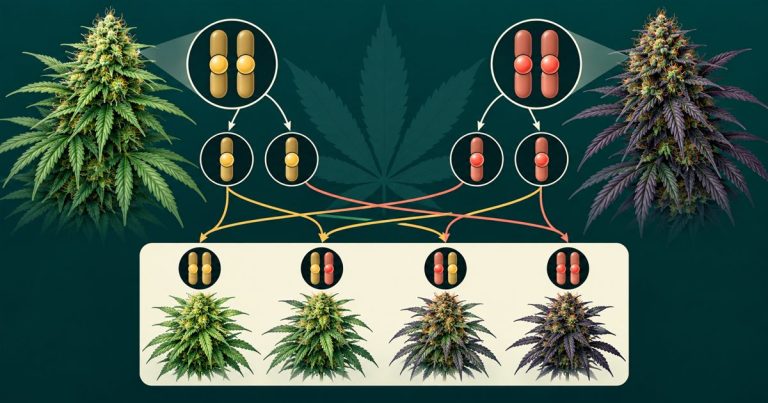
Genomic selection in cannabis breeding uses markers spread across the genome to predict which plants are most likely to pass useful performance to their offspring. Instead of waiting for every candidate to finish every trial, a breeder trains a statistical model on plants that have both genotype and phenotype records, then uses that model to rank new candidates. The prediction can shorten a decision cycle, but it’s only as trustworthy as the population, measurements, environments, and validation behind it.
What Genomic Selection Actually Predicts
The target is breeding value: the inherited part of performance that a parent is expected to contribute. This matters most for quantitative traits controlled by many loci, where following one or two markers leaves most of the signal unexplained.
A genomic model estimates many small marker effects together. The result predicts a defined trait for a particular population, management system, and model version; it doesn’t guarantee how the plant will perform or score its overall quality.
How It Differs From Marker-Assisted Selection
Marker-assisted selection usually tracks a small number of validated markers tied to major genes or QTL. Genomic selection deliberately uses genome-wide information, including markers with effects too small to justify individual decisions. The methods can work together: a breeding program may require a known major allele and then use a genomic prediction to rank the remaining candidates.
A Practical Genomic Selection Cycle
- Define one decision. Name the trait, units, stage, environment, and population before collecting data.
- Build the training population. Genotype candidates and phenotype them with consistent protocols across relevant trials.
- Fit and test the model. Keep a genuine validation set outside model training and report prediction accuracy for that set.
- Score selection candidates. Genotype the new generation, apply the locked model, and retain the prediction plus its model version.
- Select and mate deliberately. Balance predicted gain with relatedness and diversity instead of advancing only the top score.
- Refresh the evidence. Phenotype selected descendants and retrain only when new data justify a new model.
Where the Prediction Can Break
Prediction is usually strongest when the training and selection candidates are related and share similar environments. Accuracy can fall when a model crosses unrelated populations, new trait definitions, different chemotyping methods, or management conditions. Genotype-by-environment interaction also matters because a line’s relative performance can change across sites or production systems.
Cannabis adds practical complications: incomplete pedigrees, uneven cultivar naming, clonally maintained material, dioecy, strong population structure, and still-developing genomic resources. Reviews of cannabis genomics describe clear potential for molecular breeding while warning that tools must be transferable and validated in the germplasm where they will be used.
A Model Card for Breeding Decisions
Before acting on a genomic score, keep this short record with it:
- trait definition, units, and phenotype protocol;
- training-population size, ancestry, and generation;
- trial environments and years represented;
- marker platform, filters, and missing-data handling;
- validation design and prediction accuracy;
- model version and the population where use is supported.
These details help you check whether the score applies to your candidates. If the model card doesn’t match their population or the environment where you’ll use them, treat the score as exploratory.
What to Do Next
Start with one costly, well-measured trait rather than a broad claim about overall quality. Build a training set that represents the breeding population, hold out a real validation group, and compare genomic ranking with the decisions you would make from phenotype and pedigree alone. Genomic selection earns a place in the program when it improves repeatable decisions without hiding uncertainty or collapsing diversity.