An estimated breeding value, or EBV, is a statistical estimate of the genetic contribution an individual is expected to pass to offspring for a defined trait. In cannabis breeding, an EBV can help compare candidates using pedigree, phenotype, relatives, or genomic data, but it’s an estimate with uncertainty—not a score for overall quality.
Phenotype and Breeding Value Answer Different Questions
A phenotype asks what was observed in an individual. Breeding value asks how much of the relevant inherited effect that individual is expected to transmit on average. Environment, measurement error, dominance, and gene interactions can make a strong phenotype a poor estimate of transmissible value.
The site’s article on heritability in cannabis breeding explains why the usefulness of phenotype for selection depends on the population, trait, and environment. Heritability isn’t a permanent property of the trait, and an EBV isn’t independent of the data used to estimate it.
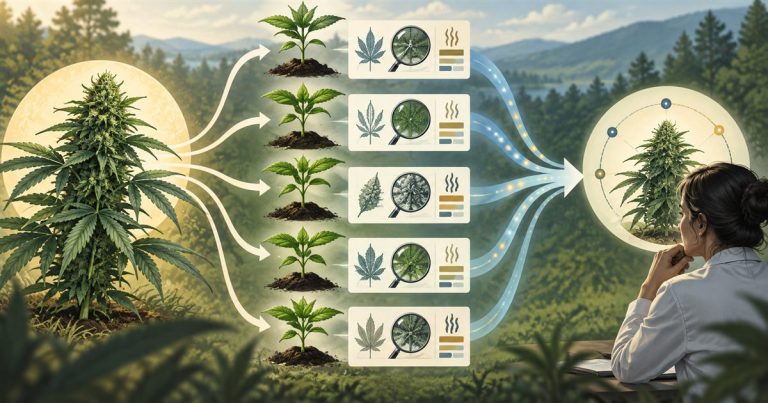
What Evidence Can Feed an EBV
- The candidate’s own standardized measurements
- Measurements from parents, siblings, and offspring
- Pedigree relationships among individuals
- Repeated records across environments or cycles
- Genomic markers when a validated model is available
Different models weight these sources differently. More data don’t automatically mean better evidence if measurements are inconsistent, pedigrees are wrong, or the training population doesn’t represent the candidates.
Accuracy Belongs Beside the Estimate
An EBV without an accuracy, reliability, standard error, or interval can look more precise than the evidence supports. A candidate evaluated from its own single record generally carries more uncertainty than one supported by connected relatives and repeated offspring records.
Rankings can change when new data arrive. That isn’t necessarily a failure; updating is part of estimation. The honest record includes the model version, evaluation date, population, trait definition, and uncertainty measure.
A Small Example Without a Trait Guarantee
Suppose two candidates have the same measured height. Candidate A comes from a family that was consistently taller across connected trials, while Candidate B grew in an unusually favorable block and has little family information. A model might estimate different breeding values even though their observed heights match. The conclusion would still apply only to the defined population, model, trait, and target environment.
This example explains the reasoning; it isn’t a cannabis dataset and doesn’t prescribe selection for height.
Check Five Things Before Comparing EBVs
- Are the estimates for the same trait definition and unit?
- Were they produced in the same evaluation population and model run?
- Does the target environment match the data reasonably well?
- What accuracy or uncertainty accompanies each estimate?
- Has the model been validated on later offspring or an independent set?
Genotype-by-environment interaction matters because rankings based on one environment may not describe another. Recurrent selection provides context for how estimates and measured outcomes can inform repeated population-improvement cycles.
Use EBVs as Decision Evidence, Not Identity Labels
An EBV can support selection when the data, model, and uncertainty fit the breeding objective. It can’t certify a strain, predict every offspring, or summarize an individual across unrelated traits. Your practical next step is to keep the estimate and its provenance together. A qualified quantitative geneticist or plant breeder should review the model before high-cost selection decisions are made.