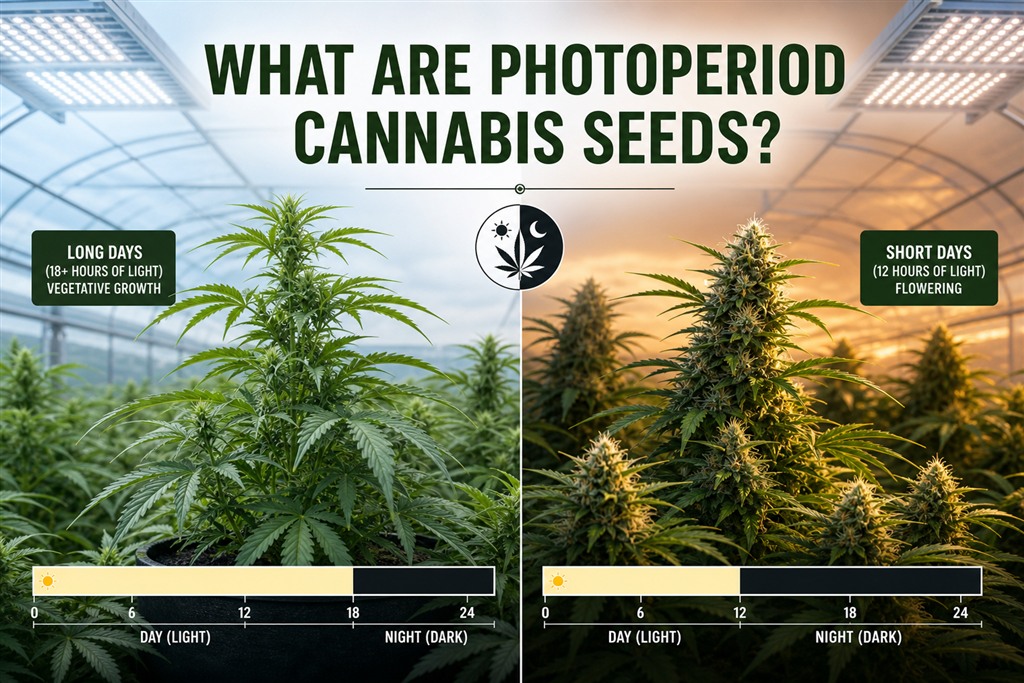
Photoperiod cannabis seeds produce plants whose flowering behavior responds to the daily light-and-dark cycle. In practice, that gives a grower more control over how long a plant remains vegetative, but it also means the cultivar’s light response and uninterrupted dark period must fit the room, season, and production plan.
The useful distinction isn’t simply “photoperiod equals 12/12.” Cannabis lines vary in their flowering thresholds, and age, genotype, temperature, and environment can affect the transition. Treat the familiar indoor schedule as a management convention, then judge the actual line by observed behavior.
How Photoperiod-Sensitive Flowering Works
Photoperiod is the amount of light and darkness a plant receives in a 24-hour cycle. Cannabis is generally described as a quantitative short-day crop, meaning shorter days and longer nights tend to promote reproductive development in sensitive cultivars. A review of flowering behavior in Cannabis sativa documents substantial variation in the thresholds and responses found across genotypes.
That variation matters. One line may begin its transition under a day length that leaves another line mostly vegetative, and outdoor plants respond to the changing natural day length at their location. “Photoperiod” therefore describes a response system, not one universal calendar date.
Photoperiod Seeds Versus Autoflowering Seeds
Photoperiod-sensitive plants use light cues as an important part of flowering progression. Autoflowering cannabis seeds produce day-neutral or relatively photoperiod-insensitive plants that transition more strongly with age and development. Research mapping cannabis flowering loci confirms that photoperiod sensitivity and autoflowering are biologically distinct, while also showing that flowering time is more complex than one simple switch.
Neither type is automatically better. The decision depends on whether you value schedule control, a shorter fixed life cycle, plant size flexibility, seasonal fit, or ease of light management.
What Photoperiod Control Gives an Indoor Grower
Indoors, a photoperiod line can remain in vegetative growth while the grower builds root mass and canopy structure, then move toward flowering after the light schedule changes. That control helps when training plants, filling a defined footprint, recovering from transplant stress, or coordinating several plants before the reproductive stage.
But the control works only if the environment is stable. Light leaks, timer failures, inconsistent schedules, and uneven canopy exposure can complicate the response. The practical setup also includes airflow and moisture management, so the site’s guide to managing indoor humidity is a useful companion when the canopy becomes dense.
How Outdoor Day Length Changes the Decision
Outdoors, the plant receives a moving signal rather than an on/off timer. Latitude, planting date, cultivar sensitivity, and the length of the frost-free season all affect whether the line can finish reliably. An early-flowering photoperiod cultivar may fit a short season, while a later one may need more time than the location provides.
Before choosing a line, ask for:
- the breeder’s observed flowering window;
- the latitude or region where it was tested;
- whether the reported date marks first flowers or harvest maturity;
- how much variation appeared across the population; and
- whether the line was evaluated outdoors, indoors, or both.
A Practical Fit Check
- Choose the environment first. Indoor timer control and outdoor seasonal light are different operating conditions.
- Define your timing limit. Work backward from weather risk, room turnover, or another real deadline.
- Verify cultivar evidence. A generic photoperiod label can’t replace line-specific flowering data.
- Plan the vegetative period. Match container, training, and available height to the size you intend to build.
- Protect the dark period. Use reliable timers and check for unintended light when running indoors.
If height control is part of that plan, plant-training methods should be chosen before the canopy becomes difficult to manage.
Choose by Response, Not Just the Label
Photoperiod seeds are useful when you want the light cycle to remain a major control over plant development. The right next step is to match a documented cultivar’s response to your actual schedule, season, and space. If the seller can’t describe when and where the line was tested, the word photoperiod doesn’t give you enough information to plan confidently.