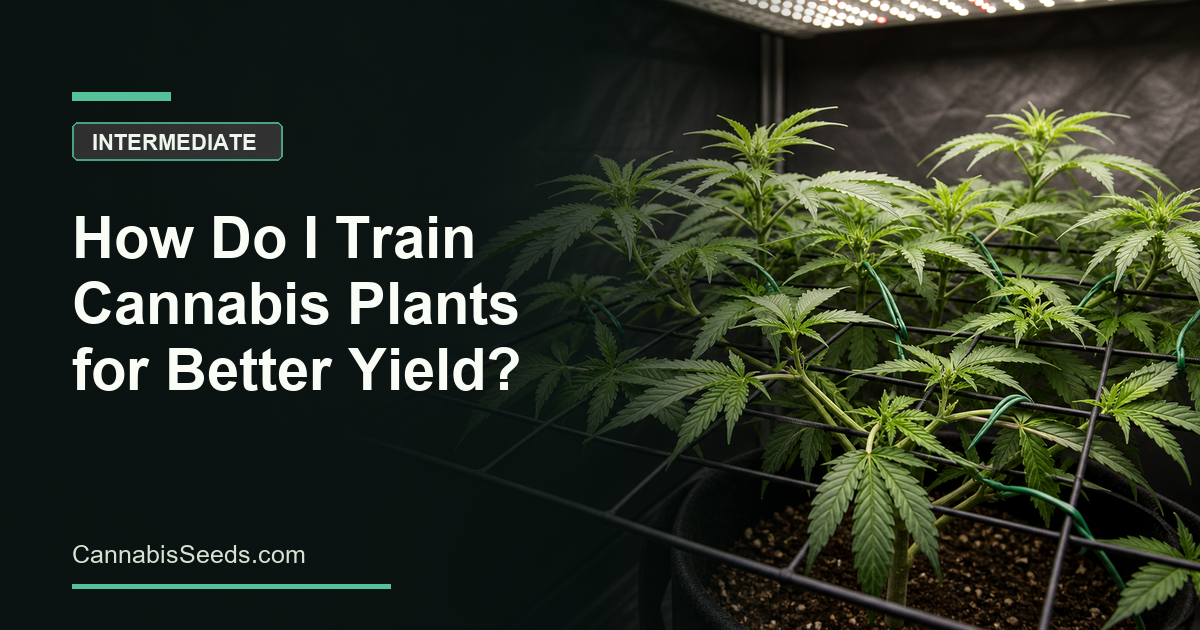
To train cannabis plants for better yield, shape the plant so more bud sites receive strong light, the canopy stays open, and the branches can support flowering growth. Training isn’t about stressing the plant just to prove you can. It’s about guiding healthy growth at the right time so the plant uses the available space more efficiently.
Why Training Can Improve Yield
Cannabis naturally favors the highest growth tips, which can leave lower branches shaded and less productive. Training spreads that growth out. A flatter, better-spaced canopy lets more sites receive useful light, and better airflow makes the plant easier to manage as it gets larger.
Training works best when the light plan supports the structure you’re building. If the canopy is uneven, pair training with the article on optimizing light distribution for even canopy growth so you’re not shaping the plant into a light pattern that still misses key branches.
Choose the Right Training Method
Low-Stress Training
Low-stress training uses gentle bending, tying, and branch positioning to open the plant without removing major growth. It’s often the best starting point because it lets you change structure gradually while watching how the plant responds.
Topping and Pruning
Topping removes the main growth tip so the plant develops multiple tops. Pruning removes growth that blocks airflow, crowds the interior, or won’t receive enough light to be useful. These methods can help, but they require better timing than simple bending because the plant has to recover from each cut.
Screens and Branch Support
A screen, soft ties, or branch supports can hold growth in a more productive position. This is useful when you want a broader flowering surface instead of one tall central cola and a lot of shaded lower growth.
Train During Vegetative Growth
Most training belongs in vegetative growth, when the plant has time to recover and redirect energy before flowering. Avoid heavy training on weak plants, freshly transplanted plants, or plants already showing pest, watering, or nutrient stress. If the plant’s posture or color looks off, compare it with the signs of a healthy cannabis plant before adding more stress.
A Practical Training Workflow
- Let the seedling establish several healthy nodes before training.
- Decide whether the main goal is height control, a wider canopy, more tops, or better airflow.
- Start with gentle branch positioning before heavier pruning.
- Make adjustments over several days instead of forcing the whole structure at once.
- Watch new growth, leaf posture, and dry-down speed after each change.
Don’t Train Past the Plant’s Recovery Window
A well-trained plant should keep growing after the adjustment. If growth stalls, leaves droop, or the plant starts showing deficiency-like symptoms, pause before making another change. Training interacts with watering and nutrition, and a plant with more active tops may expose root-zone problems faster than an untouched plant.
If symptoms appear after training, don’t jump straight to more fertilizer. Check the basics first, especially if the plant may be dealing with nutrient lockout or inconsistent root-zone conditions.
How to Know Training Is Working
Good training makes the plant easier to light, easier to inspect, and easier to manage. You should see more even growth across the canopy, better branch spacing, and fewer buried sites that never receive useful light. If the plant looks flatter, healthier, and more accessible without stalling, the training is doing its job.
1 response