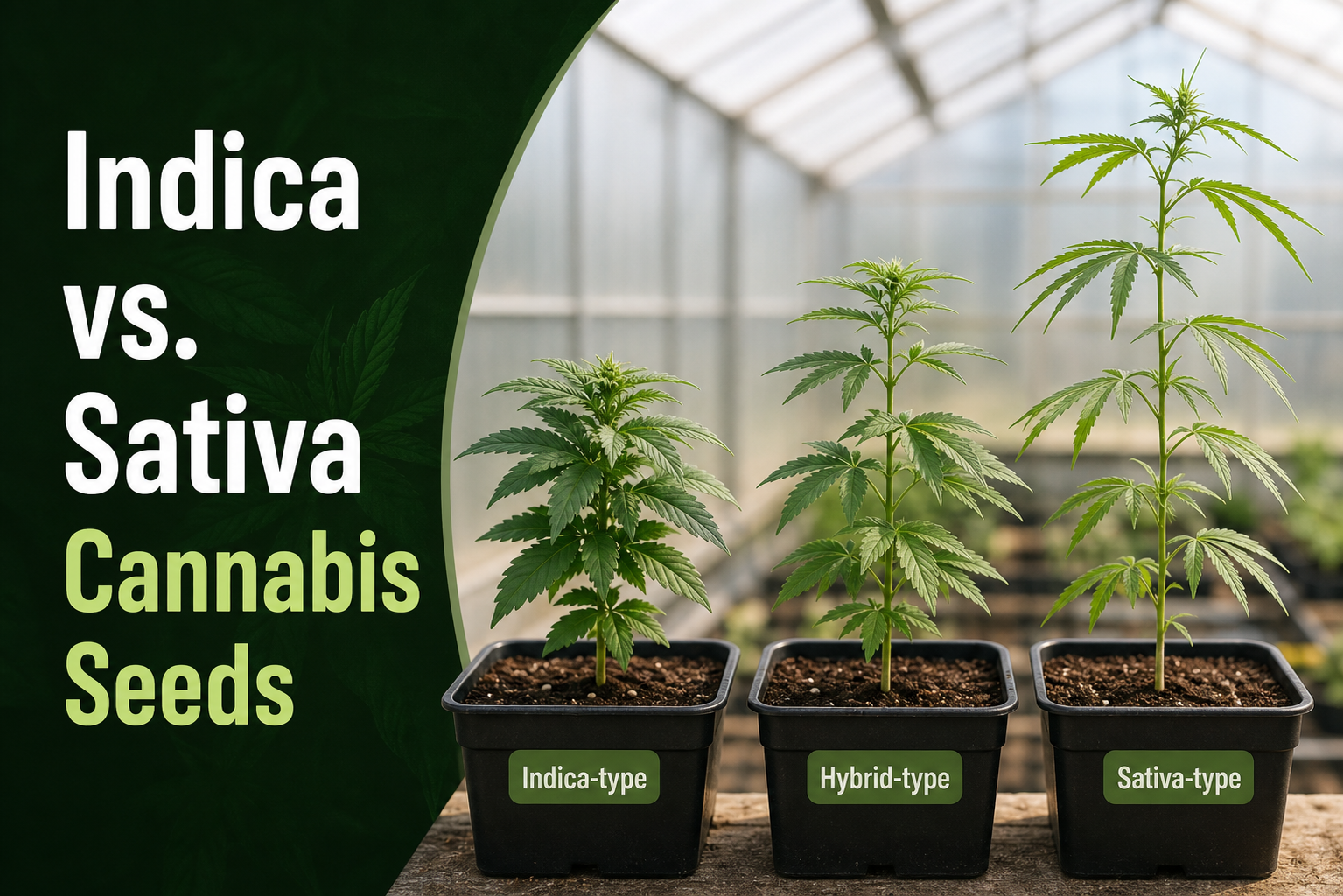
Indica [g] and sativa [g] cannabis seeds can't be told apart by appearance. The labels describe genetic background and expected plant tendencies, not a seed-shell feature, and most modern cultivars [g] are hybrids [g] whose actual behavior depends on their specific breeding line.
You Can't Identify Indica or Sativa by Looking at the Seeds
Size, color, stripes, and shell pattern vary within the same seed lot. A larger, darker, or more mottled seed isn't automatically indica, and a smaller, lighter seed isn't automatically sativa. Indica and sativa cannabis seeds should be identified through accurate labeling and breeder records.
That distinction matters because seed appearance also can't reveal:
- Plant height or internodal spacing
- Flowering time
- Cannabinoid or terpene profile
- Yield potential
- Environmental tolerance
Traditional Growth Tendencies
Broad traditional descriptions can help set expectations, but they aren't guarantees.
Indica-associated lines are often described as:
- Shorter and more compact
- Broader-leaved
- Faster to finish flowering
- Easier to fit into limited vertical space
Sativa-associated lines are often described as:
- Taller with more stretch
- Narrower-leaved
- Longer to finish flowering
- Better suited to growers who can manage height and time
Modern hybrids can combine any of these traits. The breeder's description and reliable grow reports for a specific cultivar are more useful than the category label by itself.
The Labels Don't Reliably Predict Effects
Indica and sativa are often used as shorthand for expected effects, but chemistry provides a clearer explanation. Cannabinoid [g] ratios, terpene [g] composition, harvest maturity, and individual response all matter.
If you're choosing seeds for a specific cannabinoid profile, compare documented lines such as CBD-rich cannabis seeds and review how genetic markers relate to high-CBD strains instead of relying on indica or sativa wording alone.
How to Choose Between Them
Start with the conditions you can actually provide:
- Measure available height and canopy area.
- Consider the length of the indoor schedule or outdoor season.
- Check the breeder's expected stretch and flowering time.
- Review resistance claims for humidity, mold, heat, or cold.
- Match the documented cannabinoid and terpene profile to the intended goal.
If you're growing indoors, you'll also need to plan for container size and root development. The guide to choosing a pot size for cannabis seedlings gives you a practical starting point.
Key Takeaway
The meaningful difference isn't visible in the shell. Treat indica and sativa as broad lineage descriptions, then make decisions from cultivar-specific genetics, growth data, and the conditions you can provide.