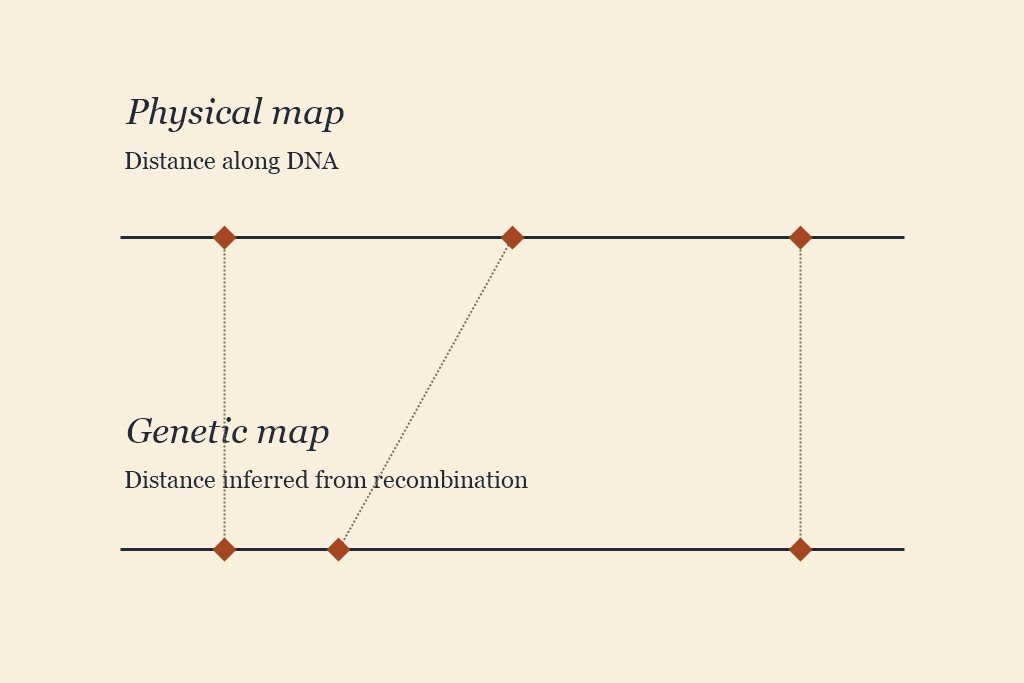
A centimorgan, abbreviated cM, is a unit of genetic map distance. It describes separation inferred from how often markers are inherited in new combinations. A base pair measures physical distance along DNA. If a cannabis paper puts two markers 5 cM apart, check which family produced the estimate before you apply it to another cross.
Why two intervals of the same size can behave differently
Imagine two stretches of chromosome that each span one million base pairs. In the family used to make the map, one stretch sees crossovers often and the other rarely does. The two stretches take up the same space on the physical map, but the one with more crossovers generally takes up more space on the genetic map. Laverty and colleagues published both kinds of map for cannabis and reported extensive regions of low recombination in their cross. Read the cannabis mapping study.
Over short intervals, 1 cM corresponds approximately to 1% recombinant offspring in an informative cross. Keep the word short in mind. If the transmitted chromosome switches parental origin twice within an interval, its two endpoint markers can still have their original combination. Counting recombinant endpoints can miss those exchanges. Mapping functions account for the relationship between observed recombination and map distance under particular assumptions. For longer intervals, treating cM as a simple percentage will mislead you. The underlying process is easier to picture if you follow what recombination changes in an offspring.
Choose the scale that answers your question
If you’re trying to locate a marker sequence, use its physical coordinates and confirm which reference genome assembly those coordinates refer to. If you’re deciding how closely a marker is likely to track a trait in a cross, use the genetic interval as a starting point and check how it was estimated. A different family can recombine differently in that stretch. When a paper gives you both scales, keep both in your notes along with the mapping parents. That lets you find the interval again without giving the cM estimate more reach than it has.