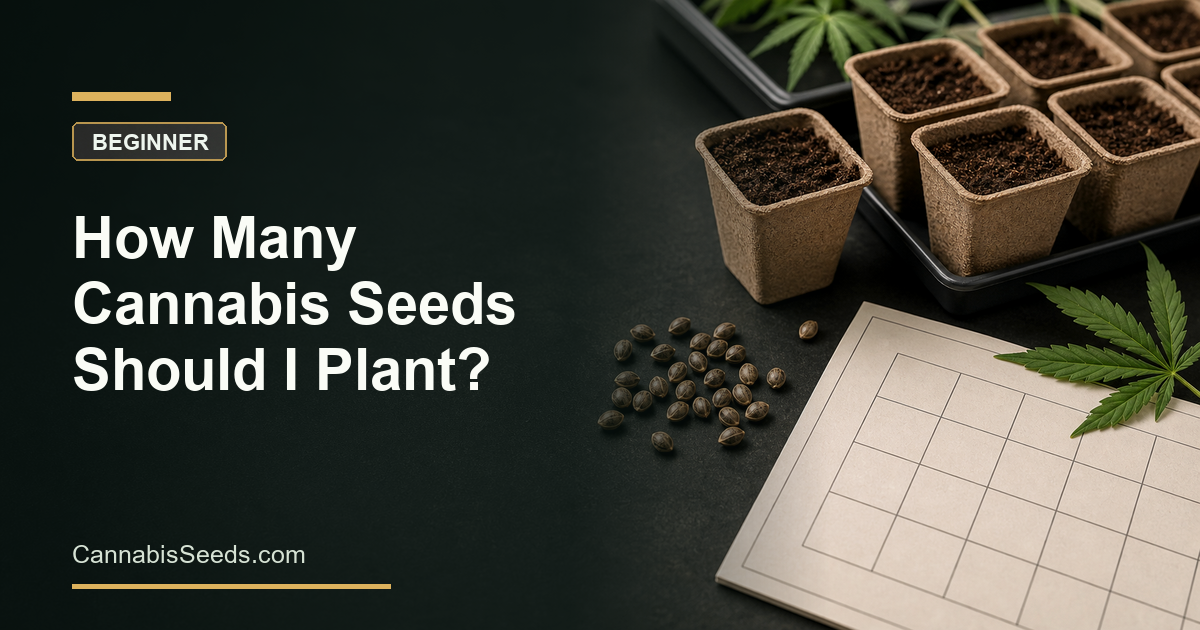
You should plant only as many cannabis seeds as you can legally, physically, and realistically manage, then add a small buffer if your seed type or germination rate makes that necessary. The right number isn’t the whole pack. It’s the number that can turn into healthy plants without overcrowding your space or pushing you past your limits.
Start With the Number of Plants You Want to Finish
Seed count should start with the finished plant count, not the seed pack. If your space can comfortably handle two mature plants, don’t start eight seedlings just because the tray has room. Young seedlings look small, but the space problem usually shows up later, when containers, canopy width, airflow, and access all start competing for room.
This is especially important indoors, where one strong plant can fill more space than a beginner expects. Before you decide how many seeds to start, make sure your container plan makes sense by reviewing the right pot size for cannabis seedlings.
Seed Type Changes the Count
Feminized, regular, and autoflowering seeds each change the math. Feminized seeds are usually planted close to the final number of plants you want because the goal is a predictable female crop. Regular seeds may require extra starts because some plants can be male. Autoflowers need a little extra care with planning because early stress can affect their short growth window.
- Feminized seeds: plant close to your target count, with a small backup only if you have room.
- Regular seeds: plan for the possibility of male plants where your legal limit allows it.
- Older seeds: use a small test batch if you’re unsure about viability.
- Autoflower seeds: start only what you can care for well from day one.
Factor in Germination Rate
Not every seed sprouts, even when your method is solid. Fresh, properly stored seeds usually perform better than old seeds or seeds that have been exposed to heat, moisture, or light. If you’re working with older stock, the guide to long-term cannabis seed storage can help you judge whether you need a small buffer.
A test germination can be smarter than planting too many seeds at once. If the seed batch is rare or expensive, testing a small number first gives you useful information without risking the whole supply.
Match the Count to Your Setup
Every seedling needs light, root space, airflow, water, attention, and later, enough room for its canopy. Crowding plants early can make watering harder and can hide weak seedlings until problems are already moving. A seedling care schedule helps, but it can’t make an overcrowded setup easy.
A Simple Way to Decide
For a first grow, choose the number of mature plants you can finish comfortably, then work backward. If you want two finished plants and you’re using reliable feminized seeds, starting two or three seeds may be enough where local rules allow it. If you’re using regular seeds, you may need more starts, but only if you have the legal room and the physical space to handle them.
Common Seed Count Mistakes
- Planting the whole pack without a finishing plan.
- Ignoring legal plant-count limits.
- Forgetting that regular seeds may produce males.
- Starting too many autoflowers in a small space.
- Assuming every seedling will stay easy to manage.
Make the Number Manageable
The best seed count is the one you can manage well through the whole grow, not just the one you can fit into a starter tray. Start with your legal limit, space, seed type, and final plant goal, then keep the batch small enough that each plant gets real attention.



2 responses